


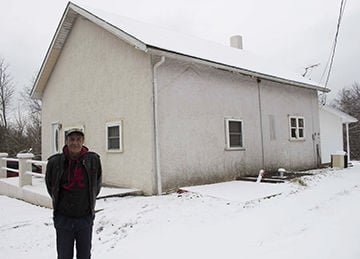
The old Vineland schoolhouse – the broad stucco building with a wide concrete porch on Vineland Road just south of De Soto – doesn’t really stand out among the homes along that rural road, but through the years, it has left a deep impression on thousands of Jefferson County residents.
The school, built in 1867, served the families of the town of Vineland for more than 80 years before students on its roster became part of the De Soto School District and the school’s classrooms became a part of history.
The building, now in its 150th year, continues to serve a useful purpose, as Ken and Leona Kamer’s home.
“There’s a lot of history here,” Ken said.
He should know. Ken and his late wife, Angelina, spent lots of time researching the old school after they moved into the building in 1995.
“My late wife worked at (the new) Vineland School for five years. She thought it was the neatest thing that she worked at the school and lived in the original schoolhouse,” Ken said.
Back in the mid 1800s, while the schoolhouse was under construction, there was no mention of the name Vineland because at that time, the area was known as Tyro, and the post office as Tunnel Station.
An article in the Jan. 4, 1867, edition of the former newspaper named The Leader updated its readers on the development of the town and the new school.
“No attempt has been made, we believe, to lay off a town plat at Tyro, although a village will crowd in perhaps without one. Two stores are now doing a good business and a good school house, costing $1,200, is nearly completed,” the article said.
The school would serve the residents along the Iron Mountain Railroad near the station, and the town became Vineland in 1868 when a post office by that name opened there. The town of Vineland was finally laid out in 1869, according to Ruth Welty, in her publication Place Names of St. Louis and Jefferson County.
No one knows exactly why the name Vineland was chosen for the town, but according to the 1867 article in The Leader, the area was a very fruitful place.
“Mr. Morse sold fruit the past season to the amount of $3,000, and the extent and production of his fruit farm is constantly on the increase. Mr. Bowen’s nursery has met with decided success, and he has prepared an additional forty acres for young fruit. His sales and orders on hand foot up 20,000 peach trees, 6,000 apple trees … and 15,000 grape vines.”
According to Della Lang’s book, Country Schools, Jefferson County Missouri, 1806-1952, the enrollment at Vineland School was usually 30-40 students in those early years in the nineteenth century. Those students, who worked on family farms, typically had poor attendance, though.
“Lizzie L. Perkins was the teacher for the spring term of 1879 (April-July). Some children were absent as many as 51 days,” Lang wrote.
Attendance usually improved in the fall semester after harvest, though, according to Lang’s book.
First-hand accounts of classroom activities in those early years are almost nonexistent, but Bonnie Kingsland, 76, of De Soto, who was a student at Vineland School in its final years, says she remembers Christmas programs and recesses when the boys played ball and the girls gathered in pairs or groups on the playground.
“We girls just chitchatted about things,” she said.
Kingsland remembers the cloakroom and outdoor restrooms, and she said she enjoyed the classroom where students from first through eighth grade all studied together.
“I liked the small school atmosphere. We learned a lot by hearing other kids reciting, even though we were supposed to be working on our work,” Kingsland said. “I don’t know how we concentrated, but we did.”
She said there were spelling bees and math contests.
“I was a pretty good speller and I was pretty proud of that,” Kingsland said.
She also remembered farm children getting excused from school during harvest time.
“The Knorpp boys were allowed out of school a couple of weeks to bring in the crop,” she said.
In 1951, the De Soto School Board voted to incorporate four small schools – Mammoth, Mothershead, Peter Moore and Vineland into the De Soto School District, according to Lang.
And although many historical accounts say that Vineland School closed for good at that point, Kingsland said that wasn’t quite the end of it. In 1948, when she was in the first grade, she attended Vineland School, then the school closed and she went to Central Elementary School in De Soto for second and third grade. In her fourth- and fifth-grade years, however, students were sent back to Vineland while work was completed at Central School, perhaps to accommodate the influx of students from one-room schools. Kingsland’s timeline puts the closing in 1952 or 1953.
Nearly 45 years later, when the Kamers purchased the old school and began updating it, they found remnants of the time when the building was a daily destination for the area’s children – part of a seesaw and the concrete platform where the outdoor restrooms were located. They also found a horseshoe while digging a flower bed, where horses may have once been hitched, Ken said.
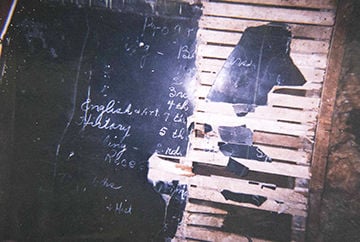
When the electrical system had to be updated, behind the walls the Kamers found a crumbling chalkboard and written on it, some of the final assignments Vineland students received.
“We were hoping to find a teacher’s name, but there was none,” Ken said.
The board was disintegrating and had to be disposed of, but the couple did take a picture of it.
In 2003, when the tornado came through the De Soto area, winds rolled up some of the old school’s metal roof, and when Ken climbed up to survey the damage, he noticed the old bell tower was unstable, so he had to take it down.
“I saved the old chimney. I’d like to make a new bell tower and put it back on top,” he said.
Ken said he heard someone in the area still had the old school bell.
He and his current wife, Leona, continue to work on the house.
“We are going to do a bunch more to the outside. I want the front of it to look like it used to be when it was an old schoolhouse,” Ken said.
Ken’s late wife, Angelina, who died in 2005, would have liked that, he said.
“She loved it, and then I fell (for it),” he said. “It was something personal between us. It is very peaceful here. It’s fairly quiet. I told her I don’t think I’m ever going to move again.”
New LOOKING BACK features are posted regularly on the Leader’s website, myleaderpaper.com. Send ideas for a local historical feature to nvrweakly@aol.com or bring or mail it to the Leader office, 503 N. Second St. (P.O. Box 159), Festus, 63028. Please include your name, phone number and a brief description of your idea. Photos are also appreciated.