


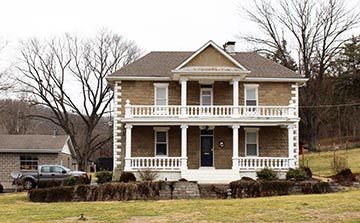
Across from the House Springs Lions Hall on Hwy. MM is a Sears, Roebuck & Co. catalog home that once belonged to a celebrated family in House Springs, the Weber family.
T.W. Burgess built the concrete block home, which is two stories tall with a distinctive style and was ordered from a catalog for Albert Ray Weber and his wife, Elizabeth (Nahlik) Weber, completing it in February 1914.
The Webers had previously moved to the property from their farm on Hillsboro-House Springs Road, 10 years earlier moving their log cabin home to the new property, according to Della Lang in her book “On the Road to History.”
“Moving buildings was no small feat in those days. The building was placed on logs, which were used as rollers and pulled by a steam engine. When the rig moved forward, the house moved off the back logs, so workmen were continually moving the logs to the front of the house,” Lang wrote.
By the time the moving crew came to the crossroads of Hillsboro-House Springs Road and the single-lane dirt road that would one day become Hwy. MM, “they were tired of working,” and left the log home in the middle of the road while they went on a trip to St. Louis to see the 1904 World’s Fair, Lang wrote.
Albert Ray Weber, one of 10 children, was among the first generation of this branch of the Weber family to be born in the U.S. His father, Ferdinand Weber, was born in Germany, and his mother, Barbara, in Bohemia (now part of the Czech Republic). Ferdinand, who was born in 1841, likely came to the U.S. and House Springs with his father, Albert, a blacksmith, who was born in Bohemia in 1811 and immigrated to the U.S. in 1854. The family settled on the outskirts of House Springs, purchasing the Marvel Stowe Farm in 1857, according to Lang.
She said that Albert Weber Sr. and his sons were the first to have a steam thresher and used it to harvest crops for other farmers in the area.
His grandson, Albert Ray Weber, donated a portion of the Hwy. MM property to the Catholic Church for the construction of St. Philomena Church, built in 1905, and its cemetery.
Albert Ray Weber is also credited with building the Farmers Hall or House Springs Community Center, now the House Springs Lions Hall. It opened Oct. 25, 1924, according to Lang. He must also have been a part of the successful barrel-building business in House Springs. A photo of Weber’s farm in Lang’s book shows hundreds of barrel staves (the thin narrow, shaped pieces of wood that form the sides of a cask) stacked on his property.
And if that isn’t enough, Albert Ray Weber also is credited with powering up House Springs, according to Lang.
“In 1923, after the Union Electric Company brought electricity to Hillsboro, the county held an auction to dispose of its large Delco light plant,” Lang wrote. “Albert Ray Weber was the high bidder at $600 (on the generator). Weber and other members of the newly formed House Springs Electric Light & Power Co. were the first to bring electricity to the town of House Springs in November of 1923.”
The Sears catalog house that once belonged to the Webers, now more than 100 years old, is still occupied.
Sears sold more than 70,000 homes through its mail-order Modern Homes program between 1908 and 1940. During that time, the company offered 447 different styles, according to the Sears, Roebuck & Co. Archives webpage.
In 1914, the materials for most of those homes, like the one along Hwy. MM, sold for about $2,000 and could be built for about $3,000, according to the website.
The Weber family continued to proliferate and many of its members became community leaders, especially in the House Springs area, but those are stories to be told another day.
Albert Weber Sr. died in 1888 and is buried in the Old St. John’s Cemetery on Rock Creek Road in High Ridge. His son, Ferdinand S. Weber, died in 1913 and is buried in St. Philomena’s Cemetery (Our Lady Queen of Peace’s Cemetery in House Springs). Albert Ray Weber died in 1947 and is buried in St. Philomena’s Cemetery.