


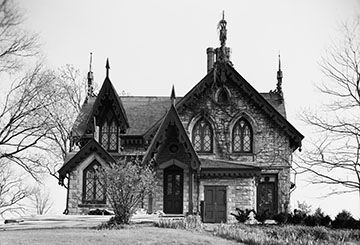
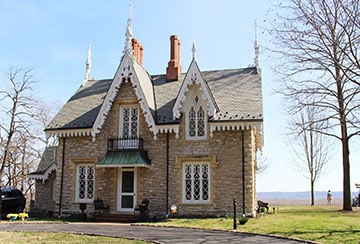
On a bluff overlooking the Mississippi River just northeast of Pevely sits a 150-year-old home with an unusual style and fascinating history
Greystone Manor, built in 1867, is listed on the National Register of Historic Places, a designation held by just a few places in Jefferson County.
“It’s considered the best example of Gothic Revival architecture in the state of Missouri,” said Jane Piper Gleason, one of the family members who own the home.
Gothic Revival, a popular architectural style in the U.S. during the last half of the 19th century, is noted for its steep roofs; pointed arches and windows; carved bargeboard trim; and asymmetrical floor plans, according to the Architectural Styles of America and Europe website.
While Greystone Manor, with its expansive vistas, acres of fields and quaint stone cottage, is beautiful, Gleason said what she likes best about the home is that it provides a place of solace in a busy world.
“It’s my bolt-hole, the place where I recharge my batteries,” she said. “It’s quiet. I bring my friends, and we all have a good time.”
Gleason and friends were busy this spring cutting some of the thousands of daffodils blooming on the grounds before a predicted snow could leave them drooping. She and her brother, Bill, take care of the home. Another sister, Julie, lives in California.
“She doesn’t get to enjoy it very much,” Gleason said.
In 1965, her parents, the late Marion and Vernon Piper, purchased nearly 200 acres along the river, along with the four homes on the property – Greystone Manor, the Meissner House, a caretaker’s home and a guest house. The Piper family has owned the property the longest, more than 50 years. Before them, there was a steady stream of owners.
Vernon was the president of Haase Olive Co. in St. Louis. Marion Piper became the historian for the Greystone Manor property, compiling a list of owners and other information about it and working with the researchers from the Missouri Department of Natural Resources to help complete the application for the National Register in 1974.
Gleason said her mother loved delving into the research and discovering the history of the property. She also enjoyed “getting the opportunity to furnish the house with antiques.”
The family only recently discovered with any certainty that the home was built in 1867 and that its builder and first owner was Maj. Emory Foster (Nov. 5, 1839 – Dec. 23, 1902), a newspaper editor who served in the Union’s 7th Missouri State Militia Cavalry during the Civil War.
“He was the hero of the Battle of Lone Jack, south of Kansas City,” Gleason said.
After the war, Foster was the editor of a newspaper in Jefferson City and later in St. Louis. He purchased 75 acres for $5,000 and built Greystone Manor high on the rocky hill over the course of two years, using grey limestone quarried on the property for the foundation and walls and yellow limestone from Ste. Genevieve for the trim, according to an article by Siegmar Muehl in Gateway Magazine, a Missouri Historical Society publication.
Foster also planted a vineyard and partnered with an adjacent property owner, George Pegram, “a steamboat man,” in the grape-growing venture, Muehl wrote.
In just a short while, though, Foster was mortgaging portions of the property to stay afloat, selling the house and half the land in 1871, according to Muehl.
Gleason, however, believes Foster sold the portion of the property with the Greystone home on it earlier and that Isidor Bush was living in the home by 1869.
Bush had property in the area for quite some time, probably a parcel adjacent to the Fosters’ 75 acres. Bush purchased 100 acres in 1851 and planted a vineyard in that area, a place he called Bushberg, according to a biography titled “Isidor Bush: Jewish Pioneer, A Man for All Seasons,” featured on the Jewish Museum of the American West website.
Bush (1822-1898), a journalist, was born in Prague, then the capitol of Bohemia. He went into the printing business with his father in Vienna at the age of 15. He participated in the European revolutions of 1848 and fled to the United States as many did, eventually settling in St. Louis, according to the article.
He was known as the founder and owner of a famous grape nursery located on the property, a business he named Isidor Bush & Son and later Bush & Son & Meissner. The first catalog of grape stock was issued in 1869.
Gustave Meissner, a horticulturist, first came to St. Louis to help Bush manage the vineyards but later partnered in the business. According to the Encyclopedia of the History of St. Louis (1899), which was cited on the National Register application, “An important feature of their business was the propagation of grape cuttings which eventually made their institution famous and caused them to become known all over the United States and to some extent in other countries.”
“The firm published an illustrated descriptive catalog of ‘American Grape Vines A Grape Growers Manual,’ which went into its fourth edition in 1894 and was translated into many foreign languages,” according to the National Register application.
Eventually, the Bush and Foster property became one parcel, with a home built for Meissner in 1875 on the same grounds.
Around the turn of the century, after Bush and Meissner died, the vineyard enterprise ended and the vineyards faded.
Since that time, several different families have owned the home and grounds, according to the family tree of homeowners Marion Piper compiled. They include the Dudley family, who purchased it in 1912 from Bush’s son and planned to turn the property into a resort, a plan the never materialized. They sold the property to the Petring family in 1919. That family sold it in 1932 to Edward Hyde, associated with International Shoe Co. In 1937, Grace Ashley Papin, a dress designer from St. Louis, purchased the property and restored it, according to the National Register application.
Papin was “a St. Louis dress designer, model, saleswoman and manufacturer, known for her original shirt stud dress registered as the Grace Ashley Jewelstud Frock,” according to the Grace Ashley Scrapbook 1936-1947 on the Missouri History Museum website.
In 1940, the home became part of a Historic American Buildings Survey completed by the National Parks Service, entitled Antebellum Houses of the Mississippi Valley, although the home was misidentified as being built before the Civil War, Muehl wrote.
The Piper family purchased the home and grounds from Papin.
Gleason said she continues to research and document the history of Greystone.
“I enjoy it but not to the extent that my mother did,” Gleason said “She initiated it. I’m just adding to it.”
Gleason is not sure what will happen to the property in the future.
“There is another generation,” she said. “But we can’t answer that question yet. We haven’t made our final plans, but we wish to preserve it. That’s what my parents would do.”
There are 14 sites in Jefferson County that are on the National Register of Historic Places. They can be viewed at dnr.mo.gov/shpo/Jefferson.htm.