


Before the first European settlers came to Jefferson County, before the English colonies were settled, before the Pilgrims landed at Plymouth Rock, even before Columbus landed on an island he called San Salvador in the Bahamas, there were peoples and nations and the business of humanity and life on this continent.
In eastern Missouri, along the Mississippi and its tributaries, Native American communities were prevalent for thousands of years. They, like people today, left traces of their lives behind – footprints, artifacts, bones and stories.
In Jefferson County, burial mounds and artifacts that date back to before the time of Christ have been found in the House Springs area, according to Della Lang in her book On the Road to History.
“Ancient cyst burials, characteristic of the Woodland Indians, were unearthed in 1940 at the corner of (what is now) Old Gravois and new Hwy. 30,” she wrote.
“The human skeletons were found lying on stone slabs, surrounded by similar stone slabs which formed a coffin-like box,” she wrote in a Heritage News article dated Jan. 1993.
“In 1953, graves were found on the Nahlik farm on Hwy. MM. In 1978, similar burials were found on the Bonacker farm on Hwy. W. The Moder farm in Byrnes Mill has also produced numerous Indian relics,” Lang wrote in her book.
In Imperial, an even older artifact was found in the Kimmswick Bone Bed, when in 1979, scientists discovered a Clovis projectile point among the bones of mastodons. Native Americans of the Clovis culture appeared over 11,000 years ago and are named for their distinct stone tools found near Clovis, New Mexico. The discovery of the Clovis point in the bone bed produced evidence, for the first time in eastern North America, that human beings and the American mastodon coexisted at least 10,000 years ago, according to an article on the Missouri Parks website about the Mastodon State Historic Site.
Near Herculaneum, an imprint of ancient feet was found in 1817 in stone where workers were quarrying. The story was recorded in a book named The Unexplained: A sourcebook of strange phenomena, by William R. Corliss.
“These impressions, at the time, attracted the general notice of the inhabitants, and were employed in building a stone chimney for John W. Honey Esq. of that place,” Corliss wrote.
The stone with the imprints of the feet was placed on the outward wall so they could be seen and it was well known to people who visited that part of the country, he said.
The author went on to say that the footprints were not of bare feet but of feet in Native American shoes.
Booker Richardson of Kimmswick found more than the imprint of shoes on his property, according to an article in The Democrat dated May 17, 1878.
“Booker Richardson of Kimmswick, while plowing for corn, ran into an old Indian grave, and on investigating he unearthed a human skeleton, in a good state of preservation. The right arm of the skeleton held a well formed earthen jug, and a pipe was in its mouth,” the article said.
Several other articles of earthenware and other relics were found in the vicinity.
“The graves have been noticed ever since the county was settled, but we believe this is the first time any effort has been made to ascertain their contents,” the reporter wrote.
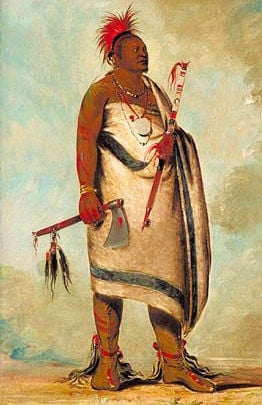
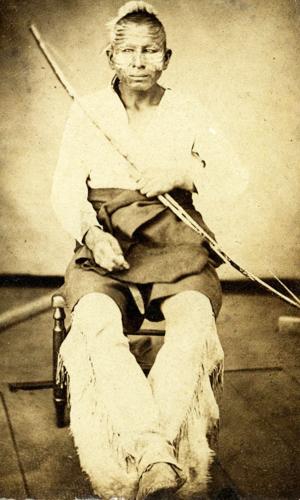
In the early years of settlement, however, especially at the end of the 18th century, those moving into the area that would become Jefferson County had first-hand encounters, sometimes disagreeably, with the Native Americans, mostly Osage, who roamed and hunted in the woods and along the rivers.
In an April 29, 1870, article in The Democrat, John L. Thomas recorded the recollections of one early settler.
“In the year 1802, Mr. Hardy McCormack, now living in Plattin Township, landed at Plattin Rock which lies upon the Mississippi River at the mouth of the transparent stream which shares the same title,” he wrote. “During the winter, it was customary for some four or five hundred Indians to come and camp on what is now called the McLane farm, and to which is also given the significant title of ‘Indian Bottom.’ This field is located near the head waters of the Plattin and at the time of Mr. McCormack’s visit constituted together with the surrounding country, one of the finest hunting regions in the West.”
In 1808, under the direction of William Clark, a trading outpost was built in the newly acquired Louisiana Purchase and called Fort Osage. That same year, Osage tribal leaders met there and signed a treaty giving up all rights and claims to 52,481,000 acres in southern Missouri for $1,200 in cash and $1,500 in merchandise, according to the article, “Native History: Osage Forced to Abandon Lands in Missouri and Arkansas,” by Alysa Landry.
The Osage, however, were more fortunate than many tribes that were removed from their native lands. When the Osage moved to Oklahoma they struck oil.
Send submissions to LOOKING BACK to nvrweakly@aol.com or bring or mail them to the Leader office, 503 N. Second St., Festus (P.O. Box 159, 63028). Please include your name, phone number, a brief description of what’s in the photo and tell us how you came by it. Please also include when it was taken, where and by whom (if known). A new LOOKING BACK photo will be posted each week.