


Most of us will one day be forgotten, with little more than an obituary and a stone to commemorate our lives. Sometimes, however, ordinary people become part of history. They may hold public office, live to be more than 100 years old or somehow stumble into greatness.
Edward Keller from Hematite accomplished at least two out of three. He served as the Hematite postmaster for five years, as well as on the local school board, but his life may have never been celebrated more than a name on the school board minutes if he hadn’t lived to the age of 101. His longevity was particularly significant since he was a Civil War veteran and there were very few of them left at the time of his death in 1945.
Keller, born Jan. 1, 1844, in Darnac Haut Rhine, in Alsace-Lorraine, France, was an immigrant and a farmer. At the age of 19, he was searching for adventure when he boarded a ship for America not long after his parents died. He arrived in November 1863, and on his second morning in the U.S., he headed straight to the recruiting office to join the Union Army, according to his obituary.
A lot of immigrants volunteered their service during the Civil War, with some 200,000 Germans and 140,000 Irish filling the ranks of the Union Army, not to mention the French, Swiss and Italians, according to Wikipedia.
Keller was part of the 7th Company of Connecticut under General Alfred Terry, who led troops to victory in the second Battle of Fort Fisher in North Carolina, according to Ruth Fitch Hopson, who wrote an article about Keller in 1939.
He mustered out in 1865 and began to travel the country looking for work. He secured a job in Maine in a granite quarry and followed the rock to St. Louis where it was being used to build the Eads Bridge.
Keller found work on the construction crew, but didn’t care for it, nor the caissons, bottomless watertight chambers filled with compressed air used to build the piers underwater in the river, he told Hopson in his 95th year.
“He said he wasn’t afraid of water but didn’t want to live in it, so he gave it up,” Hopson wrote.
Keller also worked for the Pacific Railroad.
“Chuckling again, Mr. Keller admitted that he couldn’t keep up with the Irish in digging and laying track, so he worked with the chain men, measuring out the right of way,” Hopson wrote.
Keller arrived in Jefferson County in 1868 and decided to stay. He became a naturalized citizen in Hillsboro, and settled about two miles north of Hematite where he built a log home and farmed.
“He cleared ground and split timber for rail fences,” and those fences still stood in 1939, Hopson wrote.
“In speaking of the wilderness of the post-war days, Mr. Keller said that it was as near paradise as man could find. Deer were almost as plentiful as cattle are now; there were lots of wild turkeys and other varmints,” he told Hopson. “A man could stand in his cabin door and shoot all the fresh meat he wanted.”
He and two other immigrants came to the Hematite community at about the same time –another Frenchman, Louis D. Gerber, who came from Switzerland and also had served in the Union Army, and Alois Zeltner, a German from Switzerland.
The three men romanced and then married three Cooper sisters.
Keller, at 29, married Rosanna Cooper, just 18, in 1873, and together they had 14 children. Ten of those children, five girls and five boys, lived to adulthood, according to Hopson.
Two of their sons – Herbert and Junius – served in World War I and ran into each other in Europe, not far from their father’s birthplace.
Rosanna died in June of 1917 at about 62 years of age, but Keller, 73, went on in good health for another 25 years, until he was 98 years old.
Hopson said the slim, straight man developed rheumatism in his legs but refused to use a cane and worked in the garden everyday.
According to an article in the News Democrat dated Dec. 28, 1943, “He was hale and hearty, getting his daily exercise by splitting and ranking the firewood and helping with chores.”
His hearing and sight had diminished over the years and during the last two years of his life, his health began to fail. Two of his daughters lived on the farm with him and took care of him.
Then sometime between “midnight and dawn” on October 27, 1945, he died, according to his obituary.
Today Keller’s estate belongs to Herbie Vinyard of Vinyard Funeral Home.
“My dad purchased it, and he knew the family,” Vinyard said.
He said the log home is still there.
“It was pretty primitive. It did have electric, but it never had running water or indoor plumbing,” Vinyard said.
There was a cistern for water and two springs, he said.
Vinyard said he actually went to the funeral of one of Keller’s sons, Herbert, who was living in an old soldier’s home in St. James when he died.
At that time, there was only one nephew left of the large family, Vinyard said.
“A lot of them didn’t marry and didn’t have children,” he said.
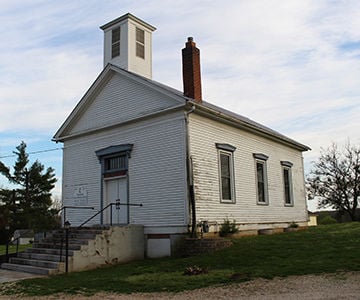
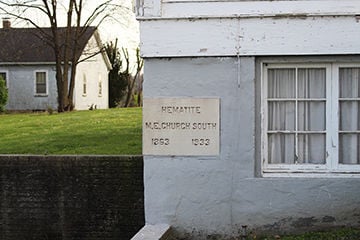
Edward Keller’s funeral services were held in the Methodist Church in Hematite and he is buried in the United Methodist Church Cemetery on Mapaville Hematite Road.
Although we know a good deal Keller’s history, there is no stone to mark his grave.