

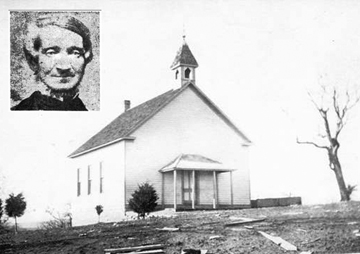
Zion Lutheran Church, which is at 9700 Zion Lutheran Church Road east of Hillsboro, is celebrating its 160th anniversary this month.
The church was chartered in October 1853, but members trace history back earlier, at least six years before then, when Pastor J. Michel Johannes arrived in the area on horseback and started holding services in the homes of the German settlers in the Sandy Valley.
Johannes’ work continued and informal church services were held in various homes. Records from 1851 indicate that meetings were being held with the purpose of establishing a Lutheran church in the community.
Most services were held in the home of Wilhelm Gieszelmann, who lived on a farm owned by Emil Steinbach.
In addition to tending to the spiritual needs of the people of the Sandy Valley, Johannes was the resident pastor at St. John’s at what is now Sulphur Springs and also preached at the German settlement on the Big River, now known as Dittmer.
According to the church’s records, something of an organized church existed before the charter, as voter meeting minutes exist, as well as records left by Johannes.
Johannes continued to work in the Sandy Creek area until 1852, when he accepted a call to Immanuel Lutheran Church near Cole Camp.
During the time of his ministry on the Sandy four couples were married and 16 children were baptized.
To replace him, St. John’s congregation called the Rev. Esaias A. Haeckel, who was installed on May 9, 1852. Haeckel was described as a tireless and energetic young pastor, who finished Johannes’ efforts to organize and chartered the church in the fall of 1853.
The church was chartered as Zion Evangelical Lutheran Church on the Sandy and Haeckel was installed as its first pastor. The charter members started a building program and joined the recently formed Lutheran Church-Missouri Synod.
Charter members included Casper Heinrich Kerckhoff (the first elder of the church), Wilheim Gieszelmann, Wilheim Luetkemeier, Fredrich Fabri, Christian Hesse, Martin Heinrich Temming (the church’s first treasurer), Johann Wuebbel, Heinrich Gerken, Christian Held and Johann Gottfried Scheidt.
Church members decided to build a parsonage before a church building. The parsonage was designed with a large room that could be used temporarily for services and meetings.
Haeckel moved to the parsonage after it was completed in late 1853.
Haeckel, who, according to church records, was very personable and much loved by the congregation, died less than two years after the church was chartered, on July 24, 1855, at the age of 28. The cause of his death was diagnosed as an acute case of small pox. He was buried in the church cemetery.
The congregation then recruited the Rev. E.O. Wolff as his replacement.
With the congregation doubling in less than five years, the room in the parsonage was becoming too crowded for Sunday services, and in the fall of 1857, Zion’s congregation resolved to build a church.
Services were held in the parsonage from 1853 to 1859. A number of resolutions were submitted to build, such as: a stone church, a log church and a frame church.
Apparently there was some difficulty in deciding whether to build a stone, log or frame church. Eventually, a frame building was decided upon in early 1858 and work began soon afterward.
Members turned to one of their own, Christian Hesse, to do all the frame work, and everything else would be turned over to a contractor in St. Louis.
Hesse, a talented builder and master carpenter, was said to have played a large role in the building of both the parsonage and church. Although he never held office in the church, he was its janitor and general caretaker of the church property. There are no records that Hesse was paid for his services.
The church was dedicated on July 24, 1859, and a steeple was added in 1898. However, it was struck by lightning on June 16, 1912, and while it didn’t burn down, church officials determined the damage would be too expensive to repair.
The new building was dedicated on Oct. 26, 1913, and it’s still being used, with several additions and modernizations through the years.
The original parsonage is now a private home. The current church stands on the same ground as the original church building.
Through the years, Zion has been known as the Church on the Rock, the Beacon and the Church on the Hill.
LOOKING BACK is a Leader online feature that highlights historic photos. Readers are invited to submit their historic Jefferson County photos for online publication. Send submissions to LOOKING BACK to nvrweakly@aol.com or bring or mail them to the Leader office, 503 N. Second St., Festus (P.O. Box 159, 63028). Please include your name, phone number, a brief description of what’s in the photo and tell us how you came by it. Please also include when it was taken, where and by whom (if known). A new LOOKING BACK feature will be posted each week.