

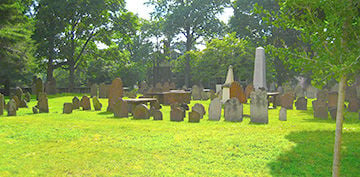
Introduction: Hartford, Conn., lies 100 miles from the Massachusetts Bay Colony (around Boston). In 1633, a band of immigrants from England’s eastern shores joined with a dissenting cleric named the Rev. Thomas Hooker in a migration to the New World. Disappointed with the lack of freedom to live and worship as they chose in the Boston area, part of the group soon moved west to three sites along the Connecticut River. Wethersfield, Windsor and Hartford were all colonized around 1636. The English settlers in these three towns wanted new rules.
The history of democracy often begins with the Greeks but then moves forward to the Magna Carta of England. Because Hooker saw the world from a different point of view than the royalty of England and Europe, the rules this group chose to live by, set out in writing in The Fundamental Orders of Connecticut of 1638-39, opened the door to a potentially more democratic form of government. The rules of this document are often cited as the foundation of our U.S. Constitution.
Chapter 1 – The Rev. Hooker leads
In June 1636, a party of 102 men, women and children from Newtowne in the Massachusetts Bay Colony forded swampy streams and climbed hills as they followed a narrow track toward the Connecticut River 100 miles inland from the Atlantic Coast. As they traveled on their two-week-long journey, horses neighed, goats bleated, pigs squealed and an occasional moan could be heard from tired travelers bearing heavy burdens.
The colonists were led by a fiery Puritan pastor named Thomas Hooker. Four young men guarded the rear of their column, tasked with seeing that no animal strayed and no strangers took them by surprise. On sunny days, as the travelers passed peacefully near Indian villages, the young men had little to do.
“All this walking is boring,” said Richard Welles, the youngest of the four at 13. “Wish I had a horse. Say, what kind of room is not in a house?”
“A mushroom,” Daniel Thompson replied, yawning.
“You’ve heard that before?”
“A dozen times.”
“Lets stop and play mumblety-peg,” Richard suggested. “We can catch up with the group later.”
“No. Our job is to guard our parents,” Daniel insisted. The oldest of the four at 17, he felt responsible to lead the other young men.
“Why are we slowing down?” Tom Holton asked.
“Look at all those wild strawberries along the creek,” Richard crowed. “People in front of us are spreading out to pick them. Let’s go.”
The four stopped and soon their mouths and chins were pink with berry juice. Then they lingered to splash away the stains and the clinging heat in the cold water.
“We’re falling far behind,” Daniel said. “Let’s get moving.”
“That Rev. Hooker sure is some talker,” Giles Spenser commented after they had caught up with the column. “Prayers in the morning, prayers in the evening. Still, most of us have more respect for him that we did for those nose-in-everyone’s-business ministers in Newtowne.
Daniel broke in. “Did you know that he even fought the devil and won?”
“How’s that?” Tom Holton asked.
“My father says that when Rev. Hooker lived back in England, soon after he returned from college at Cambridge, excitement was growing about a haunted house on the outskirts of town. The devil had been seen there,” Daniel whispered. “Rev. Hooker said he didn’t believe the house was haunted. When someone dared him, he said he’d spend the night there.”
“Really?” Giles questioned.
“That took some nerve,” Tom said.
“He went upstairs, and fell asleep,” Daniel continued. “Took his pistols with him, though. Later that night, a dim light woke him and he found himself staring at the devil. Red as could be, he was.”
“You sure that’s true?” Giles asked.
“I am. My father lived in the same town and heard the story later from Rev. Hooker.”
“So what happened?” Tom asked, his eyes widening.
“Somebody catch that hog,” yelled a man from the middle of the column, as a determined swine raced past the boys. It took all four of them to wrestle down the unhappy boar and return him to his owner.
“I’ll tell the rest of the story tonight,” Daniel whispered as word passed that it was time to pitch camp.
Did you know?
The Rev. Thomas Hooker had been educated at Cambridge University in England. His revolutionary preaching had won thousands of converts in eastern England, but brought fear to the established Church of England. Soon, Hooker was forced to escape to Holland. In 1633, he arrived in Newtowne in Massachusetts with many followers and there, too, felt the need to move on because his understanding of Biblical good governance was so different from the local authorities. Hooker and John Winthrop had once been friends, so Winthrop felt betrayed when Hooker petitioned to move with his congregation to Connecticut.
The first known Europeans to have explored the Hartford area were Dutch under Capt. Adriaen Block in 1614. Dutch fur traders returned in 1623 and established a trading post and named it Fort Hoop or “House of Hope.” A few dozen soldiers and Dutch families lived around the post.
The travelers would have passed near the villages of more than one tribe. By the 1600s, the Podunks lived east of the Connecticut River; the Tunxis tribe lived west of the Hartford area, while the Wangunks lived the south and the Saukiogs lived in what would become the Hartford area.
Mumblety-peg is a game in which each player in turn throws a knife or pointed stick from a series of positions, continuing until one fails to stick in the ground.
Chapter 2 – The Rev. Hooker and the devil
In the evening, when the teens were done with gathering wood for a fire and pitching shelters for the night, Daniel finally had time to finish his story.
“Where did I let off?” he asked.
“Rev. Hooker was face to face with the devil,” Richard said, shuddering.
“Oh, yes, so he grabbed his pistols. The devil turned and ran off down the stairs. Rev. Hooker followed right after him.”
“Whew, that took courage,” Tom said.
Daniel continued. “He followed the devil through the downstairs hallway and into the kitchen in time to see the devil disappear through the floor. Even though it had become dark in the kitchen, he could see a line of light shining up from under the floor. Rev. Hooker felt around, found a trap door, then climbed down a ladder. Hearing voices, he followed a dimly lit tunnel that led to an underground room. There he discovered the out-of-breath devil and some local men who were counterfeiting money.”
“Aw, it wasn’t even the devil,” Richard said in disappointment.
“No, but Rev. Hooker was still in trouble,” Daniel said.
“He waited quietly while the townsmen, and even some of his church members, tried to decide what to do about him. When a stranger suggested killing him, he realized his life was in danger. He reminded the men that he had told many townspeople he would be sleeping in the house and warned them that if he were not to appear in the morning, there would be a thorough investigation. Then he offered that if they would all promise to stop counterfeiting, he wouldn’t tell on them. They agreed and he spent the rest of the night sleeping peacefully in the upstairs while they cleaned out their lair.”
“Did he tell on them?” Richard asked.
“No he didn’t. But soon after, most of the guilty men moved away,” Daniel said.
“I guess if he did all that, he must not be afraid of anything,” Tom said with new respect for their leader.
***
The following day, the dusty journey of Hooker’s flock continued.
“How is it living with John Hopkins?” Giles asked 15-year-old Tom.
“Not so bad,” he said. “He and his new wife, Jane, treat me well. He’s going to teach me how to farm and later how to build a grist mill.”
Tom then frowned. “But I miss my father and mother.”
“What happened to them?” Giles asked.
“Mother died in Essex before Father decided to move to the New World. Father was killed in a logging accident near Newtowne. Tears for his parents formed in Tom’s eyes.
So you are now an orphan?” 16-year-old Giles asked.
“My father was a Freeman and I’ll inherit his land when I turn 21,” Tom replied.
“That will be a day worth celebrating,” Giles said.
Tom paused for a moment: “On the day I become a Freeman, I’ll do something spectacular like swimming across the Connecticut River to celebrate.”
“Do you have any idea how wide that river is?” Giles challenged.
“Not really, but it couldn’t be much wider than the River Stour in England.
Daniel laughed. “We’ll all find out soon enough. But if you decide to do it, I’ll swim with you.”
“Do you know how to swim?” Tom asked.
“Not yet, but you have three years to teach me.” Daniel grinned.
“Do you know anything about where we are going?” Tom asked.
“I hear it’s close to a Dutch trading post,” Giles replied. Father said a Podunk chief named Wahginnacut traveled Newtowne a few years ago and invited some of us to build a new settlement near their village on the Connecticut River Valley. Wahginnacut said he and his tribe feared the growing power of the vicious Pequot warriors and wanted help defending themselves. When our leaders investigated the possibilities, they found that the Podunks live east of the river but the land west of the river is more suitable for farming; it is flat and the soil so rich it is nearly black, they say. Then they found that the people living on the western side were members of the Saukiog tribe.
“Chief Sequassen sold them land – with the same condition as Wahginnacut – that he and his Saukiog tribe could live near by so we can all protect each other from the Pequot. After all, we are the ones with swords and muskets. And Rev. Hooker agreed.”
Did you know?
The name Pequot was taken from an Algonquin word, "pekawatawog” or “pequttoog" that meant “destroyers.” The Pequot tribe spoke the same general dialect as the Narragansett, Niantic, Montauk and Shinnecock tribes.
English customs changed over the centuries as power began to be shared by a growing merchant class in the 1500s and the system of serfs and landowning royalty began to break down. These barriers were erased even more quickly in the New World.
One important reason for the settlements in the Connecticut River Valley was the desire for common men to have more power. In Massachusetts, voting rights were given only to landowners who also were active members of the single colony-sponsored church. The men who settled Hartford had hope of opening up voting rights to men who owned property without insisting on church membership and other conditions set by clergy. This was soon to be done by redefining what it meant to be a Freeman (voter) or a Selectman (administrator). Within three years, the colony would redefine the status of men holding these titles by widening the number of those eligible.
Chapter 3 – The journey ends
Near the end of the second week, even the young men of the rear guard were becoming weary of traveling. They no longer played games of leapfrog or tag when they were bored.
“I’ll be glad when we don’t have to sleep on the ground,” Richard complained, “and my mother can cook our food until it is done.”
“Building our own homes may not be the first thing we do,” Daniel reminded them. “Some of the men think we should first build a fenced-in compound with block houses at the corners to protect ourselves in case of an attack by the Pequot.”
“My father says it wouldn’t be wise to look like we are preparing for a war. The Dutch are friendly so far and so are the Indians,” Richard said.
“I don’t understand why we are moving at all,” Giles said. “We’d just finished building a comfortable house in Newtowne when my father announced we would move again. I caught my mother crying later that day.”
“We’re moving because we want more freedom,” Daniel said in an excited voice. “My family arrived last year from Essex, England. The Archbishop of Canterbury has been making it too dangerous to stay there for those of us who think the established English Church is too political and nothing like what early Christians wanted. Wicked Archbishop Laud gets his power by agreeing with wicked King Charles that God has given kings the authority to tell everyone what to believe and how to worship. Laud has even had our people tortured or killed when they disagreed. That’s why we sailed here. We really do want to purify the church. Laud’s calling us Puritans but he means it as a slap in the face.”
“Calm down, old man,” Tom said. We’re safe from him and the king here.”
“No we’re not,” Giles insisted, becoming red in the face. “Don’t you realize that if the Dutch can sail here by way of the Connecticut River from Long Island Sound, then so can the English king’s soldiers?”
“I hadn’t thought of that,” Tom said. “Maybe we do need that protective compound.”
Richard yawned. “Why is it that we don’t see more forest?” he asked. “I thought this was supposed to be wilderness all the way west of the ocean.”
“I think it’s because so many more Indians used to live here,” Giles said. “They would start fires on purpose to keep meadowlands growing so the deer and other animals they hunted would have low-growing forage. Like these delicious wild strawberries we are finding along the creeks.”
“What happened to the Indians?” Tom asked. “We’ve only seen a few small villages along the way.”
“Wahginnacut says there used to be many more tribal members at their spring gatherings. Seems like when the Dutch, English, French and Spanish first came here, they brought some diseases that made the Indians really sick. Whole villages were wiped out. That has meant more room for us to live. But it has also meant more room for the aggressive Pequots to expand. They have taken over the land southeast of here and are a threat to us and the smaller tribes around us,” Daniel said. “I’m glad Rev. Hooker and some of the other men understand the Dutch language. Many of them had to escape to Holland and lived there for a while. It seems strange but today they consider the Dutch to be more our friends than the English king.”
***
Excitement increased as the band of travelers neared their final destination.
“Look,” Tom cried out, “I see the glitter of a wide river. We must be near.”
“Do you still want to swim across the river someday?” Daniel asked.
“Sure do,” Tom replied. “It’s wider than I thought, but I grew up swimming in the ocean, so it should be easy.”
He impulsively dropped his backpack and jumped into the water. He swam a few strokes and then turned back.
“What happened?” Daniel asked.
“I’m used to ocean waves but not to that kind of strong current. Guess I’ll need to practice.”
Soon word was passed from group to group: “We’re to camp here and wait for a Dutch schooner to take us across tomorrow.”
“What day will that be?” Richard asked.
“I think it will be July 4,” Daniel replied.
Did you know?
Although the Gregorian calendar was introduced in 1582 by Pope Gregory XIII (as a modification of the much older Julian calendar of 45 B.C.) it was not adopted by Great Britain and its colonies until Sept. 2, 1752. Prior to that change, there had been an 11-day gap, so that Sept. 2, 1751, in England would have been Sept. 13 in Paris, Lisbon and Berlin. The actual date of the arrival of the Rev. Hooker’s flock would have been approximately 10 days after July 4.
King Charles I of England (1625-49) was an unpopular monarch. He waged expensive wars with France and Spain. When members of Parliament refused to grant him more money for his wars, he dismissed them and ruled for many years under the divine right of kings to do whatever he pleased, including pressing for higher and higher taxes.
Some citizens of England wanted to purify the church; others wanted relief from arbitrary taxation by restoring their representatives and expanding their representation. This general dissatisfaction of the English population led to both a massive exodus of colonists starting in the 1630s and to a major revolt and the execution of King Charles I in 1649.
Chapter 4 -- Building new homes
The next few months passed quickly. Families began selecting building sites. Community members first built temporary shelters, often a thatched lean-to or a roof supported by poles. Slowly, most families built stone foundations to support a timbered home. The men raised framed walls and added roofs of split shingles for each other’s homes.
By autumn, most families had sufficient shelter to survive winter on the windy floodplain of the Connecticut River Valley.
By October, Tom Holten was helping John Hopkins finish the roof of their new two-room home. John had selected a site on the Little River a mile or so from where it ran into the Connecticut River southeast of his home. The loop of this smaller river was well suited to building a grist mill later.
John frequently reminded Tom, and himself, that his Cambridge degree was helpful but that the new arrivals would have to learn practical skills to survive.
“Our house is built and now is as tight as we can make it,” John announced to his wife, Jane, who was cooking rabbit stew over an open fire. “We can move in any time.”
“Have you heard anything about selling our property in Newtowne?” she asked.
“Yes, this morning I learned that it has been sold and some of our possessions will soon be shipped here on a Dutch freighter.”
“I’ll be so glad to have a bedstead again and a featherbed and some linens,” Jane said. “Tom can use our trundle bed. We can have a real table to eat from and real chairs to sit on,”
“I can have my books and my plow and harrow,” John said with satisfaction.
“And this winter you can make for us a small cradle,” Jane added shyly.
John’s eyes widened in surprise.
***
With the onset of winter, inhabitants of the village slowed down their labor. Bushels of barley, pumpkins and Indian corn had been grown or purchased from nearby tribes, then dried and stored. A few pigs had been butchered and the meat smoked to preserve it.
Snow soon covered the ground and ice formed along the shallow edges of the rivers. The cold weather gave the inhabitants time to tell stories and consider what to do about a threat that was likely to erupt in the spring.
“We still don’t know who killed Capt. John Stone and his crew,” Richard said as he, Giles, Tom and Daniel split wood one morning in the chilling air.
“Of course it was some of the Pequots,” Daniel insisted.
“But how can we tell?” Giles asked. “Stone was practically a pirate. He’d cheated Dutchmen and some of us and probably the Indians, too. He’d been kicked out of the Plymouth Colony and the Massachusetts Bay Colony for any number of crimes. Many would have wanted to kill him.”
“He was murdered four years ago. Why does anyone care anymore?” Tom asked.
“It’s confusing,” Daniel said. “Some Pequots murdered Stone and his crew in revenge for the murder of the Pequot grand sachem Tatobem. But the Dutch murdered Tatobem in revenge for the murder of their Indian friends who were on their way to visit a Dutch trading post. The Pequots think we and the Dutch are all the same so they attack us, too.”
“So revenge breeds revenge?” Tom asked.
“I don’t care who killed who,” Daniel said. “If I get a chance, I’m joining the war to eliminate the Pequot threat. Either we will be frightened by them or they will be afraid of our power. I’d prefer them afraid of us.”
“No,” Tom interrupted. “Can’t you see that if we provoke them and they provoke us, we will all be in danger?”
***
Spring brought frightening news. In response to the demands of the English leaders to turn over the killers of Capt. John Stone, Pequot warriors began cutting off river traffic from Hartford and neighboring colonies at Wethersfield and Windsor. The Pequots were also trying to persuade neighboring tribes to fight with them against the colonists.
On April 25 in Hartford, an alarm bell rang out, calling the men of the village to the church. The Rev. Hooker met the assembled group with a grim face.
“Two days ago, a large force of Pequot warriors attacked English settlers at Wethersfield. They killed nine men and women and captured two girls. They may be on their way here, so be alert.”
Did you know?
The Rev. Thomas Hooker was the first pastor of what is now known as Center Church. Four meeting houses have served its ministry in Hartford. The first, built in 1636, was a small wooden structure. It was given to Hooker to be his barn after a larger church was built in 1640. In 1739, the third meeting house was constructed. The fourth and present brick-and-stone building was completed in 1807.
At first, Hartford was called Newtowne. Soon the name was changed to Hertford (pronounced Hartford), where the Rev. Samuel Stone, another important member of the new community, had been born.
The Pequot tribe had recently migrated to Connecticut. Early historians called them fierce, cruel and warlike. After repeated atrocities committed against other Indians, Dutch and English settlers, some Englishmen began looking for a just reason to go to war with them. Insisting the Pequot leaders turn over the murderers of Capt. John Stone was used and probably precipitated the final confrontation at Missituk (Fort Mystic) in Connecticut in the spring of 1637.
Chapter 5 -- The Pequot War of 1637
By May 1, 1637, 90 volunteer soldiers had been assembled from the three river towns of Hartford, Wethersfield and Windsor. Capt. John Mason of Windsor was selected to command them. Daniel Thompson and Giles Spenser had volunteered to join in the war effort.
A month later, the battle was nearly over and the two young men had returned to Hartford. Both had been present at the battle with the Pequots at the fortified village of Missituk. Daniel returned unscathed but Giles’ arm had been hit by an arrow. In spite of the careful application of herbs, his wound continued to fester. Finally, a doctor had insisted on amputating.
When Tom found time to ask the returned fighters about their experiences at Fort Mystic, the two had very different memories.
“Volunteer soldiers from Massachusetts Bay and the Plymouth Colony joined us. Mohegans, Niantics and, thanks to Roger Williams, Narragansetts fought with us, too,” Daniel said. “Our combined forces surrounded the Pequot tribe’s main fortified village.
“Our leaders decided that there weren’t enough of us to fight our way through the heavily populated village. Instead we crept as close to it as we could and then started setting fires where the wind would carry the flames into their shelters. Their warriors began attacking. We picked them off a few at a time with our muskets and finished them with our swords.”
Giles interrupted.
“Tell Tom the rest of the story, Daniel. Women and children began rushing toward us, trying to escape the flames. We killed them all. Those who saw what was happening ran back into the burning village. The smell of cooking meat was terrible. I still have bad dreams.”
“We had every right to kill them,” Daniel insisted. “We had just grounds for war with them because members of their tribe had terrorized our towns and had also attacked other tribes around us.”
“Roger Williams says we should try harder to live at peace with them,” Giles said.
“Maybe so. But fighting men came from Rhode Island, too,” Daniel argued. “The Bible says we should kill off our enemies,”
“We are supposed to be Christians, New Testament people,” Giles replied. “We are supposed to treat others the way we want to be treated.”
“Hogwash,” said Daniel. “Those savages aren’t real people.”
“Who is Roger Williams?” Tom broke in.
“He’s another one of those Cambridge-educated ministers,” Daniel said. “Came over in 1630. He refused a call to a church in Boston because it hadn’t broken allegiance with the Church of England. He finally became a pastor at Salem but then he started questioning the rule of the religious leaders here and our right to take the Indians’ lands. He was banished from Massachusetts two years ago. I say good riddance.”
Giles broke in again.
“He lived in peace with the Narragansetts for a while and then started a colony he called Providence. As this war was breaking out, he did talk his friends the Narragansetts into helping us instead of siding with the Pequots but he still believes God loves the Indians as much as God loves us. He also believes that God loves Jews and Quakers and we should let them live according to their own consciences, not force our beliefs on them.”
“And the leaders in Massachusetts think he is crazy,” Daniel snarled.
“That didn’t keep those Bay Colony leaders from begging him to ask for the help of the Narragansetts.” Giles snapped. “And Williams must really have forgiven them because he did help, even though those were the same men who had sent him into exile in the wilderness a couple of years before.”
“Does anyone know what happened to those young girls captured at Wethersfield?” Daniel asked.
“We found out while you were away,” Tom said. “Some Dutchmen rescued them from a smaller village while the Pequot warriors were away fighting. The girls told their rescuers that they were asked many questions about us, but the most asked one was, ‘Do you know how to make gunpowder?’ ”
“See, what did I tell you?” Daniel said. “It’s a good thing we did them in. They wanted our power. Now the Pequot nation is as good as exterminated. The few that survived our attacks have run far west or joined other tribes.”
“My conscience is not as much at ease as yours,” Giles replied. “And I’ve paid by losing my arm.”
Did you know?
Native Americans refer to this historic battle as the Massacre of the Pequot People. No one knows exactly how many Pequot women and children were killed when colonists led by John Underhill and John Mason and their Indian allies surrounded the Pequot compound at Missituk (Called Fort Mystic by the English). Estimates range from 225 to 700.
Clergyman Roger Williams (1603-1683), the founder of the Rhode Island Colony, had first been persecuted in England by Archbishop Laud. Having escaped to Massachusetts, he was soon exiled from Boston for his radical beliefs. He lived with the Narragansetts for some time and formed a deep trust with the leaders of the tribe.
In later years, he encouraged otherwise unwelcome English colonists to settle in his colony. Williams believed in freedom of worship, the right of each person to go by his or her own conscience and the separation of church and state. Rhode Island became a haven for Baptists, Quakers, Jews and other religious minorities.
His influence in Rhode Island threatened neighboring colonial leaders who believed in a theocracy. However, his beliefs stood the test of time and influenced our founding fathers when they wrote the U.S. Constitution and Bill of Rights.
Chapter 6 – New fundamental orders
In May 1638, Tom and Daniel emerged from the church where a meeting of the Freemen and Selectmen had just been held.
“What do you make of what we heard?” Daniel asked.
“It seems to me that Rev. Hooker is trying to turn everything upside down,” Tom said. “In England, we had a parliament that couldn’t do much because King Charles had dismissed them in 1629. The king took all the power, made the rules and expected everyone to keep them, even when they were unfair.
“Rev. Hooker seems to think that common men should be making the rules, not royalty, but only after they try to figure out what God’s rules should be.”
“So we should be able to elect the people who uphold the laws?” Daniel asked.
“I think that is what he said,” Tom said. “Rev. Hooker said: ‘Authority is laid in the free consent of the people, because by a free choice the hearts of the people will be more inclined to the love of the persons chosen, and more ready to yield obedience.’ Do you think that is true, Daniel?”
“I know this from fighting the Pequots last year – we elected our officers and so we trusted them more. Maybe he has a point.”
“Do you think anything will come of all this talk, Tom?”
“Time will tell, Daniel. In the meantime, should we start building a small fortress? Or should we trust God to protect us?”
“I don’t know, Tom. I’m not sure a tall, rectangular wooden fence will protect us. Wood burns too easily. I saw that at Mystic.”
Just as they reached the bend in the Little River, two Podunks approached them.
“Trade furs?” one said in broken English while pointing to a pack of them on a travois.
“What do you want for the furs?” Daniel asked.
The Indian pointed to Daniel’s musket.
Daniel gestured in the direction of the Dutch trading post.
“Go there,” he said.
The Podunks nodded and went on their way.
“The Dutch have no qualms against trading the natives’ furs for guns and liquor,” Daniel said. “But I don’t think it is a good idea.”
“I wish they wouldn’t do it,” Tom agreed. “But now, I must take my leave of you and go home to plow our meadow.”
***
On Jan. 14, 1639, Tom Holton and John Hopkins walked home from a long session of the governing council at Hartford that was attended by men from Wethersfield and Windsor.
“We’ve done it,” John said. “We Freemen have agreed to the Fundamental Orders as our rule of law. Now we will have to face the wrath of Massachusetts and of King Charles when word gets out.”
“But think of what you men have done,” Tom said, sounding more excited than wary. “You’ve set up a form of governing that is more open to all us. Each town is to have representatives based on the number of voters when the council meets.”
“Yes,” John continued, “that gives us more protection if a small group tries to take power. And if a new governor neglects to call a meeting of the General Court, the way King Charles did in England, we Freemen and Selectmen will have the power to meet together and act as a General Court, making or changing our laws. The power shifts to the people. I wonder if we can make it work.”
Tom added: “Rev. Hooker was very emphatic that the purpose of government is to serve ordinary people, not to make up arbitrary rules that favor a leader’s supporters the way the king does.”
“Yes he was, Tom, but we have to be careful that we don’t allow our rules to interfere with individual rights. Not everyone understands God’s will in exactly the same way. Look at why we left England – Archbishop Laud claims to know exactly what God wants. Turns out his God wants him to torture or kill Puritans or threaten us into obedience.”
“It seems difficult to honor individual rights and the needs of the majority of people, doesn’t it John?”
“Yes it does, Tom. It also puts our lives in grave danger today, which is why we are keeping the names of the signers of this document a secret. In the long run, I hope our risk will benefit my new son, Stephen, and generations to come.”
Did you know?
Hooker also said: “The word of God requires that to maintain the peace and union of such people, there should be an orderly and decent government established according to God, in order to dispose of the affairs of the people.”
Under the Fundamental Orders, voting rights were still very limited. To vote, a person had to a be male, 21 or older and a Caucasian. He had to own real estate with a rental value of 40 shillings a year or taxable property assessed at a value of 40 pounds. This qualified a man as a Freeman.
(Before 1971, there were 240 pence in one pound sterling. Twelve pence made a shilling, and 20 shillings made a pound. A shilling was approximately the price of a good cow.)
A man of status could become a Selectman. They were granted authority to count votes at a town meeting. Later they would take care of a town’s finances, admit new residents, caring for the poor and building schools and roads.
Chapter 7 – A long-delayed swim
In the summer of 1642, Tom celebrated his 21st birthday. Within a few weeks, John Hopkins had helped him sell his father’s holdings in Newtowne and buy land in Hartford. Soon Tom became a Freeman with all the rights, privileges and obligations that title included.
“Are you ready to swim the Connecticut River?” Daniel asked him after the swearing-in had taken place in early autumn.
“I’d forgotten all about that,” Tom said. “It seems like such a childish thing to have promised. I have many responsibilities now with my new land. After all his help, John won’t be pleased if I take the risk.”
“Are you a coward, then?” Daniel teased.
“No, I am not and you know it,” Tom insisted. “Besides, you promised to do it with me. Are you willing to do it now?”
“I’ve been practicing in the Little River,” Daniel replied.
“So have I,” Tom said, “But it is not as deep nor as wide as the Connecticut.”
“If I still had my other arm, I’d do it too,” Giles said, touching the stump where his arm had been.
“You can watch and go for help if we get into any trouble,” Tom said.
“No time like the present,” Daniel insisted. “We have the day off because of the swearing in. Let’s do it now.”
Together, the three friends walked down to the river.
“There’s more water than usual in fall,” Tom noted.
“We’ve had much rain upriver lately,” Giles said, eyeing the rising water.
“It will be higher next spring,” Daniel noted. “Let’s go.”
Daniel stripped to his underwear and plunged in. Tom frowned but followed him.
The swiftly flowing water pushed them downstream as they swam, but they managed to cross without incident. They landed nearly a quarter of a mile downriver. Tom’s chest was heaving and he was taking great gulps of air as he struggled to the opposite shore.
“We’d better walk upstream before we plunge in again,” Tom said. “That will give us time to catch our breath.”
They turned and strolled about half a mile.
“Looks clear,” Daniel said, before plunging in again.
They had swum about halfway across when they noticed Giles waving his good arm and pointing. From his higher vantage point, he could see a wave of tree limbs and debris moving rapidly toward the swimmers. Tom could barely hear his warning scream, “Watch out!”
The swimmers began trying to dodge as small trees began floating into them at a rapid pace. Then a large log caught up with Daniel and gave him a hard rap on the head.
Tom watched in horror as Daniel began to sink from the surface. Using all his might, he swam to where his friend was going under and grabbed him with one arm. He held on to a floating log with the other arm and let the current take them until they reached a shallow bend, then he swam one-armed until he felt the river bed beneath his feet.
On shore, he turned his friend onto his side and tried to squeeze the water from his body. After what seemed an eternity, Daniel coughed and began spitting water.
Just then Giles arrived with some other men.
Daniel coughed again, sat up, and to everyone’s amazement quipped: “Want to do that again?”
Everyone laughed in relief.
“You may do it again if you want,” Tom said. “I have other plans.”
“I’ll bet they involve that pretty little blue-eyed Beth” Daniel said as he spat out more water.
Tom grinned shyly. “Could be. John has promised to help me build a house on my land. I’d like to have someone soft to share it with.”
Epilogue
In 1639, divisions between the English colonies of Massachusetts and Connecticut continued to grow. John Winthrop had begun with a vision of a “City on a Hill” ruled by clergy. He had imagined a tightly knit community in the Boston area. Instead, English colonists had continued to move to less populated areas out of his control. Mistrust remained between the colonies of Connecticut, Massachusetts and Rhode Island for many years.
The Fundamental Orders of Connecticut were adopted by representatives from Windsor, Wethersfield and Hartford. The document they hammered out later served as a model for the U.S. Constitution. As a prelude to the drafting of the Fundamental Orders, Thomas Hooker preached a sermon in which he stated, “The foundation of authority is laid firstly in the free consent of the people.”
By 1642, the town of Hartford had grown. New colonists were arriving and spreading out along the rivers. The rapid new growth was inspired by the exodus of many from England, as a civil war there began to stir. That rebellion would culminate in the 10-year reign of the only commoner to lead England in 1,000 years (from 1649 until the death of Oliver Cromwell in 1659).
The first grist mill was built on the Little River (now called the Park River) in 1642. As it thrived, more mills were built to bolt the grain that fed the people of Hartford.
Tom Holton and Elizabeth Olmstead were married in 1643 and raised a family in Hartford.
Although the Dutch colony remained, its population did not grow as quickly. On Sept. 8, 1664, the Dutch government surrendered the colony of New Netherlands to the English. Some Dutch settlers remained near Hartford.
John Hopkins, his son, Stephen, and his grandson, Ebenezer, owned at least one mill in the Hartford area for 100 years.
In 1788, the third combination church building and meeting house held the Connecticut convention that ratified the U.S. Constitution.
For many years Center Church was called a Congregational Church, named such because the church’s governance is based on the will of each separate congregation, not on a distant hierarchy.
The First Church of Hartford, today known as Center Church and part of the United Church of Christ, has been a center for worship and meetings for 384 years. Because a “church” is truly “the people” rather than a particular building, this church counts that it was first organized in Newtowne (now Cambridge, Mass.) in 1632.