

Introduction
In 1885, Queen Elizabeth I consented to establishing a permanent colony in the New World. Inhabitants of the colony, established by Sir Walter Raleigh on Roanoke Island (now part of North Carolina) famously disappeared three years after their last shipment of supplies from England. The disruption in shipments was caused by the war with Spain in 1588 (in which the Spanish Armanda was defeated).
Although it is suspected that Native Americans took the settlers captive, no definitive proof of the cause of their disappearance has surfaced.
Virginia Dare, the first child recorded as born to English colonists in the New World was born at Roanoke.
The first permanent colony was established at Jamestowne in 1607, 40 miles up the James River from Cape Henry, Va. Stockholders in the Virginia Company of London expected to make an easy profit from the gold they had been told was richly available in the New World.
But because the colonists lacked resources and experience in coping with the challenges of the New World, investors faced continued demands for food and other supplies.
More supplies and colonists were shipped over in 1608. Still the colony sustained many deaths due to disease and warfare with the Powhatan Indians. John Smith pleaded that the company should send fewer gentleman adventurers and more carpenters, fishermen, blacksmith, masons and those who understood agricultural practices. He humbly noted that the gentry and soldiers did not know enough about the practicalities of building a community.
In response, a third load of supplies and colonists was sent in 1609. One of the seven ships, the Sea Venture, was large and well-equipped and had an experienced captain. The first women to join the colony traveled on the flagship Sea Venture.
A total of more than 600 souls traveled on the seven ships of the flotilla.
Here we begin the story.
Chapter 1 – An excellent adventure
Plymouth Harbor, England, early June, 1609
Young Joshua Proctor watched with excitement as the shoreline of Plymouth harbor retreated from his vantage point on the flagship Sea Venture. His imagination had been full of daydreams of sailing ships since his brother, John, had invited him to join with a group of settlers headed for the New World colony at Jamestowne.
His father, Nicholas, had not been sure of the wisdom of sending Joshua on such a perilous voyage at the age of 12. His brother John, twice his age, had reassured them that no ill had befallen those who had previously made the voyage and none would befall the two of them.
Surrounding the Sea Venture, Joshua could see six other ships all loaded with supplies, soldiers and colonists heading across the vast Atlantic Ocean toward the coast of Virginia. Aboard the Sea Venture were approximately 140 men plus 11 women and children.
Joshua’s excitement soon turned to discomfort as the waves began to rock the boat and his stomach in rhythm. Quietly, he slipped below deck and climbed into the hammock that his brother had designated for him.
As he lay there swinging gently to the rhythm of the waves, he wondered what life would soon be like. He knew it would be nothing like the life he had been living in London as the son of a tailor of fine clothing for the local gentry.
John had spent his adult years currying the favor of several gentleman customers. These gentlemen had helped him to petition to become a settler of the two-year-old Jamestowne colony.
John had paid his own fare for the voyage and also Joshua’s. This, he had explained, would entitle him to land, 100 acres of land or more, to be granted when the colony was tamed.
“I don’t like it,” Joshua heard one passing sailor remark to another. “There are women aboard. Bad luck, you know.”
“One way or another there will be trouble,” the other sailor agreed.
By the sixth week at sea, Joshua had made friends with ship’s cabin boy, Luke.
“Capt. Newport is a bit cross these days because the admiral is aboard,” Luke complained to Joshua one day as he stopped between errands to talk.
“Admiral Somers is in charge of all seven of the ships in the flotilla. I overheard the captain tell the navigator he doesn’t like anyone looking over his shoulder.
“If the admiral is in charge, then who is Sir Thomas Gates?” Joshua asked. “I can see that he likes giving orders, too.”
“Aye, he does,” Luke replied. “Gates is to be in charge of the colony after we reach Jamestowne.”
“Luke, will you stay when we reach the colony?”
“Not me. I want to be a sailor not a farmer as my father was. Working the land for the local lord, he never was anything but poor. I want to be rich.”
“But they don’t pay you much, do they?”
“Not now. But wait and see. I’ll ship out on a privateer and share in Spanish treasure when I’m older.
“Luke’s plan sounds like a good life to me,” Joshua told his brother John later in the day.
John looked thoughtful.
“So far, we’ve had sunny days and fair winds,” he said. “But the sea can be a dangerous place. I prefer the life of a landowner. If I pay for the crossing of another settler, then they have to work for me for seven years. I paid for Jack Crook over there. He will serve us or face severe punishment.”
John gestured toward a man with the big scar on his cheek.
“Luke says Crook got the scar in a fight while he was in jail and nearly killed the other man.”
“That’s true,” John explained. “But I hear that where we are going we will need fighters to protect us from the naturals.”
“What are the naturals like?”
“They look a little like us but they are ignorant savages. We must teach them to be more like us – or kill them if they won’t.”
Chapter 2 – Sunshine and storm
“Capt. Newport says we are making good time. We should be at Jamestowne within a month,” Luke whispered to Joshua one day as he rushed by.
Joshua rested in the warm sunlight. In the distance, he could observe the ship Lion sailing a safe interval beyond.
Joshua turned his attention to one of the sailors as he climbed the rigging and took his place in the crow’s nest. The sailor searched the sea all around them with a spyglass and then shouted down, “All’s well.”
“Think you would have the courage to climb that far up the riggings?” his brother John asked as he sat down next to Joshua.
“I don’t know. That looks pretty high up. But I guess I could learn with practice.”
“The food is getting pretty bad, isn’t it” John asked. “I found dead bugs in my biscuit this morning and dead maggots in my pork last night. But don’t despair, little brother, we’ll soon be having fresh fish and maybe an occasional deer.”
“Why do all these people want to travel to the New World?” Joshua asked.
“See those well-dressed men over there?” John indicated. “They are younger sons of some of the lords. They won’t inherit their father’s property and so they want to make their own fortunes.“
“I overheard that there are piles of gold to be found,” Joshua whispered.
“That’s probably not true. None has been found so far. Capt. John Smith has warned the company that there are too many adventurers in Jamestowne and not enough workers. That’s why we are bringing some with us.
“But at least one person aboard this ship may make his fortune, Joshua. I hear that John Rolfe over there has brought tobacco seed with him. The Spanish have tried to keep a monopoly on tobacco. The person who smuggled the seed to him could have been put to death. Rolfe plans to grow tobacco in the New World and make money from shipping it back to England.”
“But why? Joshua asked. “What good is it?”
“Rolfe says that, when smoked, it cures colds and fevers and even cancers. Tobacco leaves can be applied for the relief of pain and to heal wounds and burns.”
“Then it’s wondrous herb then indeed.” Joshua said. “He seems like a gentleman but some of the passengers seem dirty and rough.”
“Don’t speak so loudly,” John warned, glancing around. “Some of them are petty criminals, thieves and pickpockets. Judges in London want to get rid of them.”
“I don’t think the captain and the admiral like each other very much,” Joshua whispered.
“Very observant,” John agreed. “In theory, the captain is always in charge of the ship, but with Admiral Somers aboard, he can reverse the captain’s orders. Relax, as long as all goes well, there shouldn’t be more than an occasional test of wills.”
By early July, Joshua had become a seasoned traveler. He had learned how to tread safely on the rolling decks and sleep peacefully in a hammock. On the morning of July 23, Joshua woke up to another bright sunny sky.
Capt. Christopher Newport calculated that they should arrive at their destination in another eight days or so. Crew members were confident that all was well.
By Tuesday, July 24, the sky had turned dark.
“The clouds are thick upon us,” one sailor shouted.
“The whistling of the wind is most unusual,” another shouted back.
The howling wind and crashing waves began to roar in their ears.
“It’s so dark, I can scarcely see,” the first mate complained.
“I’ve heard of winds like this in these southern seas,” another sailor cried. “I fear what will happen next.”
Just then, a huge wave struck the Sea Venture. The violent rolling of the ship and the water streaming over the top deck caused the sailors to hang on as they were nearly swept overboard. That wave was followed by another and then another. The storm began to blow in earnest, coming in from the northeast.
“Bring down the mainsail,” Capt. Newport ordered.
For hours, the crew fought the wind and bailed waves of water that fell from the heavens or splashed over onto the main deck.
“Can you see any of the other ships?” Capt. Newport shouted.
“None in sight,” a deck hand shouted back at him from each direction.
LOOK IT UP
Tobacco: It is thought that the first tobacco plants were brought from South America to Europe by the Spanish around 1550. The Spanish conquerors had learned from the natives to smoke tobacco as a remedy for diarrhea, pain relief and as a narcotic. In a time when herbs provided the only medical relief for most of Europe, the new herb was welcomed as a miracle cure for many conditions.
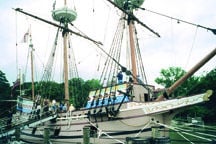
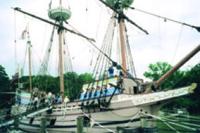
Godspeed: A replica of the ship was completed in 2006. The deck of the reproduction is 65 feet long while the overall length is 88 feet. The main mast is 71 feet high. The original Godspeed was one of three ships that delivered the first load of colonists to Virginia in 1607. Today, the replica is on display at Jamestown, Va.
The Third Supply: It was a flotilla of seven sailing ships: The flagship Sea Venture, the Blessing, the Lion, the Falcon, the Unitie, the Diamond and the Swallow.
The newly constructed flagship Sea Venture was launched in 1609. Her trip to Virginia was probably her maiden voyage. Anticipating the needs of colonists as they traveled to the New World, the Virginia Company had authorized the building of a ship designed to accommodate a large number of passengers.
The defensive weapons of the Sea Venture were placed on her main deck, not below as was usual. This meant the ship didn’t need double timbering. Instead, the hold was sheathed and furnished for berths for passengers.
Chapter 3 -- Batten down the hatches!
The terrible storm halted the bickering between the captain, the admiral and the governor. The wind and waves battered the ship without mercy. The rain poured down on the cold, miserable crew.
Soon Admiral Somers took charge of steering of the ship and rarely left his post. Gov. Gates began assigning crew members to man the pumps and form bailing lines. Capt. Newport oversaw the volunteers looking for leaks and patching them.
The Sea Venture was the newest of the ships in the flotilla and also the largest. Although it had been well-built, the oakum that was applied to breaches in the wooden hull had not had time to set properly before it set sail.
Because of the pressure of the water against the hull and the twisting and turning of the ship’s structure as the waves hit, bits of oakum began to give way. Water began to wash in through numerous cracks. Joshua joined the bailing line in trying to keep the water level from rising in the hold. John helped the ship’s crew with patching cracks.
Two days after the storm began, there came a blessed stillness in the air. Some among the passengers rejoiced, but the more experienced sailors looked above them at the cyclonic clouds and held their breath.
One sailor climbed the main mast and searched.
“No sight of the other ships,” he reported.
The bailers stood up straight and stretched their aching arms and backs.
“The storm’s not done yet,” one sailor warned.
Within the hour, the wind returned. The spoken prayers of the passengers and crew went unheard over the unending assault of the wind and rain.
“The sea is giving battle to heaven itself,” one crewman cried.
“This is not rain but a river flowing down on our heads,” another replied.
“I’ve never seen a storm like this in all my 30 years at sea,” the navigator roared.
With the assault of each high wave, the ship creaked and groaned. Then the passengers held their breaths as the ship plunged over the crest and slipped rapidly into the trough.
“She could break up at any moment,” one hardy mariner called.
“We’ve got a major leak. Five feet of water in the ballast,” Gates reported to the captain. “The men are swimming in the chilling water trying to find the breach. One sailor has nearly drowned, the water is coming in so quickly.”
No one had time to eat or sleep. As many of the crew as could be spared were told to go around the ship with candles to check the ship’s ribs for leaks. But the location of the largest leak continued to be a mystery.
“We think it must be near the galley, since biscuits have begun popping up on top of the water,” the quartermaster reported.
Joshua could sense that many of the crew members were beginning to despair. He prayed as he continued bailing: Dear God, please let me live to see the New World.
For two more dread-filled days and nights the winds and rain continued. Men worked for an hour, then rested for an hour as others took their places.
On several occasions, a huge wave knocked the whipstaff out of the hands of the helmsman and knocked him to the deck. Each time, another sailor would grab the it and with brute strength bring it back into position.
When St. Elmo’s fire began to illuminate the mast, the superstitious seamen were sure they were all doomed.
Without the help of sun or stars, the navigator could not tell how far the wind had blown the ship and in which direction.
As the Sea Venture continued to take on water, the crew threw overboard most of the passengers’ luggage, barrels of beer, hogsheads of oil, cider vinegar and wine. Then they began tossing in their heavy military supplies.
The crew had eaten no food from Tuesday until Friday and had little sleep. Many no longer held any hope.
“At least I’ll die with my friends,” one grim passenger told Joshua as they continued bailing.
Near dawn of the fourth day, the captain issued the order that made even the bravest souls fear: “We can’t keep the water out any longer. Let’s close up the hatches and turn our souls over to God.”
LOOK IT UP
Oakum: Loose hemp or jute fiber, sometimes treated with tar, creosote, or asphalt; used chiefly for caulking seams in wooden ships.
Whipstaff: Smaller boats and ships are usually steered by a rudder. By the 1600s, ships were becoming too tall to be steered directly by a rudder attached to a tiller. A thin pole, often covered by grease, had to be run from the rudder to the steering mechanism, the whipstaff.
St. Elmo’s fire: A strange phenomenon akin to lightning. High voltage traveling between clouds and the ground beneath can cause air molecules to glow. The phenomenon was observed by mariners, particularly during thunderstorms. Nitrogen and oxygen in the Earth’s atmosphere can cause St. Elmo’s fire to appear as a blue or violet glow.
Superstitious sailors often saw omens in the appearance of St. Elmo’s fire.
Chapter 4 – Land ho!
When the sun rose on Saturday morning, the Sea Venture was still afloat, but barely. Shortly thereafter, Sir George Somers, who had been keeping watch, shouted the word the passengers and crew had prayed for: “Land Ho!”
“Look, Joshua. I see trees waving in the wind,” John shouted.
The boatswain took a sounding and found the depth of the sea at 13 fathoms; later just seven and then four.
“Islands like these often have sharp reefs,” Luke whispered to Joshua, who was on deck trying to dry out his clothes. “If we hit one, the ship could sink.”
“How do you know?” Josh questioned.
“I was on the Godspeed three years ago,” Luke answered.
“But the Godspeed didn’t land on an island. It landed at Cape Henry,” Joshua replied. “You heard it from one of the crew, didn’t you?”
Luke’s neck turned pinker below his sunburn.
“Yeah, I head it from the navigator.”
“Did he say where we are?”
“He guessed that this is probably Bermuda. It could also be one of the islands to the south by the Spanish territories. We’ve been driven by the wind for so long that no one is sure where we are.”
As John walked toward them, Luke turned to go.
“Stay, Luke,” John said. “Boys, the ship is half-sunk with all that water still in the hold. The seamen agree we can’t make it to Jamestowne. The bigwigs are talking about running the ship aground as near to shore as possible and then bringing the passengers and crew ashore a few at a time in the long boat. I want you boys to be alert.
“Luke, can you swim?”
“Yes, sir.”
“Joshua, you know how to swim, don’t you?”
“I know how to swim in the Thames River. I don’t know how to swim in pounding surf.”
“If we do go aground and you are tossed in accidentally, remember to try not to fight the waves. Swim alongside them, but always aim toward some place on shore.”
Just as he said it, the ship lurched violently and stopped moving. Each successive wave crashed against the hull and tried to push the ship closer to shore. Soon the ship was turning sideways. A tearing noise could be heard in the hull as hung up on some rocks or coral reef.
“How far are we from shore?” Joshua asked.
“I think a little less than a mile,” John replied. “But it seems to be shallow most of the way in.”
Crewmen set the anchor and lowered the longboat.
“Women and children first,” the captain ordered.
“Get into the longboat,” John ordered.
“Why? I’m not a child,” Joshua replied.
“No, but the women and children will need help to get ashore. Now do what I say!”
And John was right. The longboard, overloaded with 16 passengers and four crew members, stuck in the sand about a hundred yards from the shore.
While the helmsman tried to hold the longboat’s position, the other men, including Sir Thomas Gates and Joshua, picked up the smallest children and struggled not to lose their boots in the shifting wet sands as they made their way to shore.
The women found their skirts hard to manage. Eventually two of them lifted the wet hindrances up above the water so they could keep their balance as the tide ebbed and flowed around them.
On shore, Gates handed one woman her child and immediately ordered the women to rest in the warm sand next to a rugged cliff.
“Joshua, see if you can find a way up over the top of that cliff. If you do, search for fresh water in the immediate area.”
Joshua examined the steep cliff that surrounded the semicircle of sand on the beach. At first, it seemed impossible to climb but then he noticed a slight gap. With both hands he was able to slowly scale to the gap.
At the very top was a windswept field with a few trees all leaning in the same direction. Not far beyond and slightly lower, he could see an area thick with trees. Apprehensively, he walked in that direction.
Then he had a disturbing thought. Are there dangerous naturals on this island?
LOOK IT UP
Bermuda: The Bermuda chain consists of 181 islands with a complete land mass of only 20 square miles. The largest island is called Bermuda. The closest North American location is at Cape Hatteras, N.C., 590 nautical miles away.
Since Christopher Columbus had reported the presence of the West Indies to the king and queen of Spain in 1492, Spanish ships had been bringing explorers and exploiters to the New World. They had claimed much of North and South America as their own, including the Florida peninsula.
One explorer, Juan de Bermu’dez, had landed on the main island of Bermuda. Legend says that, seeing how lush the vegetation was, he left some pigs there in hope that they would multiply and provide food for other explorers or even marooned sailors.
After England defeated the Spanish Armada, English ships soon began expanding exploration and colonization. This set the English in direct conflict with Spanish interests.
Bermuda has a humid subtropical climate warmed by the gulf stream. Ocean breezes keep the highest summer temperatures around 90 degrees. A low of 50 degrees might occur once or twice in the winter.
Fathom: A fathom is a unit of measurement used to plumb the depth of a body of water. Each fathom indicates a depth of approximately 6 feet.
Longboat: An open boat that could be rowed by eight or 10 men on each side. The lines of a longboat were designed for use in steep waves or against the tide. If necessary, they could be fitted with sails.
Chapter 5 – A temporary home
By the time Joshua returned to the shore, dozens of people were milling around the cove.
“What have you found?” Somers demanded as Joshua sat down to rest.
“Just northeast of here, the ascent from the beach is more gradual,” Josh replied. “There are sheltering trees about a quarter of a mile from here. But I couldn’t find any fresh water.”
“Show me the way,” Somers ordered, shouldering his arquebus.
“Josh led Somers up the rocky cliff and then around to the more gently sloping ground.”
“Looks like a good crop of cedar trees,” Somers said with a smile. “They’ll give us some shelter and eventually plenty of good wood for building a new ship. It will take some effort to get there, but we will reach Jamestowne yet.”
They kept up a marching pace until Somers finally stopped.
“I’m relieved to see no sign of Naturals living here,” he said. “Perhaps none will threaten our survival.”
When they finally returned to the cove, John was waiting. John smiled broadly at Joshua, then turned and reported the news to Somers.
“Sir, all 150 of us are safe. The passengers have been brought ashore and so has the dog. Some of the crew members are still on the ship, trying to salvage what they can. Gates won’t let them stop unless salvaging becomes too dangerous. He ordered them to gather up the carpenter’s tools first so we can begin building a new ship right away.
“The crew will come ashore before dark and spend the night. They’ll begin again tomorrow; that is, if the ship is still aground by then. We all know the ship could wash away and sink at any time.”
“Thank you Mr. Proctor,” Somers replied. “I see that all is in good order.”
Later, Joshua and Luke went to inspect the pile of goods that was being dumped onto the sand. Pots and pans, a few casks of larded pork, ale, wine, and also carpenters’ tools, ropes and smaller ships riggings were strewn wherever they were dropped. The women had spread out the wet blankets and clothing to dry.
By supper, the aroma of freshly cooked fish was filling the air. Gates had ordered a group of men to find driftwood and another group to spear some of the multitude of fish swimming just beyond the shore.
Supervised by the ship’s cook, the fish had been skewered and were slowly cooking over an open fire. One woman had thought to gather seawater in a kettle. Near the open fire, the water had evaporated and a light residue of salt was appearing.
“At least we’ll not starve here,” Luke said as he joined Josh and John in squatting around the fire and picking fragile fish bones from their teeth.
Just then the last of the seamen came to shore and began beaching the longboat.
“Let us give thanks to the Almighty God that not a single one of us was lost during the shipwreck,” the Rev. Robert Bucke declared in a powerful preacher’s voice. And all of them did.
After dark, most of the exhausted crew took now-dried-out blankets to one end of the cove and immediately fell sleep. The women and children retired to the other end of the cove.
In between them, some of the senior male passengers opened a small cask of wine and sat around the fire, toasting their survival.
Joshua and Luke had curled up under a jutting stone apron just far enough away so they could hear the men speaking.
“I assume that I will be taking charge,” Gates asserted. “We are, after all, now on dry land.”
“But we haven’t yet reached our destination,” Admiral Somers disagreed, “so it is still my responsibility to see that we arrive safely at Jamestowne.”
“My crew is still my responsibility,” Capt. Newport reminded them. “You are the admiral of the whole flotilla, but I am the captain of these sailors.”
“Let me remind you that your ship is now aground on an uncharted island,” Gates growled. I’m to be the governor here.
“I’ll remind you that you were only to be governor for a brief time; until Lord de la Warre arrives at Jamestowne to take over,” Somers insisted, scowling.
“Sounds like trouble ahead,” Luke whispered.
“It’s so warm here, I think I’ll use my blanket to sleep on instead of under.” Joshua said, and promptly fell asleep.
LOOK IT UP
Arquebus: The earliest version of a firearm, the arquebus was a portable, long-barreled gun used from the late 1400s. It was fired by a wheel lock. The name means “hook gun” from the shape of the butt. Four of these weapons were recovered from the wreckage of the Sea Venture.
Rev. Robert Bucke: He was chaplain on the Sea Venture and one of the castaways on Bermuda He was the second pastor to serve in Jamestowne. He arrived there in May 1610 and served until his death about 1623. He is probably best remembered for performing the ceremony at the wedding of John Rolfe and Pocahontas. He also owned valuable property in and around Jamestown.
Chapter 6 – Pirate or privateer?
The following morning, Capt. Newport climbed to the highest point above the beach. He was pleased to see that the Sea Venture was still lodged firmly on the reef.
Quickly, he woke his crew and they began the daylong chore of bringing ashore anything they could strip from the ship.
Somers took John and Joshua to search for food, since most of the ship’s stores had been tossed overboard or ruined by the seawater.
“Look! Is that a hog?” Joshua yelled as they walked along the grassy area.
“It is indeed,” Somers replied and aiming his arquebus, he shot.
He missed, but the noise set a number of other hogs running toward the trees.
“I wonder how all those hogs got to this island,” John asked.
“Perhaps some were left by design by some Spanish explorers,” Somers said. “It would make sense to have food available if sailors were marooned on an island such as this one. Or maybe a ship was wrecked on the reef and the hogs swam ashore.”
While Somers explored, Gates organized another group to look for a campsite. He chose an area shaded by tall cedar trees.
In small groups, the shipwrecked survivors began moving the rescued stores of supplies up onto the flattened hilltop area sheltered by many cedar trees.
Joshua and John returned with Somers later in the day. Their search had been successful and long before sunset, they were able to bring with them an abundance of bird eggs and a dead feral hog. They also brought the news that from an even higher vantage point they could see many islands in the chain.
“I’m fairly sure now that we are on the main island called Bermudez,” Somers told Gates. “If so, we are no more than a dozen sailing days from Virginia.”
At dusk, while the aroma of roast pig filled the air around the camp, the sailors were still being urged to make one more trip to the wreck before dark.
“Clouds are forming,” the captain warned. “By tomorrow, there may come another storm. If the ship slips from the reef, all that is on it will be lost.”
“These cedar trees won’t provide us with much cover tonight if it storms,” Joshua said.
“No,” John said. “But we will soon begin building thatched lean-tos. And the cedars will form windbreaks. If we are here long enough, we’ll build more permanent dwellings.”
After nightfall, the group gratefully shared small quantities of boiled eggs and roast pork.
“We saw lots more hogs today,” Joshua reminded him. “Now all we have to do is figure out how to catch them.”
That night, their sleep was disturbed by awful howls in the distance.
“’Tis the devil himself,” one sailor shouted.
“Quiet down,” Gates ordered. “It’s more likely a bird or beast. Tell those on watch to be especially vigilant.”
“Looks like the whole chain of islands is uninhabited,” Somers told Gates a few days later after more exploration.
“Do we still need lookouts?” Gates asked.
“Yes, we’d better keep some in case Spanish pirate ships pass this way.
Having overheard their conversation, Joshua had a question for John.
“What’s the difference between a Spanish pirate and an English privateer?”
“They both do pretty much the same mischief,” John replied. “They both attack each other’s ships and take all the valuables they can find. But the English privateers give a share to the king.”
“Does that really make it right?” Joshua asked.
“No, but it does make it legal,” John replied.
“Do you two know that Capt. Newport was a privateer?” Luke asked with a grin.
“Is that true?” Joshua asked in a shocked voice.
“Yes, it is true,” John said.
Because the sense of impending danger had decreased, two distinctly separate camps began to broaden out. Many of the sailors and a few of those sent to serve as indentured servants began to build shelters farther and further away from the main group of passengers led by Gates.
Both Somers and Gates became alarmed as a cluster of men with questionable reputations began to form far from the center of activity.
“I know what kind of men we are dealing with here,” Gates told Somers. “I assure you that there will be punishment for any crime.”
“At least we agree on that goal,” Somers answered.
LOOK IT UP
■ As a young man, Capt. Christopher Newport had worked as a privateer. For 20 years, he joined the crews of a series of privateer ships in raiding Spanish freighters in the Caribbean. The spoils of these raids were shared with the London merchants who funded the missions and with the crown. In August 1592, he captured the Madre de Deus (Mother of God) and took from that ship the largest amount of plunder in that century. He returned to England carrying tons of spices, silks, gemstones and other treasures.
In 1608, he brought a shipload of settlers and supplies to Jamestowne, so this voyage on the Sea Venture was his second one to Jamestowne.
■ The Cahow bird is now Bermuda’s national bird. It is well-known for its piercing scream. At night, its call can sound more like a large wild animal than the small bird it is.
Chapter 7 – A Spanish galleon in sight
One day Joshua and Luke heard the terrible cry that occasionally awoke them at night and more often startled them during the day.
“Nothing has hurt us. Let’s find out what it is,” Joshua said. And so they stalked in the direction of the sound.
“It’s coming from that ordinary looking white-and-gray bird,” Joshua reported.
Luke laughed when he saw it.
“You mean that seabird can make that frightening noise? It will not bother my sleep again.”
Sir Thomas Gates kept his promise to be a strict disciplinarian. He began using a bell to call his assigned groups to work, and also for meals, to gather for worship and to rest.
He expected an immediate response to the bell and gave punishments if workers faltered. Some cooked, some fished, some hunted and some worked at digging latrines and building shelters.
“Gates may be a bully when it comes to working, but at least he eats with us and works side by side with us and worships with us. That’s unusual for an aristocrat,” John said. “Many people are expressing confidence in him now because of his actions.”
Not anxious to join in the rigidly scheduled life set up by Gates, Somers volunteered to begin charting the islands for the benefit of the Virginia Company.
“I think this might be an excellent place for another colony,” Somers told Gates. “If only I can find something of value to sustain it and to bring profit to our stockholders.”
Several volunteers joined Somers and soon Gates was suggesting that the known troublemakers should also join Somers’ expeditions. Somers and a few of his men built a small boat and wandered from island to island while most of the ship’s crew were busy fitting the longboat with a mast and sails.
By August, the Sea Venture’s longboat had been converted into a pinnace. Carpenters had added a deck and hatches and had fitted a mast and sails, using most of the Sea Venture’s salvaged parts.
“Henry Ravens said he is anxious to make the journey to Jamestowne,” Luke reported to Joshua.
“Why was Henry chosen?” Joshua asked.
“He’s the master mate,” Luke said. He’s had long years of seafaring experience. The other men he’s taking with him haven’t had as much time afloat.”
“I hope they make it,” John said. “I’m anxious to get there and pick out some good land. Joshua, you may not like Jack Crook, but he was raised on a farm and knows enough of agriculture to help us grow crops. As the colony continues to expand, we should do well. Then I can send for Alice and our child.”
Just then the community bell rang out an alarm.
“What is it?” John shouted as they rushed to the center of the camp.
“Pirates, we fear,” Capt. Newport yelled. “A watchman has spotted a Spanish galleon with many cannons sailing near the islands.”
“The crew might just be looking for a source of fresh water,” Joshua suggested.
“Well, if they are, we have none to share,” John said. “Our own supply of rainwater is running short and we’ve been unable to find any fresh water springs.”
“Is everyone here?” Gates shouted to the assembled group.
“We’re missing six sailors,” Capt. Newport reported.
“I knew I’d rue the day I let them wander,” Gates replied.
“Well, we have nothing to do but wait and see,” Somers added turning the conversation back to the crisis at hand.
“Capt. Newport, give out what weapons we have,” Somers ordered. “How I wish we had been able to bring in that cannon but it was too heavy and we lost it into the depths.”
“Yes, a hearty cannon blast might chase them away, even if it is a war ship.” Gates agreed.
“But maybe it would have just let them know that we are here,” Capt. Newport considered.
“Oh, they know,” the watchman broke in. “I could see someone with a spyglass looking at our foundered ship.”
“That might be a better warning,” Somers said. “They can see what the barrier reefs around this island can do to a ship.
After hours of watching the galleon, the watchmen reported that it had sailed parallel to the shore for a long way, then turned away and headed out to sea.
“We’re saved this time,” John sighed. “Still, we must remain alert.”
But trouble on the island was just beginning.
LOOK IT UP
Pinnace: A small sailing ship more suitable for short runs than long ocean voyages.
While construction of the first pinnace was in progress, Sir Thomas Gates prepared two letters, one for Lord de la Warre and another for the Virginia Company in London. He expressed his hope that when Lord de la Warre brought over the next flotilla of settlers in 1610, as planned, he would send a ship or two to pick up the castaways.
Spanish galleons: Warships. They often protected the freighters that carried gold and later emeralds from South America.
Chapter 8 – Joshua finds a cure
After Henry Ravens left for Virginia on the first pinnace, trouble began brewing.
People began getting sick with headaches and stomach disorders. This was surprising because the castaways were enjoying a much more varied diet than they had on the Sea Venture, or for most of them, even in England.
On the island, they ate fish and shellfish and a number of exotic vegetables, including cassava, bamboo shoots, sea grapes and heart of palm from palmetto trees. And they had pork. Those who were not sick had plenty of energy do chores and to build ships.
Such work was required of them. Gates ordered the construction of a second pinnace. Having used most of the fittings and riggings from the wreck on the first, this one had to be made from materials crafted on the island. Bermuda cedar trees provided wood that was tough and rot-resistant, but the wood required long hours of hard work to shape into lumber for a ship. Gates ran into opposition.
A sailor named James Wunt and five of his friends refused to work.
“I overheard Wunt last night,” Luke told Joshua. “He is questioning why his group should have to work so hard to go somewhere they don’t want to go. They want to stay here. They think life is better here than it would be at Jamestowne.
“I can’t blame them,” Joshua agreed. “It’s warm here, even now in winter. And there’s plenty of food. If John wasn’t so bent on going on, I think I’d like to stay here myself.”
“Whist, don’t let anyone hear you say that,” Luke cautioned. “I hear Gates has been angry with them ever since Wunt and the others couldn’t be found during the alarm.”
“What do you think Gates will do?” Joshua asked.
They found out when Gates called for an assembly of the castaways. Wunt and his men were brought forward with hands tied behind their backs.
“Wunt, you and your men are the dregs of society,” Gates shouted. “In London, you were given the choice between jail for petty crimes or service to the company. No wonder you want to stay here. But you can’t. Not with us.
“I’m declaring martial law. You and your men will be rowed to a distant island. You will take with you no water, no game or stored foods and no tools.”
“You can’t do that,” Wunt snarled.
“Does anyone here question my authority?” Gates searched the faces in the crowd. No one spoke.
Along with trouble came celebrations. Just before Christmas, some of the colonists built the first church on Bermuda from palmetto and cedar trees. They thatched the roof with palmetto leaves.
A few days later, Joshua asked Luke an important question.
“Have you noticed that people seem to get sick after we eat raw cassava?”
“Not really,” Luke replied.
“Seems that when I ate the raw pieces, I would get a headache or a bellyache soon afterward. I haven’t had either since I realized that.”
“Guess that’s why I don’t know, Joshua. I refuse to eat them. Maybe someone else has noticed this, too. I’ll ask some of the sailors.”
Later that day, Luke found Joshua as he was helping to carry more wooden timbers to build the Deliverance.
“I talked to an old seaman who had been captured by the Spanish and served on a freighter in the Caribbean. He said that the Spanish always peeled and cooked the tubers before they ate them. He’d tried to tell our cook that when he first started serving the cassava but the cook told him he was crazy.”
“Luke, the sailors like a challenge. Maybe John and I can challenge three of them to eat the cassava raw and see if they get sick.”
And so they did, as their fellow sailors laid bets on the outcome. Within a few days, experience had proved that the raw cassava had unpleasant consequences.
“Wish we had known that sooner,” some of the castaways commented to John.
“Thank you for figuring that out,” the three sailors the told Joshua. “I’m beginning to feel better.”
“Guess we’ll have to learn about other risks when we get to Virginia,” Joshua told Luke.
LOOK IT UP
Cassava: Never eat cassava raw. The toxins must be soaked and cooked out. Cut tuber into slices. Peel and discard the peel, cut in half, remove core and discard. Boil the starchy white vegetable as you would potato.
Raw cassava reacts with human digestion to form small quantities of the poison cyanide. The frequent eating of this tuber can result in serious illness or death.
Cassava root (tuber) is a major source of carbohydrates in tropical climates. Cassava flour may be used in breads, crackers or puddings. The Spanish called pearl cassava tapioca.
This plant is plentiful in subtropical climates. Natives of Central and South America depended on it. Cassava plants grow on Bermuda and a recipe for Cassava Pie, thought to have been developed in 1612, is part of their culture.
Bermuda cedar trees: Juniperus Bermudiana has an exotic aroma. The wood is said to be harder and darker in color than any other North American variety. The wood repels moths and fleas and prevents mildew and rot. At one time, these cedar trees grew in thick groves on Bermuda, about 500 to an acre.
The 80-ton pinnace Deliverance and later the 30-ton Patience were both made from Bermuda cedar.
Heart of Palm: It can be harvested from the tops of palmetto trees. The vegetable may be scooped out. The seeds may be dried and ground into a kind of flour.
Chapter 9 – Mutiny!
The pinnace Deliverance was well on its way to being completed. As work progressed, most of the castaways began to realize that the pinnace was too small to take them all. Rumors were flying that only a few of Gates’ favorites would be sailing with him to Virginia.
Gates was spending all his time supervising the pinnace’s construction. When Somers questioned him, he was vague about how he would manage the problem.
“Somers and Gates are quarreling again,” Luke reported.
“Are we ever going to be able to get off this island and on to Virginia?” John asked, frowning.
The answer became apparent when Somers talked some of his sailors into building a second pinnace. With fewer men and a shorter amount of time to work with, the pinnace they named Patience was considerably smaller.
Then a great tragedy struck.
“Why is the bell ringing now?” Joshua asked.
“Rev. Bucke is ringing it because there will be a funeral for the wife and daughter of John Rolfe,” Luke replied. “The infant girl he named Bermuda has died and now so has her mother. We’ve already lost two of the male passengers as well but this death is an especially sad one. Master Rolfe can barely hide his grief.”
Even thought the time to leave was getting shorter, more problems plagued the leaders. Stephen Hopkins, a Puritan who worked as a clerk for Rev. Bucke, whispered about staying on Bermuda. Feeling that his authority was once again being tested, Gates sentenced Hopkins to death.
Many of the passengers suggested that Hopkins be pardoned. He was a gentleman, they argued. He wasn’t planning mutiny; only making conversation. After so many of the passengers stood up for Hopkins, he was granted a pardon.
Then Henry Paine refused to report for his watch and assaulted the officer sent to find him. Gates sentenced Paine to death. This time he saw that the sentence was carried out as a warning to the others. After that, things settled into a quiet, if not happy routine.
Somers took time to visit the outcasts on the deserted island. Wunt declared that they had repented and wanted to come back and help finish the pinnace. Gates finally agreed.
Tempers flared. At the Somers camp, a sailor named Robert Waters hit a fellow sailor on the head with a shovel. The man died. Somers arrested Waters and sentenced him to death. Quickly, his shipmates freed Waters and he quietly disappeared. No one was able find him.
By March, the Deliverance had been completed. The day Gates declared the construction done happened to fall on Joshua’s 13th birthday.
“When’s your birthday?” he asked Luke.
“I really don’t know. My mother died and my father never wanted to talk about it”.
“So you don’t even know exactly how old you are?”
“I’m old enough to hold my own with the seafaring men around me,” Luke bragged.
After the much smaller Patience was completed in late April, the castaways began packing their belongings inside the two pinnaces. Throughout their time on Bermuda, the women had been busy preserving salted pork, dried fish and vegetables to tide them over on the short voyage to Virginia and later to and share with the colonists at Jamestowne. They had also cleaned out crockery and watertight barrels to hold fresh water for the voyage.
Before they shoved off, Rev. Bucke prayed for their safety.
With a sense of satisfaction, Gates wrote in his journal that of the 151 people who made it ashore on Bermuda, 142 were able to leave for Jamestown nine months later.
Although he had heard nothing from them, he held out hope that he would find Henry Ravens and his crewmen at Jamestowne. He noted that Jeffrey Briars, William Hitchman, Mistress Rolfe and two children had died of natural causes. Samuel Edward had been murdered by Robert Waters, whom he assumed was still hiding somewhere on Bermuda.
Gates added that Somers had asked Christopher Carter and Edward Chard to stay behind and “hold” the islands for future English colonists.
With great anticipation, the castaways left the island.
“It will be so good to settle down, build nice homes,” one of the women said.
“Hope they have some flour left over at Jamestown, Joshua told John. “I crave the taste of real bread.”
LOOK IT UP
John Rolfe was in his 20s when he and his wife sailed on the Sea Venture. Their baby girl was born on Bermuda and christened on Feb. 11, 1610. His child and then his wife died shortly thereafter.
Stephen Hopkins is thought to have found passage back to England. He returned in 1620 as one of the original colonists of the Massachusetts Bay Colony and signer of the Mayflower Compact.,
Robert Waters hid well and remained on the islands when the others left for Virginia.
Chapter 10 – The starving time ends
In early May 1610, the Deliverance and Patience turned into the James River and a day later were within sight of Jamestowne. The survivors of the Sea Venture had expected to be greeted by more than 200 of their fellow countrymen. Instead, what they saw as they disembarked were a few skeleton-thin survivors coming out to greet them from a disintegrating fortress.
A few of the former castaways looked at each other in shock. Those who had wanted to stay in Bermuda could scarcely hide the “I told you so” looks on their faces.
The surviving Jamestowne colonists were filled with joy at seeing the new arrivals, partly because they had assumed that the Sea Venture had been lost in the storm and all aboard perished. But mostly, they rejoiced when the newcomers began unloading food.
After a hasty meal, Jamestown’s leader, George Percy, prepared to tell of the horrors of winter they had faced.
“We’ve survived ill fate...” he began.
“Did any of the ships of the Third Supply arrive?” Gates interrupted.
“Yes, Excellency, the other ships did arrive late last summer,” Percy explained. “But they brought more problems than help.
“The Blessing, Lion and Falcon arrived first, but most of their stores of food had gotten wet and been ruined by the storm. In fact, in the first three days after those passengers arrived, they ate the entire crop of corn the we Jamestowne settlers had grown so far that summer.
“The Unite arrived at the same time, but nearly all on board were sick, so many returned to England with that ship. Then the Diamond appeared a few days later, and the Swallow a few days after that.
“The captains of these ships noted the lack of food and prevalent diseases among us, so they unloaded the passengers quickly. They left us the few remaining stores of food they felt they could spare and quickly turned their ships back toward home, leaving the 145 of us to figure out how to feed an extra 200.
“Fear of attacks by Powhatans kept us from going out to hunt and fish. Colonists began to sicken from malnutrition as well as disease. Many died from fevers. I became ill, too. Fresh water has been scarce and the brackish James River water seemed to make us more sick.
“Weakened from lack of food, my fellows allowed the fort to fall into disrepair, even burning some of the earlier-built houses for fuel. As food supplies dwindled and fear of venturing out of the stockade to find food increased, they began to eat anything they could find: shoe leather, rats and worse.
“Don’t let Percy lie to you,” one man broke in. “He has been a totally incompetent leader. He angered the Powhatans by killing their women and children. He says he was ill, but look at him – he’s still here when so many others have died.
“Capt. John Smith kept the colony in food and goods by trading glass beads, copper and iron implements to the Indians in exchange. But other people (there he glared at Percy) attacked Smith as incompetent. George Percy took charge in the spring of 1609. Powhatan didn’t like him so Powhatan’s tribe begin withholding food. Percy attacked them and they began attacking us.
Gates and Somers look grim as they took a few days to assess the situation. They decided that the food they had brought wouldn’t be enough to last another winter and the colony could not survive under such dire conditions.
By June, with the help of the new arrivals, the surviving Jamestowne settlers had buried their cannon and heavy equipment and joined them on the Deliverance and Patience. All were preparing to head back to England when someone sighted ships.
Lord de la Warre arrived just in time to persuade the others to stay. He brought with him two ships bearing fresh supplies and at least 150 more colonists.
“Do you think we will all end up like those who went through the starving time?” Joshua asked.
“Don’t fear, little brother,” John reassured him. “We will stay and we will get land and find a way to make this colony grow.”
Epilogue
At Jamestowne, the winter of 1609 was called “the starving time.” Of 214 colonists, only 60 were still alive when the castaways from the Sea Venture arrived.
Henry Ravens and his crew left in August, exactly one month after the wrecking of the Sea Venture, but they did not make it to Jamestown and were never seen again. The assumption is that they were lost at sea, but some historians assert that they did make it to Virginia, only to be killed by Powhatan Indians, who later boasted to one of the settlers of what they had done.
In early June 1610, Sir George Somers volunteered to return to Bermuda aboard the Patience to bring more supplies for the struggling colony of Virginia. On June 19, 1610, he left with a few of the colonists. He died on Bermuda on Nov. 9, 1610, at the age of 56. Though his nephew, Capt. Matthew Somers, returned to England aboard the Patience with his uncle’s body, his heart was buried in Bermuda.
Sir George Somers is credited with starting the Bermuda colony. For many years the English called Bermuda the Somers Isles.
John Rolfe is also remembered for planting tobacco and promoting its pleasures to the people of England. In doing so, he began the first profitable crop in Virginia.
John Proctor’s voyage on the Sea Venture may have been his second trip to the New World. Some historical papers record his first trip as happening in 1607.
He helped to build up the Jamestowne colony, and made at least two more trips back to London to escort more settlers to the New World. His wife, Allys (Alice), would later join him. She is recorded as having voyaged to the colony on the ship George in 1621.