


By Peggy Koch
Chapter 1
Katy heard a noise from behind. Somewhere, hidden by the trees, an animal lurked. Alone in the deep woods she felt fear. Was it a bear? Just a squirrel? Or her imagination?
A sudden breeze blew one of her white shirts off of the low bushes, where she had laid it to dry in the sun. The nearby bushes were blanketed with her other laundry. The nearly dry shirt fell into the dust.
Katy suddenly realized what a wonderful gift clothespins were, now that she didn’t have any. She even began to feel gratitude for her family’s old-fashioned clothes washer at home with the monster wringer that ate buttons. (By her ninth year of life, Katy had grown expert at removing broken buttons and sewing on new ones because of the wringer.)
Katy began to cry as she picked up the shirt. It was stiff from the soap that wouldn’t come out in the cold water. And now it had brown stains from the dust. She’d have to rewash it. And then, she was sure, it wouldn’t be dry in time to take back to her campsite.
She knew what she wanted to write to her mother. And she knew she couldn’t.
Dear Mother,
I hate camp. I wish I were dead. Dad is really mean to have brought me here. And now he’s left me alone to do four weeks of laundry in a bathroom lavatory with only cold water out in the middle of nowhere.
Why did you let him bring me here? You know how mean he can be. I want to come home. Instead, I have to stay for four more long weeks of mosquitoes and strangers and rules, rules, rules. I love you.
Katy
How had she come to this? As she rewashed the shirt, she began to remember.
Katy Nelson had a problem. She didn’t like herself very well. She didn’t like anyone else very well either, except her mother.
She liked her school in St. Louis. Her father was a teacher. He never stopped teaching, so she was well prepared to answer her teachers’ questions at school. But outside school, she was shy and withdrawn. When other children played on the streets and sidewalks of her neighborhood, she hid in the house, reading books.
“I’m the only kid on the block whose father won’t let me do my homework after school!” she mused. “But then I’m probably the only one who asks to do homework right after school.”
“Get outside and play,” her father would insist. “Get some exercise. Have some fun. You can do your homework after you dry the supper dishes.”
But playing with the other children wasn’t fun for Katy. She was scared and awkward and the other children teased her.
One afternoon, her father got so disgusted with her, he literally took a broom and swept her out of the house.
“Don’t come back until suppertime,” he warned her.
As usual, her mother was at work.
“My mother would understand,” Katy thought to herself. “I wish she would stay home like the other moms on the block.”
As soon as her father wasn’t looking, Katy sneaked back into the house and grabbed two raggedy old picnic blankets and some clothespins. In the backyard, she made a tent by using the clothespins to fix the edges of the blankets together on top of the clothesline. Then she set rocks on the lower edges to form an upside-down V. She hid inside the tent until suppertime.
So it was that on a cold morning in January 1953, Katy’s father informed her in no uncertain terms: “You are going to camp in New Jersey with me this summer.
“I was a counselor at Trailblazer Camp the year after you were born,” he said in response to her doubtful look. “It’s a great experience. And you get to go for free since I’ll be a counselor again.
“It will be fun,” he continued. “You can go swimming and ride in a boat. And during the break, we can go see New York City together.”
When she got outside, Katy began to cry. The tears froze on her cheeks as she walked to school.
LOOK IT UP
The Trailblazers Camp program was long established by the time Katy had a chance to participate. In 1887, the original editor of Life Magazine founded the “Life Fresh Air Fund” so that disadvantaged children from New York could share in the clean air and sunshine of a country farm. By 1918, nearly 40,000 boys and girls had been able to spend two weeks in the country. The expense at that time for two weeks was $6.92 for each camper.
Chapter 2 – Heading east
Katy thought about going to camp with her father as she walked to school on the slippery sidewalk of a busy viaduct that ran above two sets of railroad tracks. She noticed how snarled the traffic had become in the roadbed next to her as the snow poured down. She understood that her dad and mom would have to slip-slide to work, too.
“I don’t want to go to camp,” she though resentfully. “I don’t want to leave my mother. She’s the only friend I’ve got. I know the other kids will make fun of me just like they do here. And my dad didn’t even give me a choice.”
Katy thought about what she had overheard her parents saying.
“Does Katy understand what camp will be like, Fred?” her mother had whispered to her father.
“I’ve tried to tell her, but I don’t think she understands. But she should have some idea since we’ve taken her to visit friends who live on farms.”
“Yes Fred, but this sounds even more primitive than those farms. I worry how she will adapt.”
“Well, she will just have to figure it all out once she gets there. Be good for her.”
By May, Katy’s father was full of enthusiastic plans for the trip.
“We’ll go north into Canada first, Katy,” he boomed. “That way you can see several states as we travel.”
The trip was beginning to seem a little more real to Katy by then. Her mother was already packing a big nylon duffel bag with her summer shorts and shirts. Her mother had thoughtfully included some Archie and Jughead comic books and crossword puzzles. She had also packed a stack of postcards, each with a stamp, so Katy could write home every day.
“I’ll write to you almost every day, too,” her mom promised.
On Friday, June 12, school was out. On Saturday, they loaded their duffel bags and climbed into Fred’s aging Chevy.
“Are we there yet?” Katy wanted to ask a dozen times over the three-day trip. But she knew better. Dad didn’t like to be disturbed when he was driving.
They stayed in a roadside cabin in Ohio and in the morning they stopped to see a two-headed calf.
“I thought it would be alive,” a disappointed Katy told her father.
“So did I, Katy. This could be real, or it could be the result of a good taxidermist. I just don’t know.”
Another long day’s drive brought them to Buffalo, N.Y., just across the border from the Canadian province of Ontario.
Katy was impressed with Niagara Falls. It looked much prettier than the picture on the Nabisco Shredded Wheat boxes. The water on the American side fell in a sweeping falls. They walked out on a stone outcropping to get a better view.
Up close, the mist drifted upward, kissing Katy’s cheek.
“Look at the double rainbow,” her father pointed out. “Bet you never saw one like it at home.”
Ontario didn’t look much different from northern Missouri to Katy. The land was green and rolling. The waiter who served them at breakfast did talk a little funny, but the biggest difference was that they boiled their breakfast sausage instead of frying it. It tasted yucky but Katy knew she had to clean her plate or once again hear the story of how her father had survived college. He had lived on a few eggs a week while gathering sticks to cook them with as he walked to his rented room. Fred had been the first in his family to even graduate from high school.
“We’ll be late getting there,” her father explained on the last day of the trip. Most of the counselors have already spent one week living in the woods and practicing their skills for when the campers arrive.
“So camp will start right away?”
“No, we’ll have another week of training first,” her father answered. “Tonight, you will be staying at the infirmary with the camp nurse.”
“I thought I’d be staying near you,” Katy questioned, sounding alarmed.
“No, you’ll stay there all this week while we counselors finish our training sessions. Next Monday the campers will arrive and you’ll go to your campsite with your counselors.”
“Yuck,” Kathy thought.
LOOK IT UP
By policy, the St. Louis Board of Education never closed the schools when the weather was icy. Most students walked to school. The teachers often rode the public transit buses. Even if only three of the nine teachers and half the students showed up, there would be school. Those who did attend would probably read books and draw pictures instead of having class instructions.
The two-headed calf may have been real. A two-headed calf was born in Martvili (about 170 miles from Tbilisi, the capital of Georgia) on Jan. 2, 2011. Photos and video are being shown on the Internet.
Niagara Falls in Buffalo: Sometimes called “the American Falls,” this single fall showed a classic curve of water all across its width. Shortly after Katy’s visit, a ledge of rock collapsed, leaving a large pile of debris that spoils the effect to this day. It gave Katy the shivers to remember that she had stood on that ledge just months before the collapse. Most people now travel to the Canadian side to see the more dramatic Horseshoe Falls.”
Chapter 3 – What have I gotten into?
Late Monday, June 15, 1953
Dear Mother,
We got here O.K. I’m not sick but I’m staying in the infirmary. Maria says she’ll take us around to see the camp tomorrow. I miss you.
Many Midwesterners think of New Jersey as a polluted extension of New York City. That’s what Katy had expected to see when they traveled the last miles toward the camp. Instead, she saw hills that rolled up into Kittatinny Mountains of the Appalachians. The thick woods were full of familiar trees such as oak, hickory and maple. The difference was that they were also filled with wild blueberry bushes and rhododendron, which her father identified for her they drove past. Creeks showed strata deposits of shale, sandstone and slate.
They arrived at the dining hall on the boys’ side of Trailblazer Camp around suppertime on Monday. Katy was tired. All she wanted to do was curl up with a comic book.
Her father had other ideas. Another counselor offered to walk with them and show how the camp had changed. Dad insisted she go along. It was on this walk that Katy learned a great deal that did not please her.
As they hiked along the inviting shore of Lake Mashipacong, her dad began to point. “You’ll be staying on the girls’ side of the lake over there.”
Katy looked across the lake. It was a long way across.
As they came to a clearing, Katy noticed a group of shelters that looked like covered wagons without the wheels.
“You’ll be staying in a campsite like this,” her father explained. Earlier groups of campers built all these campsites using natural materials like saplings and canvas. The cots used to be made from sapling frames and ropes, too. Now there are some donated metal beds as well. Some of the other shelters look like tepees, some like lean-tos.
“Where’s the bathroom?” Katy asked with suspicion in her voice.
“Over there,” he pointed to an outhouse. Behind an open door, she could see three circular holes in the seat.
“How did they make those round holes? Katy asked, picturing inconvenient splinters.
“They used slices from a hollow tree.”
Katy stared at a kerosene lamp that was sitting on top of a splintery wooden table.
“Yes, that’s what you will be using for light, Katy. But your mother also packed a flashlight. And see, there is mosquito netting around each of the beds. That keeps you from being bitten at night. Just be sure to keep your arms away from the netting.”
“I don’t like it here. I want to go home!” Katy blurted out, then started crying.
“Well, you are not going home, so make the best of it!” he father growled.
Tears rolled off Katy’s cheeks.
Fred looked dismayed. “It will be all right, honey. I promise,” he finally comforted.
Before nightfall, Katy found that more substantial buildings had also been constructed. The dining rooms had been built by local woodsmen and craftsmen in the late 1930s. These buildings had been put together by hand using local logs and stones.
“They were built of natural materials to help the campers learn the value of the natural world around them,” her father explained.
The following morning, Katy awoke to an eerie wailing. She blinked her eyes at a wall of the infirmary, then realized where she was. Outside the window, she could see the nurse, Shirley, sitting in a grove of stately trees, her image slightly blurred by morning mist. In her hands was a flute. The notes of the haunting tune she played seemed to linger with the mist.
On the other side of the bedroom, Shirley’s assistant, Maria, climbed out of bed, then knelt on the hard wooden floor and prayed. Katy stopped feeling resentful long enough to enjoy the peaceful scene.
At breakfast, Katy was introduced to 8-year-old Phillip, whose mother, Ann, would also be working as a counselor. Maria gave them a tour of the grounds, first taking them to the girls dining hall for breakfast. Next door was the counselors’ office and a recreation room complete with a piano. Then Maria them on a tour of the camp, promising them they could ride a donkey in the afternoon.
Katy was alarmed. That didn’t sound like a treat to her.
LOOK IT UP
By 1953, when Katy attended camp, a permanent location for what was now being called Trailblazer Camp on a 1,000 acre tract with a 55-acre lake had been well established. The theme was primitive decentralized camping in which campers were expected to participate in every aspect of daily survival.
Chapter 4 – Camping is a lot of work
Dear Mother:
Did you know that flying squirrels don’t really fly, but they bite? There are bears here, too. The nurse is nice. We got to ride a donkey named Tina. I carved a cross with a pocketknife. I didn’t cut myself.
I miss you.
Katy’s thoughts about eight weeks of camping became more doubtful as Maria took Katy and Phillip for a hiking tour.
“All of the campsites are primitive,” Maria said. Each camper has daily chores. You will take turns cleaning the lanterns each morning or liming and cleaning the outhouse. We cook with wood, so you will learn to build and light a fire and to cook on it. One day you must heat the water for washing dishes and then sanitize them. The only luxury is a cold-water spigot.
Katy frowned.
“It’s not all work,” Maria said. “Sometimes we wade in the creek to get shovels full of clay for making art projects. The girls and boys have a lot of fun doing this.
“Oh, and we also have an underground food cache at each campsite, so the raccoons and bears don’t get into our stored food.
Phillip’s eyes got big. “There are bears around here?”
“Yes, but if you ignore them, they ignore you,” Maria reassured them.
“That’s right,” Katy added. “We used to pass brown bears on the path when we stayed in the cabins at Yellowstone Park. They didn’t bother us at all.
Phillip looked unconvinced.
Next, Maria took them to the commissary. “Here’s where the mail comes in. Oh, and did you bring a pocketknife? No? Well, you had better buy one. They come in handy.”
Katy bought a Lone Ranger knife with a mother-of-pearl handle for a quarter.
After lunch, another counselor gave them a crash course in how to chop wood with an ax. Katy wondered what her mother would think about the sharpness of the pocket knife and the ax.
“It’s hard chopping wood, isn’t it?” Katy asked Phillip.
He strutted, big-boy style.
“Not for me.”
Then they met Tina. Katy had never seen a donkey close up before. Tina was gray and had great big ears.
“You may ride her if you want,” Maria told them.
Phillip wanted to and took a turn immediately. Katy was more reluctant.
“Do you think she can carry me?” she whispered to Maria. “She looks so small.”
“You’d be surprised how strong she is, Katy. Just try.”
So Katy petted Tina, then took a ride around the donkey’s enclosure.
“Now, don’t expect to ride her when the other campers come,” Maria explained. “There are just too many of them. She’s strong, but she gets tired just like we do.
That evening, the counselors all rode together to a scenic spot by a cascading waterfall. The moss-covered stepping stones were slippery, Katy discovered when she tried to wade up them.
Back at the infirmary, Maria showed Phillip and Katy how to carve pieces of a cedar wood into crosses. In spite of her fears, Katy was able to make a crude cross without stabbing herself. That pleased her.
The following morning, Katy ventured out into the woods that surrounded the infirmary. She had never before seen so many towering trees. They blocked out the sun, leaving few plants growing on the forest floor. Only feathery ferns seemed to thrive and the fragile “Indian Peace Pipes.”
Katy amused herself by watching the flying squirrels. Oh, they couldn’t really fly, Maria had explained. But they had skin flaps between their front and hind paws that allowed them to glide from tree to tree.
Suddenly, Katy came across one lying on the ground.
“Are you sick?” she asked. The squirrel moved, so she knew it was alive.
Without really thinking, she reached down and tried to pick it up.
“Shirley can help you,” she told the squirrel.
It bit her. She let go quickly.
At the infirmary, Shirley administered dabs of pink mercurochrome.
“Don’t worry. He just grazed your skin,” she assured Katy. “But please don’t try to pick up any more sick animals.” They don’t understand that you aren’t trying to hurt them.”
Katy started wondering about what else she still had to learn.
LOOK IT UP
Many familiar animals live in the woods in western New Jersey, where the camp is located. Whitetail deer abound. Also foxes, red and gray squirrels, chipmunks, beaver, woodchucks, raccoons and opossum. Trout, pickerel and bass swim in the clear streams and lakes.
Black bears were uncommon in 1953, but the bear population is increasing again and has caused some recent changes in how food is handled at the campsites.
Chapter 5 – “We are all so different”
Dear Mother,
I’m living at Homestead Campsite now. Jan and Naomi are our counselors. They are nice. We can pick ripe blueberries off bushes that grow right by our campsite. We went swimming Monday and Tuesday in the lake. The lake is deep. Elena likes the Brooklyn Dodgers. She has never heard of the St. Louis Cardinals. Do I have an accent? I miss you.
“Please trade with me,” Katy pleaded. “Jan said we could trade.”
“You’d rather clean the latrine than make a fire?” Sonja questioned.
“I’m afraid of matches,” Katy admitted.
“OK, sure.”
Katy was just beginning to get to know her campmates. Eight girls and two counselors lived at the isolated campsite.
Sonja was from Harlem. Elena and Angelina had lived their whole lives in Brooklyn. Grace came from the Bronx.
Katy was just beginning to understand what her father had explained to her.
“The children who come to this camp are disadvantaged. Many of them have never been more than a few blocks from their tenement homes. Most have never seen a cow and think milk comes from a glass bottle. The only birds they recognize are pigeons.”
Listening to the other campers, she began to realize that New York City was much bigger than St. Louis, and much more restricted in size. To each of the other girls, their neighborhood or borough was separate and each thought theirs was the best.
Katy was also learning about nationalities. Two of the girls were Puerto Rican, which was sort of part of the United States but not a state, they explained. They both spoke Spanish. In Connie’s neighborhood, everyone spoke some Italian. Two girls from Harlem were black.
Grace’s grandmother had come from Ireland. Her skinny body and the sores on her face suggested that she didn’t always get enough of the right things to eat.
The other girls seemed uncertain of the outdoor wilderness and the nightly concert of crickets and tree toads.
“These girls don’t make fun of me,” Katy realized with relief after the first week.
When Elena yelled excitedly because she “saar a deer” one morning, Katy wanted to laugh. But no one else did, so she didn’t either.
“They all talk funny,” Katie noted. Soon she began to distinguish the various accents. Then one morning, Elena suggested to Katy that she had a funny accent.
“I have an accent?” Katy questioned. That was a new idea. Did the others think she talked funny, too?
One of the high points at camp was the day that Lois Goodrich, the camp director, sat among a group of girls and told them about the Pilgrims and pioneers who had built their country as a democracy. Miss Goodrich explained how the campers were to practice democracy in their small groups.
“You have to learn how to make democracy work,” she insisted.
The girls would be allowed to choose some of their daily activities. For example, they could ask to go swimming or do crafts on a certain day and then vote on it and if most of them agreed, the counselors would list that activity on the schedule.
Miss Goodrich also told the story of the camp. Katy was impressed by how many people it had taken over many years to build up what they now took for granted. Parts of the campsites had been put together through the labor of campers who came before them.
Miss Goodrich encouraged the girls to make their campsites pretty.
“Make table decorations using the flowers and grasses you find. Use your imaginations,” she insisted. “Be grateful for all the gifts of nature. Be grateful for the other campers in your group. Feel that gratitude when you sing grace before each meal.
“I want each of you to go home realizing your own value. You deserve to be respected. So do your parents. Sometimes your parents won’t understand what is going on in your minds and hearts. You may not be able to change that, but do try to understand them and be aware of all that they are going through.
At the nightly powwow around the campfire, Elena summed up what she had heard.
“Our parents don’t understand us, but Miss Goodrich told us to understand them.”
LOOK IT UP
Lois Goodrich had been a member of the camp staff since 1931. In 1953, she was the director of the Girls’ Camp. She retired in 1980, having served for nearly 50 years.
Puerto Rico was, and still is, a territory of the U.S. Periodically, there are attempts to make it our 51st state.
Chapter 6 – Don’t get burned!
Dear Mother,
We learned how to make a fire. Today we had Italian spaghetti. Connie taught us how to use a spoon to wrap the spaghetti around our fork. I’m learning to like Spanish rice, too. Joan, the dietitian can raise just one eyebrow. I can do it now, too. I miss you.
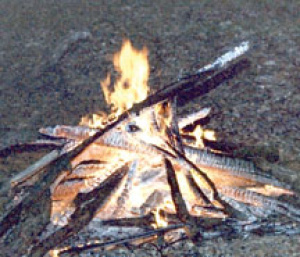
For the first week of camp, the counselors gave the campers lessons in how to build a fire.
“First, we have to gather some tinder,” Jan instructed. “Get busy and bring me some, girls.”
The campers scattered and soon brought back baskets full of leaves, moss and twigs.
“Now we have to break the twigs and sort them into big and little pieces.” Naomi demonstrated.
“This moss is too damp, Yolanda,” Jan explained. “Drop it over there in the sun so it can dry.”
“Now what about the middle-sized sticks of wood? We have to figure out a way to arrange them so that the air can get to the fire.
The campers decided to arrange the tinder into a tripod shape. Finally, they added larger chunks of wood, leaving a gap so they could light the fire.
“Be careful not to knock the wood over when you light it,” Naomi admonished. She looked at Katy. “Do you want to light it?” Katy backed away.
“OK, how about you, Yolanda?”
Yolanda took a match, scraped it against the box, then lit the fire. As she withdrew her hand, the carefully arranged stack collapsed. The tinder smoked, smothered by the wood. It took a long time for the fire to break into a blaze.
“We’ll have to think of a better way,” Jan explained. “We’ll be participating in a fire building contest in a week.”
“I hope we win the contest,” Angelina bubbled.
Soon the group worked out job charts for cleaning the lanterns, chopping wood, cooking, dish washing and cleaning and liming the latrine.
Katy didn’t mind her other jobs like washing dishes but she dreaded the day she would have to light a fire or sanitize the dishes.
“After we wash the dishes,” Jan explained, “they have to be sterilized.”
She demonstrated by lowering a metal rack of them into water heated to a rolling boil. She took out an egg timer. “Five minutes later, we pull them out and when they’ve cooled a bit, we place them onto these drying racks or on hooks to air-dry.
Katy’s eyes grew big. As awkward as she was, Katy just knew she would burn herself.
The campers and counselors usually ate one ate meal each day in the dining hall, first singing grace together. The counselors insisted on good manners: “Elbows off the table,” and “eat with your fork” and “use your napkin.”
“No turtle backs,” Jan would tell Grace, who always slouched.
As the week progressed, the counselors insisted the campers prepare at least one meal a day. The girls gathered in the afternoon and planned a meal that included at least four healthy ingredients. “No, we can’t just have hot dogs on buns and chips, Grace,” Jan insisted.
“You girls need to include low-cost ingredients,” Naomi reminded them. “You can order freshly picked garden vegetables with our other supplies. They were planted by volunteers this spring.
The word “dietitian” was new to Katy.
“She checks our meals so that they are good for us,” Jan explained as she introduced Joan to the girls. After that, Joan seemed to take a special interest in Katy.
“Do you understand why you weigh more than is comfortable?” Joan asked one day.
“Not exactly,” Katie replied.
“I’m going to help you,” Joan reassured her. “All food has something in it called calories. Calories are fuel for our bodies. But if we eat more than we use up, our bodies will store the extra calories as fat.
“It’s nothing to be ashamed of. Be glad you have enough to eat. But here is a calorie chart. It shows that ice cream has a lot more calories than carrots. If you can learn to use this chart, you will have a tool for helping yourself to choose what size you will be.”
Katy took the chart back to camp and tucked it away, determined to learn how to help herself. Before long, the waist bands on her shorts began to feel looser.
LOOK IT UP
Counting calories was much more difficult in 1953. Prepared foods were not readily available. There was no requirement to show the number of calories on any food – fresh, canned or frozen. People like Katy had to use a calorie chart, then weigh the food on a scale. They had to determine if foods had oil, sugar or starches in them. Oily foods had the most calories, sugar came next. Fruit and vegetables were much better. It took Katy about three years to really learn how to eat.
Chapter 7 – An unfit mother
Dear Mother,
The fire-building contest is tomorrow. Turtles are not nice mothers like you.
We have church out on a hillside on Sundays, not in a building. Canoes are tipsy.
I miss you.
Out on a grassy field, the girls from each campsite had assembled. Each group had brought out split wood, sticks and tinder. They assembled their fire beds and at a signal, a designated person from each group lit the tinder.
Many strategies had been used, but from the start there was little doubt which would win. One campsite had prepared a modified log cabin with the smaller pieces of wood laid closer together at the top. It was obviously the perfect combination because the fire caught quickly, then blazed into action.
“Too bad we didn’t think of that,” Katy could hear Jan mutter to herself.
The following afternoon, as the girls walked to the lake for their daily swim, Connie noticed a turtle digging in the sand by the creek. The group stopped to gawk as the mother turtle began laying eggs.
In answer to their many questions, Naomi explained: “She’ll lay as many as a hundred eggs, bury them in the warm sand and leave.”
“She won’t watch over them?” Katy questioned. “What kind of mother is she, anyhow?”
“This is the way turtles have been acting for thousands of years,” Naomi replied, and as you can see around the lake, there are plenty of turtles.
Katy thought about her own mother.
“She’d never do that to me,” she told herself.
But Katy did feel abandoned. Her mother had gone along with her father’s plan to take her away for the whole summer.
“Most of the girls get to go home after four weeks, but I have to stay for two months,” she thought resentfully. “I never even see my father. I can sometimes see the back of his head at the Protestant church service on Sunday morning. But when I tried to walk up and talk to him last week, he was too busy with the boys in his campsite and shooed me away.”
Katy had to admit that it was fun learning how to paddle a canoe. First the counselors demonstrated how to use paddles, then they took turns taking a pair of girls out on the lake. Katy was intrigued by the dragonflies that hovered over the calm lake. Then one lighted on her arm. She held still, delighted to watch the little blue creature with bulging eyes.
Grace screamed when one landed on her.
“Don’t worry,” Jan explained. “They don’t bite.”
Another favorite activity of the girls was skinny-dipping in the lake just before sunset. Swimming without their bathing suits took a little getting used to, but in three weeks, the girls had learned to relax and enjoy the coolness of the water.
They would undress in the shower room, wrap up in a towel, and then drop the towel at the edge of the dock and jump into the shallow part of water. They would splash each other and play noisily as the sun slowly set, leaving behind it a mellow sky of peach, blue and gold.
Then, one evening Jan whispered, “Girls, be quiet – right now.” Everyone stopped their rioting immediately.
“Wait quietly. We’ll get out of the water in a few minutes when the sky gets darker.
As twilight began to fall, Naomi instructed: “Now slowly walk toward the dock, pick up your towels, cover yourselves, wade out of the water, and move quickly to the shower room.”
What was that all about? Angelina demanded as they dressed.
“I spotted some men at the far end of the lake,” Jan explained. They were carrying fishing poles, so I suppose they were just planning to go fishing. But we have to be cautious.”
“How come we never see the boys from that side of the camp?” Grace questioned.
“Oh, we have that worked out,” Jan explained. “They skinny-dip on alternate days and you girls aren’t allowed down here then.”
“By the way, we have some news for you,” Naomi added as they walked back to their campsite. “We’re all going on a vagabond camping trip next week.”
“Aren’t we already camping?” Yolanda questioned.
“Not like this,” Naomi answered smiling.
LOOK IT UP
Female dragonflies lay their eggs on plants in slowly moving waters like lakes and swamps. The eggs hatch as larvae. Called nymphs, these strange-looking creatures live and feed in the water. It can take as many as four years to complete this stage.
As adults, they climb out of the water, shed their skin and open their wings. They mate and lay eggs, completing the cycle.
They only live about two months. They do have mouths and they do eat. But their mouths are so small they don’t present much of a threat to humans.
Chapter 8 – Going camping
Dear Mother,
Did you know that dragonflies don’t have mouths and can’t bite? But ants do when they are mad. When I get home, I’ll teach you how to make breakfast on a flat stone.
I miss you.
“Let’s get organized,” Jan announced with excitement in her voice. “We are going vagabond camping for three days.
Katy looked at the covered wagon without wheels where they were sleeping and wondered why. “Isn’t this primitive enough?” she asked Connie.
She asked herself the same question again as the girls plodded along a dusty road that ran up and down the steep hills of the Adirondack range. The hot summer sun beat down on them all.
Tina had been borrowed for the occasion. The donkey was patiently pulling a cart loaded with tents, sleeping bags, food and a shovel. Tina strained as she pulled the cart up the first hill. Katy felt sorry for her. Then the girls discovered that they were expected to walk behind the cart as it rolled downhill pulling on a rope to keep the cart from knocking over Tina. That was OK on the first steep hill, but after the third hill Katy became tired of the work.
“This isn’t fun at all,” Sonja complained as she wiped sweat out of her eyes.
Finally, they reached what the counselors considered to be a perfect campsite, with a panoramic view of the surrounding ridgelines.
“There’s nothing here but trees and rocks,” Elena noted. “Where’s the bathroom?”
That’s when they discovered that the shovel was for digging a ditch latrine. It had to be at least three feet deep and would be covered over when they were done camping, Jan explained.
“Why do we need to put up these tents?” Yolanda complained. “You said we could sleep out under the stars.”
“Yes, you can tonight but you can’t always tell when it will rain. The tents are for just in case.”
The evening went peacefully enough. The girls sang songs and ate cookies. But just before they climbed into their sleeping bags, they smelled a strange odor.
“What is that?” Angelina asked.
“I think it’s a skunk,” Jan guessed. “He’s probably just passing by. Don’t worry.”
Before her eyes closed in sleep, Katy gazed up at a million stars and wondered who lived on them and if their parents made them go to camp.
Early the following morning, the girls were awakened by a shriek. Grace was shaking her hand furiously and stomping. Her hand was clutching one of the cookies they had shared the night before and her arm was covered with little black ants.
“I guess you didn’t know that ants love sugar,” Jan commented, trying not to laugh. “It’s not a good idea to hold onto a cookie when you sleep on the ground.”
It seemed to Katy that the whole day was spent cooking, cleaning up and getting ready to eat again. They did go on a short hike together around midday.
The following night the girls sang songs and made s’mores out of squares of chocolate, graham crackers and toasted marshmallows. The hot marshmallow melted the chocolate, making a gooey but delicious mess.
“You have chocolate on your face,” they’d tell each other and giggle.
As they sang, that strange odor returned. Jan panned her flashlights around the nearby trees. Sitting next to one of them was a small skunk seemingly blinded by the light. The campers froze.
Slowly, the skunk turned and rambled off into the woods.
“I think he was listening to our music,” Naomi commented. “I’ve heard before of music-loving skunks. Maybe we’d better stop singing now.”
They had slept for a short time when the counselors woke the girls and made them crawl into the tents. “See, there’s lightning in the distance,” they explained.
“But I can see the stars,” Katy protested.
“Better safe than sorry,” Jan insisted.
No rain ever fell. The sun came out brightly at dawn. As they cooked their morning breakfast on flat rocks that had been heated in a fire, Jan suddenly thought out loud: “Yesterday was the Fourth of July!”
Soon the campers were either complaining or laughing. “You mean we really didn’t need to go into those smelly old tents after all?”
LOOK IT UP
1953 was a year of record heat and little rain in the eastern United States.
Breakfast on a rock is made by first heating a rock with a flat surface – or two bricks – in a campfire. Remove carefully.
Lay two strips of bacon on the rock. While it is sizzling, tear a round hole in the center of a piece of bread.
When the bacon is nearly done, place the bread on top of the bacon. Crack an egg and pour the contents into the hole in the bread. Let it cook for a while. Turn carefully so that egg can cook on both sides. Pick up with your fingers and enjoy, but be careful of the runny yolk if you didn’t cook it long enough.
S’mores are usually made beginning with a graham cracker broken into two pieces. Add two to four squares of a chocolate bar to one graham cracker. Toast a marshmallow over the fire until it’s gooey. Quickly place the marshmallow on top of the chocolate and cover with the second piece of graham cracker. Wait a few seconds for the chocolate to melt and enjoy.
Chapter 9 – New York City
Dear Mother,
We went to New York City. The buildings are really tall. The subway smells bad. I liked the Statue of Liberty. Wish you were with us.
Shortly after the camping trip, it was time for the other girls to go home. The counselors were given a week off to refresh themselves.
Katy’s father had promised to take her to New York City. He had also promised her mother that he would get her clothes washed at a Laundromat during the break. But when her father saw the heavy duffel bag filled with dirty clothes, he decided to leave it at camp.
Together they drove to the nearest large town, Port Jervis. At the train station they caught a ride on the Lackawanna Railroad into New York City.
“Look at all those tall buildings stacked up together, Dad. How can they live that way?” Katy questioned as the train pulled in to Grand Central Station.
They spent the night at a hotel on Manhattan Island. The next day, they took a ride on the Staten Island Ferry into New York Harbor. Her father pointed out the various islands and boroughs.
The main attraction for Katy was seeing the Statue of Liberty. In time she would forget the statistics her father shared but she would never forget the towering statue of a woman that rose from the water on Liberty Island clad in majestic weathered copper blue.
“Look, Katie, over there is Ellis Island, where millions of people entered the United States from countries all over the world.
“See all those skyscrapers. The tallest is the Empire State Building and that rectangular one is the United Nations Building. They just finished it last year.”
Katy experienced her first automat.
“It’s sort of like a cafeteria, but not exactly,” Dad explained. “The food sits in its own glassed-in square. You put coins into a slot. The window opens and we take the food out.”
A long ride on the subway system took them to Coney Island one swelteringly hot day. Katy hated the subway.
“These underground trains may take people where they want to go,” she thought, “but they sure smell bad. I don’t like standing up on a moving train and there are just too many people in here making too much noise.”
Katy was impressed by the amusement park.
“Look Dad, That Cyclone rollercoaster sure is a lot bigger than the Comet at the Forest Park Highlands.”
“Bet you’ve never seen anything like this Parachute Jump, Katy. It’s the first ride of its kind, introduced at the 1939 New York World’s Fair.”
“How high is it, Dad?
“Nearly 2,000 feet. That’s higher than any of the hills in Missouri. But it’s safe. See the guy wires tethered to the parachutes?”
“Can we ride it?”
“No, we don’t have enough money. So let’s cool off in the ocean. The water will feel great.”
The sandy beach was crowded with thousands of New Yorkers also trying to escape the heat. Even the water was dotted with hundreds of heads.
“Try to float,” her father encouraged. “It’s much easier in sea water because of all the salt. Just lie down like you do in bed and trust the water.”
Then he demonstrated, bobbing like a cork as the waves came in.
Katy tried, too. “This is easy!”
They shared a tomato pie for lunch. A flat circle of cooked bread dough was topped with cooked tomato, cheese and some green flecks that tasted funny. (Katy would discover later that she had tasted her first pizza that day. The flecks were probably basil and oregano.)
The last day, they took a cruise out into the Atlantic. The same charity that sponsored the camp also sponsored a large hospital ship.
“Disadvantaged New Yorkers can spend the day on the ship,” Dad explained. “While they are enjoying themselves cruising, playing games and eating, doctors and nurses check to see if they look healthy. If not, they’ll strike up a conversation and see if they can help.”
Katy wondered about her dad’s health. He was not as jolly as usual as they rode the train back to camp.
LOOK IT UP
Statue of Liberty: It was dedicated in 1886, a gift to the U.S. from the people of France. It is 305 feet tall from the base of its pedestal to the tip of the torch. The statue’s face alone is more than 8 feet tall. There are 154 steps from the pedestal to the top of the head. The statue weighs 225 tons (450,000 pounds). The seven rays on her crown stand for the seven continents.
United Nations Building: The official headquarters of the U.N. was completed in 1952, the year before Katy’s visit to New York. The building overlooks the East River and is located in the Turtle Bay neighborhood of Manhattan Island. The main headquarters in New York contains the General Assembly and Security Council. The land used by the U.N. is considered to be international territory.
Empire State Building: In 1953, it still was the tallest in New York City.
Chapter 10 – Washing clothes and going home
Dear Mother,
Hope you are doing OK. I used the sterilizer today and didn’t burn myself.
Wish I could come home.
When Katy and her father arrived back at camp, she expected that he would see to getting her clothes washed. Instead, he drove her out to a small restroom in the nearby state park and announced that he expected her to wash her own clothes.
Katy cried after he left. It was one thing to hand wash a few items in camp and hang them on a line to dry. It was quite another to wash nearly all her clothes in cold water with nothing but a cake of Ivory soap.
“Where do I hang up my clothes?” she had asked him.
“Oh, on the bushes, I suppose.” Then he drove off.
Katy spent most of that day scrubbing, rinsing and wringing out her shirts and socks. Eventually, the surrounding bushes were decorated with drying laundry. When clouds began to gather, she prayed it wouldn’t rain until they had all dried. It was late afternoon when her father finally picked her up.
Her new campmates arrived following day. Another group of girls to get to know. Another group of girls she hoped would trade jobs with her so she could avoid the dreaded sanitizing rack.
But Katy was feeling better about camp. She loved the swimming and singing and making crafts projects with clay from the creek. This time, she would be the one in the know instead of the last one to catch on.
At least I’ve finally learned how to light a fire, she congratulated herself.
When jobs had been assigned and it came her turn to lower the rack into the boiling water of the sterilizer, to her relief, she found a girl who was willing to trade. But then Jan intervened.
“No, this time you have to do it for yourself.”
Katy was so afraid that her hands shook as she carefully lowered the heavy rack of dishes into the bubbling water. Then she waited in dread until Jan called time and she had to lift them out. To her great relief, she had no trouble at all.
Very early on the morning of Aug. 9, the 10th day of the new camping session, Jan awakened Katy.
“Your father is sick. He needs to go home. Pack your bag and be prepared to leave as quickly as possible.”
Katy was mostly happy to be going home. Still, she was not prepared for how ill her father looked. What would she do if he passed out while driving the car? She tried to watch what he did.
His story came out slowly. He had been in the hospital for nearly a week. As he put it, “The doctors wanted to take out a kidney, but they couldn’t decide which one was worse, so I decided to go home and talk to our doctor.”
The drive home was much shorter. They headed almost directly west through West Virginia this time.
To Katy, her modest frame home suddenly looked like a mansion.
“It’s just wonderful having hot water for a bath and a window fan to cool me at night and no mosquitoes buzzing in my ears. I never really noticed before,” she told her mother.
Katy proudly burned the trash the night they got home. The next day, she cooked spaghetti with Campbell’s Tomato Soup and Velveeta cheese melted in. She began trying to use the calorie chart and changed how she ate.
Subsequent medical tests suggested that her father had suffered a bout of kidney stones. He recovered quickly at home.
When Katy remembered the experience in the following years, she recalled both the fun and the tears. She remembered how lost she had felt, how alone. But she also remembered that kind people had always seemed to turn up in time to help the sharp edges of reality.
Many years later, in her mother’s journal, she found words that made her realize the impact her camping experience had on her life.
“Katy left a child and came back a young woman,” her mother had written. “She has lost weight and stands taller. She’s more confident. I guess we didn’t make a mistake sending her to camp after all.”
LOOK IT UP
Trailblazer Camp continues to serve the population of New York City to this day. Additions to the program include winter activities, lessons in caring for the environment and climbing.
The organization continues to lease the land on which the camps are held. The property, once owned by the Doris Duke Fund, recently was transferred to the Nature Conservancy.
Trailblazer Camp celebrates its 125th year in 2011.