
Chapter 1 – Sun and swimming pools
In the McKann household, excited words were flying around the children’s heads. Gabby, Mason and Harry turned off their electronics to listen to their parents’ noisy discussion.
“Calm down, Hal. I know you are convinced, but we need to be sensible,” Mom shouted. “Yes, I think it’s an amazing offer but how in the world are we going to get passports and pack and catch the cruise ship in just four weeks?”
“This is an opportunity we can’t afford to miss, Grace,” Dad insisted. “It’s too bad that Fred’s wife isn’t able to take the trip but he wants to sell us the tickets at half price. Half price, Grace! I’ve always wanted to take the kids on a cruise. Because of spring break they will only miss school for two days. And they’ll learn more about the world on this trip than they could ever learn in two days at school. I already have permission to take the time off.”
“But what about my job?” Grace asked.
“You only work part-time at home writing. You don’t even have to ask off.”
“True, but I have deadlines to keep and you didn’t even think to ask if I have any right now.”
“Well do you?”
“I think I can manage them.”
“Kids, come in here,” Dad yelled.
Harry, Mason and Gabby trooped in, trying to act as if they hadn’t been listening.
“Your mother and I have a chance to take you on a cruise to Mexico and Central America. Would you like to go?”
“I don’t know,” said Mason. “Would I have to miss baseball practice? Coach doesn’t like that.”
“What is a cruise?” Gabby asked.
“Well, Gabriella, we can unpack our suitcases just once for the whole trip. This cruise ship is like a big city with swimming pools and hot tubs and nightly entertainment and a special area for young girls like you to play in while parents relax.
“What about us, Dad?” Harry broke in. “I’m not a kid anymore.”
“No, you aren’t,” Dad agreed. “But there are activities for older teenagers too – a disco and many games and contests.”
“What about me?” Mason asked. I’m 12, not a kid but not a teen yet.”
“They have video games and crafts and entertainment for you, too.”
Dad smiled an invitation at Mom. “The crew does all the work, Grace. No dishes to wash. No beds to make and if we need a clean towel, you just ask for one. The food is great and you can eat as much as you want.”
Mom frowned.
“OK kids, you can eat as much as Mom thinks you should have,” Dad amended. “Think about this, Grace – in the evenings professional entertainers sing and dance. Comedians and acrobats perform too. Games and music are available during the day for us and the kids. You and I can dress up at night but we don’t have to. Think about how rested we’ll be when we get home.”
“You sound like a TV ad for a cruise ship,” Mom snipped. “And you haven’t even told us exactly where we will be going.”
“Okay, I did rehearse a little, Grace. But it’s a great trip. We can drive to New Orleans and get on the ship there. Then we will stop at an island off Honduras and a port in Guatemala. We can get off at Costa Maya in the Yucatan Peninsula and take a tour to a Mayan temple in the jungle. Then we’ll spend some time in Cozumel.
“Here’s a brochure about the local tours. They will cost extra but I like the idea of taking the kids on the Sea Spi on Roatan Island in Honduras. Each of us gets this little boat that looks like a wave runner. Guides take people out where the sea is shallow so we can see starfish and other creatures that live on the bottom. Cozumel is our last stop. We can get some souvenirs and maybe the kids will want to swim with some dolphins.
“I’d like to do that,” 8-year-old Gabby said with enthusiasm. “I saw that on TV and it looked like fun.”
When they were alone later that evening, Grace turned her misty brown eyes to Hal and said, “I wonder if this exotic cruise will be as pleasant as you suggest.”
“We’ll have a lot of fun,” he replied.
Did you know?
Cruise ships offer differing amenities but most have lounges and some common rooms where larger parties of guests can gather. They often have a swimming pool with an open deck and another one that offers filtered sun for those no longer seeking a golden tan.
Workout rooms are common, a library, a card room, a disco and even a computer room are often provided. Many have a casino.
Most cruise ships are elegantly appointed with a large central atrium that may be decorated in gilded work, statues and marble floors. A piano player often sets the tone for the more formal entertainment and dancing in the atrium.
A moderate-sized ship may accommodate 2,000 passengers and a crew of 700—more people than many smaller towns in Missouri.
Chapter 2 – Safety first
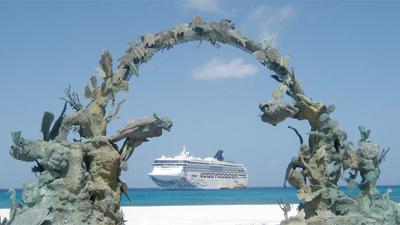
Four weeks later, after waiting in a long line, the McKann family boarded the towering ship that they hoped would take them on a great adventure.
“This cabin is awfully small,” Harry noted, looking around at the cramped but efficient room and bath he would share with his younger brother for a week.
“It’s compact,” Dad corrected. “Don’t worry, you won’t be spending much time in here.
“Our cabin isn’t much larger,” he said as the family moved next door. “Your sister will sleep in here with us on the love seat. It wasn’t easy booking beds for you three at the last minute.”
Not long afterward, a voice boomed into the cabin: “It’s time for your safety drill. Join us on your assigned deck.”
The family joined a milling crowd.
“What’s that funny thing above us?” Gabby asked as Mom strapped her into an orange life vest.
“That’s a lifeboat,” Mom answered.
“That’s what we have to get into if the ship sinks,” Harry said with a smirk.
“Is the ship gonna sink?” Gabby asked with a pout.
“No,” explained Dad. “It’s just a precaution.”
“When do we start having fun?” Mason asked.
The family had been waiting at an emergency station with other anxious passengers for 15 minutes while the crew finished checking details.
“I’m hungry,” Harry said.
“Be patient. In just a few more minutes, we’ll take you up to the food court,” Dad promised.
“Don’t worry, there will be plenty of food, even for a hungry teenager,” Mom assured them.
At the food court, Mason’s eyes nearly popped out as he noisily counted the many serving stations. “Look, there’s all kinds of fruit on that counter and sandwiches on this one and fried chicken on another and look at all those desserts. Can I eat all of this?”
“Maybe not all of it tonight,” Mom said. “Save room for some more good things tomorrow. I’ll be back in a moment. I’m going to check out the salad bar.”
The family quickly loaded up their plates. For a few moments, all were quiet except for brief sighs of satisfaction. Then Harry asked: “What’s there to do after supper?”
“We can all go swimming,” Dad suggested.
Harry yawned, “I mean, what’s there to do for a teenager?”
“There are movies and a dance party,” Mom suggested.
“What about me?” Mason asked.
“This cruise offers activities by age groups,” Mom said. “All can learn circus skills like juggling and plate spinning, only the skills get more difficult for the older groups. There are also sports and games and treasure hunts.
“I’d like to go on a treasure hunt,” Gabby said.
“I wish I was a teenager,” Mason sighed after looking at the list of activities. “I don’t want to hang around with 10-year-olds.”
“You’ll be a teenager in September,” Mom consoled him. “For tonight, you might want to check out the video games. We’re all going to bed early. I’m beat. Be back by 9 p.m., boys.
“You boys are on the honor system all week,” Dad added. “Do not leave your cabin after 10 p.m. without our permission.”
“That’s too early,” Harry protested.
“We said no,” Mom snapped.
***
Harry woke at midnight. Mason was gently snoring. Silently he got up. Soundlessly he opened the cabin door and walked out into the corridor.
Where should I start? he thought.
Harry found his way out onto a wide main deck and watched as the ship slipped through the dark estuarial waters that for 90 miles join the Mississippi River to the Gulf of Mexico. Climbing to the top deck, he watched a happy couple pointing to the stars. Lights from the tall petroleum refineries glittered onto the swirling water along the banks.
Harry watched a lone crewman swabbing the main deck while carefully avoiding areas where passengers might soon tread. Then he strolled into the six-story-high atrium at the center of the ship. He paused just long enough to listen to a few band tunes and watch couples dancing in the dim light. Bored, he strode past the colorful flickering lights of the casino.
They have no way of knowing how old I am, he thought.
As he turned to stroll through the doorway, a burly crewman gave him an unwelcoming glare. He quickly walked on past and back to his cabin.
Did you know?
Don’t want to bother going ashore? Many adults choose to enjoy themselves on the ship. People watching is always fun. They can shop at duty-free shops on board for clothing, jewelry, even buy artwork on some cruises. They can participate in events such as cooking classes; music and games are planned for “on sea” days.
Cruise ships are well-known for their delicious food. Some food is available 24 hours a day. Formal evening meals can include five courses. Specials such as lobster and prime rib are delivered with style and flair.
On many cruises guests may order as many different dishes from the menu as they wish. Informal meals are served buffet-style from stations at a cafeteria-styled restaurant. Meals can be enjoyed in glassed-in air conditioning or outside in the open air, in shade or sun. The number of mouth-watering choices can be amazing – from Oriental, Mexican and other popular ethnic items to roast beef, turkey with gravy, stews and soups. For those who want “a burger and fries” or pizza, casually eaten items are often served from informal stations around the ship.
Travelers do not have to gain weight on a cruise. Sensible choices abound. But watch out for the giant, freshly baked chocolate chip cookies.
Chapter 3 – A day at sea
The following morning, Dad posed a question to the family.
“Would you like a sit-down breakfast served by waiters or another trip to the food court?”
“I’d rather do the food court,” Harry said. “We can sit outside in the fresh air.”
As they ate, Dad explained: “Today we will travel all day. Tomorrow afternoon, we’ll arrive at the island of Roatan on the coast of Honduras.”
“So what do we do today?” Harry asked.
“This morning, your mother and I will relax by the pool,” Dad said. “We’ll drop Gabby off so she can have fun with the Starfish.”
“Real starfishes?” asked Gabby breathlessly.
“No dear,” Starfish is the name of the group of children from 6 to 9 years old. This morning they’ll be learning to paint circus scenes,” Mom said.
“That sounds like fun!”
“Boys, there’s a rock-climbing wall. You might want to take that on.”
Mason’s eyes lit up. “Really, Mom? Will they teach me how?”
“Piece of cake,” Harry said, yawning.
“At lunch, we’ll make plans for the rest of the day,” Dad said.
***
“I had so much fun,” Gabby said at lunch as Mom tried to dab thick spots of red paint from Gabby’s nose.
“You look like a circus clown,” Harry teased.
The afternoon flew by quickly. While their parents and Gabby napped, Harry and Mason went on a scavenger hunt and then played video games.
“Wear something special for dinner,” Mom ordered as she herded her reluctant sons back from the video parlor.
The boys looked at each other and groaned.
In the vast main dining room, supper was served under dimmed lights by waiters in immaculate uniforms. Their waiter spoke with a thick accent but seemed to understand English perfectly as he took their orders.
“What are all these forks for?” Harry asked.
“One’s for your salad and one’s for your main dish and the little one is to help you pull out crabmeat if that’s what you ordered,” Mom explained.
Just then Gabby knocked over her milk. The waiter noticed and quickly wiped up the mess, then brought her a clean plate with a fresh order of food.
“Wow, that’s service,” Harry said. “Wonder what he gets paid to move so fast.”
“He probably doesn’t get paid a wage like we do,” Dad said. “On most cruises, the servers get tips from the passengers at the end of the week, so his wage depends on pleasing us.”
“That’s not an easy way to make a living,” Harry said. “People can really be crabby.”
Dad looked at his watch. “It’s almost time for the magician to begin. You boys are welcome to join us or you can take care of yourselves.”
“I’d like to go,” Mason said.
“See you later,” Harry decided. “I’m going to walk off some of this food.”
“Be in your cabin by 10 p.m.,” Dad reminded. “I’ll be checking.”
Harry took a leisurely stroll around the ship. Starting on the top deck, he found a beauty shop and a spa where guests could be wrapped in avocado for $100 an hour.
I don’t even like to eat avocados, he thought.
Next, he discovered a disco for teens. How 1980s, he decided.
And so it went as he worked his way down nine levels. Finally he spotted a door that said “Employees Only.” The door was locked. As he walked away, the man who had waited on them at supper pulled out a card key.
“Hey,” Harry called. “I want to ask a question.”
He could see the man trying to stifle his impatience. “What would you like, sir?”
“If you only get paid tips, why do you do this job?”
The man couldn’t quite hide his surprise. He studied the boy’s face. Seeing Harry’s honestly puzzled expression, he answered: “I have a wife and children at home in India. I will spend six months at a time working and not even be able to see them. We work every day of the week and do the hardest work on Saturdays when we clean up from one group and prepare for a new group of passengers. At home I had no job. Here I can at least send money to my family.”
“Wow,” Harry replied, not knowing what else to say. “What’s your name?”
The man smiled. “My name is Dipak. Thank you for asking.” Then he quickly disappeared through the door.
Did you know?
Cruise ship crew members work for six months at a time. Cruises begin on Saturdays at 5 p.m. and end on the following Saturday at approximately 8 a.m. Within a few hours, the crew must clean cabins and common rooms, take out the trash and garbage and reload endless crates of fresh food for the next voyage.
Most of the service staff is paid by voluntary “tips” usually solicited at the end of a journey. This is a great incentive for the servers to treat travelers like kings and queens – and they do.
Crews may come from as many as 50 different countries. For some, English is a challenge but all have interesting stories to tell. Many come from economically depressed areas and quite a few have left family members behind. Cruise members get more than just a job. A cruise ship can be an education in diversity for passengers and crew alike.
Chapter 4 – Sea Spi and shipwreck
Low-slung buildings lined the streets of a port town on Roatan Island. Going ashore, the cruise crowd was greeted by costumed Hondurans and a band that played lively Caribbean songs. Soon, the McKann family headed toward Coral Cay Marine and Nature Park in a van, riding over bumpy roads.
“I’ve never seen water so blue,” Gabby crowed as she and Mom climbed aboard their double-wide floating Sea Spi. They stretched out on their stomachs and the guide showed Mom how to steer as they watched the shallow floor of the sea through transparent panels. Dad and the boys took single-wide craft.
“Does the sun shine here all the time?” Gabby asked.
“Most of the time,” the guide replied.
“Let’s go,” he shouted, leading the way to a quiet bay filled with water so clear that they could see mounds of colorful coral growing up from the sandy bottom, along with green sea grass that swayed as the tide gently moved in and out.
“What’s that?” Gabby asked pointing.
“That’s a crab skimming sideways along the sandy bottom,” Mom said.
“How do I make this thing go faster?” Harry shouted to the guide.
“Why would you want to go faster?” the guide softly replied. “You see more when you take your time.”
“That fish looks like a shark,” Mason called out.
“Don’t worry,” the guide answered laughing, “it isn’t. If it were, we’d all be moving faster. Keep looking and you may see turtles and stingrays as we go into deeper water.”
After a few moments, the guide suggested: “Let’s go see a shipwreck.”
Soon the rusted hulk of a large freighter loomed in the distance.
“Count how many kinds of marine life you can observe clinging to it,” the guide challenged. “The ocean is trying to reclaim it.”
Back on shore, the family played for a while on the warm sandy beach.
“I may remember this place as the most spectacular part of the trip,” Mom said with a contented smile as they sunned on the beach. “Hot sun, cool clear water, tropical trees in the distance, exotic creatures.”
“Now you sound like a travel ad,” Dad joked.
Mom, how come my skin is all red now from the sun but yours is still brown? Gabby asked.
“Some people sunburn more easily. You are like your father,” Mom said, pointing to his sun-reddened back. “Put on your shirt, Hal.”
When the van returned, they loaded in.
“Look at that pretty little church,” Mom said as they passed by the edge of town.
“It’s more than a church,” the driver said. “See the students in uniforms beginning to walk home? It’s also a school. Many years ago, we had no school and no books. Now church people from the United States send us books and teachers to teach us how to use them. We are very grateful.”
“The people look really different,” Mason whispered to Dad as they walked back to the ship. “Why?”
“Some are the descendants of African slaves, others were native to this area long before the Spanish arrived. Then the English came.” Dad answered quietly.
***
“I’m starved,” said Dad when they got back to their rooms. “Let’s eat at the Italian restaurant tonight.”
“I’m tired,” Harry replied. “I’d like to take a nap now and eat a burger later. OK?”
Mom and Dad looked at each other.
“OK with me,” Dad said. “But remember, I’ll be checking on you.”
***
Around 8 p.m. Harry woke with a start. A dark-haired young woman was quietly letting herself into the cabin. She was holding two towels, folded to look like frogs.
“So sorry,” she said. “I knocked but no one answered. I came in to do your turn-down.”
“Why do you do that?” Harry asked.
“To make our visitors feel more special,” she replied.
“Why are your eyes so red?” Harry asked.
The dark-haired young woman hung her head. “Please don’t tell anyone you noticed this,” she begged.
“Are you sick?” Harry asked.
“Another passenger just slapped me for not bringing her fresh towels quickly enough,” she blurted out.
“What’s your name?”
“I’m Marika.”
“Can’t you tell your boss?”
“If I tell, they won’t let me work again,” she said. “We are not to do anything that distracts you from your pleasant journey. Please do not tell.”
Did you know?
Where the shallow ocean floor is sandy or muddy, crabs may dart quickly across the sediments along with slow-moving sea stars and snails. Crabs wearing snail shells are known as hermit crabs. They can also be found on the sandy beaches.
Some fish and sharks prefer to live near the bottom, swimming just above the sandy floor. Other animals live buried in the sand or mud, such as clams, worms and sea urchins. Sea grass, which looks like a lawn of swaying tall grass, can also grow in sand and mud.
In tropical waters, coral reefs grow on rocky areas of the shallow ocean floor. Coral reefs are named after animals whose skeletons make up most of the reef rocks, but reefs are also home to hundreds of other types of animals and algae. Invertebrates like sponges, sea fans, worms, crabs, and echinoderms are common too. Many species of colorful fish swim through these reefs.
Chapter 5 – Bargaining
As the McKann family ate a formal breakfast the following morning, Harry said, “Have you noticed how some passengers order the help around or ignore them? Not many say thank you to the servers and most don’t even make eye contact.”
Mom looked up from her eggs with a start.
“No, I hadn’t thought about it. I guess like me they’ve been taught not to speak to strangers. Besides, many of the servers don’t speak much English and we wouldn’t want to embarrass them.”
“But they are real people just like us,” Harry protested.
“That’s true, son,” Mom agreed. “That is so true.”
***
Soon the cruise ship docked at an industrial area called Puerto Barrios, at the eastern corner of Guatemala. The vast port was surrounded by modest but prosperous-looking homes. As the cruise ship pulled in, the family watched cone-shaped mountains in the distance and the hovering clouds that promised no more than a quick jungle shower. Between the ship and the brooding mountains stood foothills covered by broad-leafed tropical trees and banana palms.
An hour later, they were seated in an open-air trolley. In the fresh morning air, the trolley took them to the center of the city of Santo Tomas de Castilla through narrow streets crowded with businesses, small shops and street vendors. Then a guide began to tell them the history of Guatemala.
“Long before Europeans saw this land, Mayans had constructed heavily populated cities throughout much of Central America. Thick jungles still conceal many of these early urban complexes under centuries of earth and tangled vines. Other cities and temples have recently been excavated and now speak of a culture that has never been forgotten by the Mayan people.
“Not much of this town survived after an earthquake in 1976. Even this old Spanish-styled church has been nearly rebuilt.”
The guide continued.
“By the late 1800s, several foreign countries had become aware of the agricultural possibilities. The United Fruit Co. was the most well-known. How many of you had a banana for breakfast this morning?”
Nearly everyone on the trolley raised a hand.
“One of the sweetest I’ve ever tasted,” a passenger shouted.
“It probably was grown in Guatemala,” the guide explained. “Our country produces most of the bananas sold. We also grow the best coffee in the world. Do stop in at the craft bazaar and pick up some bags of Guatemalan coffee as a gift for family and friends.”
“That would be easier to carry home than bananas,” Dad whispered.
After the tour, the large rectangular cultural center and bazaar with row upon row of small vendor stalls beckoned the McKanns. On the ship, they had been told that most vendors were willing to take half or even less than their originally quoted price.
“Look at that pretty necklace,” Gabby pointed out one decorated with brightly-faceted black stones.
“I’ll show you how it’s done,” Mom said.
“Quanto?” she asked the vendor.
“Forty dollar.” The vendor smiled appealingly.
“It’s pretty, but I think I will look around some more.”
“No, No. Stay! How much you pay?
“Fifteen?”
“No look, real onyx. I make myself. See?” The vendor picked up a mirror and scratched it with the edge of the center stone. “It makes deep scratch.”
Mom picked up a similar necklace. This one was trimmed with pieces of blue stone.
“Lapis lazuli.”
“How much for two?”
“Sixty.”
Finally, they settled on $20 apiece. “One for you and one for me, Gabby,” Mom said. “I have no idea if that was a fair price. I do hope that most of the profit goes to the vendors.”
Then they continued combing the stalls filled with local needlework, weaving, leather, jewelry and wood carvings. On a stage, local performers both Hispanic and Mayan played lively music and danced for shoppers’ entertainment.
“Aren’t those little kids cute?” Gabby said, as she noticed small children in the audience imitating the dancers.
Having gained confidence in her bargaining skills, Mom approached a woman selling silky scarves. Mom talked her down to $15 apiece but then decided to do some more looking before she bought.
“When you come back, it cost you $25,” the vendor threatened.
“Time to leave,” Mom said as she headed for the door.
Did you know?
In the early 1960s, Puerto Barrios became the primary base for the Guatemalan Navy. The port as it is today was built around 1976 after a severe earthquake destroyed older facilities along with many buildings in Santo Tomas. Cruise ships began visiting in 2004.
Guatemala has been inhabited by humans for at least 12,000 years, perhaps much longer. These inhabitants began to cultivate corn 5,000 years ago. The heart of ancient Mayan territory also includes the modern countries of Belize, El Salvador, Honduras and the Mexican states of Yucatan, Campeche, Quintana Roo, Tabasco and Chiapas. It is estimated that the population before Columbus included about eight million. Approximately seven million Mayans currently live in the area.
Before 1492, the Mayan civilization flourished and had little contact with other cultures. Then the Spanish conquistadors arrived. Later, Guatemala became part of the Mexican empire. In 1841 the country became nominally independent.
Some Mayans have adopted the Spanish-influenced culture of Mexico. Others continue to live a more traditional lifestyle. In Guatemala, people of Mayan descent comprise around 40 percent of the population. Many women continue to wear colorful traditional clothing that varies in style according to their local identity.
Chapter 6 – Restricted
Back aboard the ship, the family enjoyed an early supper and then were entertained by songs and dancers. Later, a crowd began gathering on the main deck. Bright lights flooded onto the dark shore and loud noises of moving machinery brought many out to see what was happening.
Harry asked around and learned that a shipment of fresh food had not arrived on time to be loaded on their ship in New Orleans, so the food had been trucked in many miles overland from the nearest airport in Guatemala. The captain of their ship had been forced to postpone leaving for their next destination.
Passengers watched as their crew, obviously not used to doing such a task, tried to load large containers packed in dry ice with a fork lift. The first crates tumbled and fell. Many of the smaller boxes were strewn along the pavement. The disorganized crew had to repackage the food and bring it aboard to the cheers of the crowd.
***
After Dad’s 10 p.m. check, Harry sneaked out and walked the halls again, hoping to see pretty Marika. When he found her between cabins, he smiled. She smiled.
“Where do you come from?” Harry asked, trying to figure out at the same time who she reminded him of, with her black hair and sweet face.
“I come from where we are going, from a small village near Costa Maya. Are you going to see the pyramids at Chacchoben?”
“Yes.”
“My home is near there. The name means the red maize we grow for food.”
“You are smiling. You must be feeling better,” Harry replied.
“Yes, the end of my six months is up when we return to New Orleans. I received a letter from my husband today assuring me that our children are doing well.”
“How old are you?” he asked with a puzzled frown. “I thought you were about my age.”
“I’m 19.”
“How many children do you have?”
“Two.”
Well, I guess she isn’t looking for a boyfriend, Harry thought as he said a polite goodbye.
***
The following morning the family spent two hours at a port in Belize. As the McKanns rode a Tender back to their cruise ship, they discussed their brief shopping trip.
“The only good thing about that stop was that all the vendors spoke good English,” Harry said.
“That’s because it used to be an English crown colony,” Dad said.
“I still can’t get over being told I could shop in that compound with a very high fence around it but not to step outside the gate into the country,” Mom said.
“They didn’t say we couldn’t,” Dad reminded her. “They warned us we shouldn’t because of the high crime rate.”
“What kind of country is that where we’re not even safe?” Mason asked. “Everyone there was smiling at us and being really friendly.”
“That’s because the people we met were mostly sales people and passengers from other ships,” Dad said. “I’m sure there are many honest people living in Belize but we have no way of knowing who is and who isn’t.”
“This afternoon, I’m going to the cooking show,” Mom said, changing the subject. “Gabby, you can help your group finish painting the props for the circus show if you want. Now what are you boys going to do?”
“I want to learn how to walk on stilts,” Mason said.
“I’ll just stroll around and see what’s going on,” Harry said.
“I’m going to take a nap,” Dad yawned.
***
While Mom and Gabby dressed up for a formal dinner, Dad pulled up an article on Belize that he had saved before the trip.
“It says here that Belize used to be part of a single country that included other parts of Mexico and Central America.”
“But why isn’t it safe?” Mason demanded.
“This article says Belize has the world's third-highest murder rate, with only Honduras and Venezuela being worse. Tourists have been among those murdered. Illegal drugs are suspected to play a part in the problem.”
“Will it be like that at the next stop?” Gabby asked.
“No dear. Costa Maya is in Mexico. I’m sure the Mexican government is more alert. The cruise lines don’t like bad publicity, so they won’t send us where it isn’t safe. You wouldn’t want to miss seeing a real pyramid, would you?”
“What’s a pyramid, Daddy?”
“You’ll find out tomorrow.”
Did you know?
“Before the 1700s, most of Central America was part of Spanish Mexico. In 1763, after the signing of the Treaty of Paris, Spain allowed British settlers to come in and set up a logwood industry. They brought thousands of slaves from Africa to cut logwood for dye and to export mahogany. The Spanish often challenged the British over control of the territory. It wasn’t until 1871 that British Honduras was formally declared a British colony.
Until 1981, Belize represented the last British colony on the continent. Belize independence was achieved on Sept. 21, 1981, and a constitution was introduced. The country’s name was changed then from British Honduras to Belize. The government still retains its link with the United Kingdom.
Chapter 7 – Welcome to the Jungle
The following day, the ship docked at the port of Costa Maya.
“These stores look new,” Harry noted as the family walked past a boardwalk of shops and small restaurants.
“They are,” Dad explained. “This whole area has recently been developed to welcome cruise ship passengers.”
At the end of the boardwalk, a smiling guide began his spiel.
“My name is Juan, as common a name in Mexico as John is in the U.S.” Addressing the dozens of people waiting to board the bus, he asked, “Have you ever wondered where the Maya people went?”
He smiled as he gestured graciously toward the group and asked, “Who told you they are gone? The people who built the now ruined cities at Tulum and Chichen Itza and many other places still undiscovered in the jungle, these Maya people still exist. Look around you. Some drive buses and others run tourist shops. They build homes and repair them when hurricanes hit. They farm, growing delicious pineapples and coconuts for their oil. They make medicines from local plants. They have partly been absorbed by an alien culture and are now struggling to regain their Maya identity.”
“Mom, how come he has hazel eyes and light brown skin?” Harry whispered as they climbed into the bus. “I thought all Mexicans were dark,”
“I am one of them,” the guide continued when all the passengers had been seated. “I am Mestizo, part Spanish, part Maya.”
“There’s your answer,” Mom whispered back.
“I was raised to be ashamed of my Maya blood by the dominant Spanish culture, but my Maya grandmother insisted that I be proud of my race. More and more Mayans are becoming aware of our noble heritage these days.
“Our ancestors discovered a counting system far superior to the ancient Romans – a system that included use of the zero in calculations. And they used it for a thousand years before Europeans discovered it.”
“Is that right, Dad?” Mason whispered. “I remember when we learned Roman numerals.”
“Shush,” Dad said. “I want to hear him.”
“We developed a calendar with 365 days in a year. That was far superior to the Julian calendar being used in Europe at the same time.”
“They did?” Harry mouthed.
“That’s amazing,” Mom whispered. “The Julian calendar had to be replaced by the Gregorian calendar that we now use because it was so inaccurate that spring on the calendar was arriving in the middle of winter.”
“So how come they knew more than our ancestors did?” Harry whispered.
“I’ve heard somewhere that they were amazingly accurate astronomers,” Mom replied.
Dad stared at the two of them and put his finger to his mouth with a shush.
“We are traveling through the district of Quintana Roo,” the guide continued. “We will soon reach the ruins of Chacchoben. That name means ‘The place of red corn’. We do not know what the ancient ones called their city. You may notice that this road runs perfectly straight headed south. There is only one curve in it for a distance of 40 miles.
“Enjoy your bus ride. I will tell you more when we arrive.”
The quiet passengers gazed out the window noticing the passing scene of flat, cultivated fields along the way. Through the windows, they could see that many local families lived in sheltered huts, some made in the traditional Maya pattern of horizontal sticks and thatched roofs while others were crafted from wood or tin. A few inhabitants lined the road selling fresh fruit, vegetables and crafts. Along the way, the random trees hung low to the ground, their growth stunted by wind and salt from the nearby sea.
Then the scenery changed and they were surrounded by heavy foliage on trees and shrubs.
“Is this a jungle?” Mason asked just as he spotted a squad of men in military uniforms carrying assault rifles. “Dad, who are those people?”
Mom and Dad saw them too and gave each other a dismayed look.
Quickly, the guide rose and pointed them out. “Don’t worry,” he explained, “they are Mexican soldiers. We are so close to Belize here that they must patrol the border trying to keep out migrants from the south.”
“Does he mean that Mexicans have border patrols to keep people out too?” Harry asked.
Did you know?
The earliest human settlements in the area of Chacchoben (chak-CHO-ben) have been dated at around 1000 B.C. Studies made during the excavations suggest that the city’s site was abandoned and reoccupied more than once, before finally being abandoned for good. Archeological evidence further suggests that even after the collapse of the Maya civilization in the 1200s when it was overrun by the Aztecs, the site of Chacchoben was still used as a ceremonial center. Rituals took place at the abandoned temples.
With the arrival of the Spanish conquistadors in the 1500s and the eventual conquest of what today is Mexico and Central America, there were major changes in the local religion and in general in the way the Maya population lived. For many years after, the Maya population in the Yucatan Peninsula lived at odds with the Mexican government. Many Maya families fled into British Honduras (now Belize) and Guatemala. Visits to Chacchoben ceased and the buildings were covered by the encroaching jungle.
Over the centuries, robbers have pillaged the region, removing artifacts and even carving out pieces of stone buildings. In recent history they have sometimes threatened local archaeologists who are trying to preserve the history.
Chapter 8 – An ancient graveyard
At the site of Chacchoben, the passengers of the air-conditioned bus stepped out into the steamy air of the jungle.
“Ugh, said Harry. “It’s only 10 o’clock in the morning. Why is it so hot already?”
“Why does the humidity feel so oppressive, Juan?” Dad asked the guide,
“There are a number of lagoons and low areas that are permanently humid or flooded during the rainy season,” the guide explained.
Soon Juan gathered the tour group together at the foot of a tall pyramid. “You are standing at the ceremonial center of this ancient city. Because of my training as a university educated architect, I understand how these structures were built. The excavators have found that in the earliest years, only a small rectangular temple existed at this site. The rest of the base was used as a courtyard for assembling the people.
“The settlement probably had less than 400 inhabitants in the beginning – perhaps as early as 200 A.D. Because these people had learned how to raise a steady food supply, the population gradually grew to as many as 20,000 by the year 1200 A.D. As the population increased, the pyramid was raised higher and wider. Rulers in later generations added wings and finally incorporated those wings into a pyramid that must have seemed like a mountain on this flat land. This pyramid has been carefully reassembled. The lines have been left to indicate where the renewal work has occurred. Juan held up a chart that showed how the pyramid had developed.
“Here at the base of the largest pyramid is a stone slab called a stella with Mayan hieroglyphic inscriptions. We believe we have translated the names of some of the gods at this site.
“Hey Grace,” Dad whispered, “Are you listening to this? You seem to be miles away.”
“There’s something familiar about that stella,” she whispered. “I know this sounds silly but I feel like I’ve been here before.”
Dad gave a puzzled frown.
“Why did the Mayans leave?” Harry asked.
“Around 1200, bloodthirsty Aztecs invaded. Many Mayans died, others fled to more remote areas. Then after 1492, the Spanish came and conquered with iron weapons and European diseases. Most of what we know about that time, or think we know, was written by the hostile Spanish who did not bother to learn from us. They only criticized our ways.
“Now, we will follow this circular path. Along it are three smaller restored pyramids, as well as many walls, staircases, streets, courtyards, gathering places and foundations of homes and storehouses.”
As the group strolled around the ruins of Chacchoben, Juan pointed out green clumps of trees covered with Spanish moss, palm trees and different varieties of orchids.
“Notice this tree with tiny flowers on it?” he asked. “A potion can be made from these flowers that can bring on visions. A tea made from the leaves can treat diabetes. My ancestors had their own pharmacy in the jungle. Palm trees like this one produce tiny coconuts rich with oil. In good years, builders in the community would trade the oil to other settlements in exchange for the hard jade tools they needed to work the limestone rocks that formed the common buildings and pyramids.”
He held out both hands in emphasis. “They accomplished all this construction without using a single metal tool.
“Is he ever going to stop showing us charts and diagrams and let us explore by ourselves?” Mason whispered impatiently.
“Listen and learn,” Mother whispered back.
“Excavation is continuing on several mounds known to contain other buildings. Some structures still bear traces of the red paint with which they were originally coated. There is continued research in the site and as you explore in small groups you may see ongoing work.”
“Did the Mayans practice human sacrifices?” someone else asked.
“Mayans never practiced human sacrifices,” Juan assured the group, sounding a bit defensive. “It was the Aztecs who brought the custom when they invaded. We were more likely to be the ones being sacrificed than the ones doing the sacrificing.”
Juan’s voice became softer. “This is the graveyard of many people who lived more than a thousand years ago. Please be as respectful as you would be at a cemetery in your own city or town.”
Mom gasped and grabbed Dad’s hand tightly.
Did you know?
In 1839, a lawyer from the U.S., John Lloyd Stephens, and an English artist, Frederick Catherwood, traveled to the Yucatan Peninsula to check out rumors of lost cities buried by the jungle. To their amazement, they found massive pyramids, exotic statuary and stellae inscribed with unknown hieroglyphs. After a key was discovered to help translate the ancient writings, much was learned about lore of the Mayans.
The artifacts of the Mayans are on display in many lands. There is an impressive display of pre-Columbian art at the St. Louis Art Museum.
The Yucatan's indigenous population was first exposed to Europeans after a party of Spanish shipwreck survivors came ashore in 1511. One survivor started a family with a local woman; he became a counselor among local tribal leaders.
For a few years, Spanish military leaders failed to conquer the Yucatan. European diseases, massive recruitment of native warriors from other regions of Mexico and internal hatred between tribal leaders eventually turned the tide and the Yucatan Peninsula also surrendered to Mexican forces.
In 1942 when Serviliano Cohuo, a Yucatec Mayan man wanting a place to farm stumbled across the ruins of a temple. He decided to settle down nearby and built his home at the base of the tallest pyramid. He married and had children The ruins of Chacchoben became their playground.
In 1972, Archaeologist Dr. Peter Harrison spotted the ruins from a plane and quickly investigated. The Cohuo family showed him the site. Later, the family agreed to allow a project sponsored by Tulane University and the Royal Ontario Museum.
In 1974 Quintana Roo was declared a new Mexican State, and the government started regulating landholdings. In 1978, Serviliano Cohuo, was designated honorary guard of Chacchoben and was granted his farm. Serviliano Cohuo passed away in 1991.
In June 1994, under the auspices of the INAH (National Institute of Anthropology and History), a new restoration project began. A Mexican Archeologist Juan Rique conducted excavations and restoration of some of the buildings. In October 2002, the restored complexes were officially opened to the public. Restoration work continues.
Chapter 9 – Practicing Spanish
With the formal tour completed at Chacchoben, the McKann family split off from the crowd and headed down the path toward the densest part of the jungle.
“Glad we brought bug spray,” Mason said as he dusted a strange-looking insect off the back of Harry’s shirt.
“It feels kind of spooky here,” Gabby said. Just then an animal let out a bone-chilling scream from a high tree. Harry jumped back and looked up. “What was that?”
“Look,” Mason called. “There’s a couple of skinny little monkeys swinging through the trees.”
When they spotted a worker carefully removing dirt and plants from some dressed stones, Harry asked: “Habla Espanol?”
“Si,” the worker replied.
In broken Spanish, Harry continued: “We just saw monkeys and heard a scream.”
The worker replied in Spanish.
“What did he say?” Gabby demanded.
“He said that what we heard was probably a howler monkey but what Mason saw were spider monkeys. Howler monkeys hide from humans.”
“Ask him if there are any dangerous animals around here,” Mason said.
After waiting for a reply, Harry translated: “He said there can be jaguar, ocelot, puma and tapir living in the less populated parts of the jungle but nothing to worry about in a busy place like this.”
“What other animals live here?” Mason wanted to know.
“They mostly see deer, wild pigs, armadillo and an occasional gray fox,” Harry translated. “Looks like my three years of Spanish class just paid off.”
“Gracias, Amigo,” Harry thanked the worker as they walked on.
“De nada,” the man replied.
“Hal, you take the boys to explore the other temples. I’m not up to climbing to a breathtaking view of the jungle, as the guide described it, since it involves doing so at our own risk. Gabby and I will look for more orchids to take pictures of on the way back to the bus.”
“Why are you so quiet, Mom?” Gabby asked as they stopped to look at various plants. “Why is everyone so quiet?”
“For me, this really is like visiting a graveyard, Gabby. Seems I can almost hear their spirits whispering to me. And don’t tell Dad but back at the big pyramid, it seemed like I could see a large man dressed in strange clothes standing at the top looking down on us.”
“You’re weird, Mom,” Gabby said.
***
Gabby was giddy with enthusiasm as the ship headed for Cozumel that night.
“I can’t wait to play with the dolphins,” she said.
“They are just big fish,” Harry teased.
“I’ve heard they are really friendly and smart,” Mason added.
The following morning, the family had only a short time to walk along the crowded beach at Cozumel and visit a few of the numerous shops before catching their tour bus.
Then something caught Mom’s eye.
“I really want to buy the Mayan calendar in that store, Hal.”
“Quanto?” she asked a clerk.
“Three hundred fifty U.S. dollar,” the salesman replied, after getting on a ladder to check the back.
“No way,” Hal said. Grace turned to go.
“OK, we offering a discount today. Let me check.” The clerk conferred with someone else.
“I can give you for $250.”
“No!” Dad said.
And after a pause in which Grace studied the colorful piece, Hal demanded: “Let’s go, Grace.”
Grace looked disappointed.
“Wait, WAIT! – What you give me for it?” the salesman countered.
“I’ll give you $100.” Hal used his firmest voice.
“Can’t do. How about $150?”
“No.”
“Well then I give you for $120. You said you would pay me $120.”
“No, I didn’t.” Hal replied. “I said $100.”
Harry ran outside, then came back and breathlessly said, “We’ve got to go. Our bus is leaving.”
The family turned and started to leave.
The clerk caught them on the front steps.
“OK, OK, I give you for $100!”
Dad chuckled: “Good save, Harry.” he whispered.
“I learned from the last place,” Harry replied.
“I would have given him $200,” Mom said as they walked on. “I really like this calendar.”
***
When they found the storefront where they were to meet their dolphin tour, to Gabby’s great disappointment they were told that the attraction was closed because of a brewing storm.
“What storm?” Dad asked.
“Go back to your ship now,” the clerk said in broken English. “It may be a bad one.”
Did you know?
Circled around the “Time Bearer” are glyphs representing the Mayan 365-day year. Eighteen of these “months” each contain 20 days. The nineteenth “month” contains five.
The single-circle calendar is the easiest to understand of the several different ways the Mayans kept track of time. Their astronomers used a calendar of meshing, repeating cycles. Any day on these cycles would not repeat for 52 years.
A third system allowed Mayan mathematicians to project their combination of calendars millions of years into the past and the future. Archeologists have discovered that the Mayans began counting time as of Aug. 31, 3114 B.C. The present calendar ended in the year 2012 and a new cycle began.
Chapter 10 -- Too much rocking
Back on the ship, an announcement caught the McKanns’ attention: “A storm that has involved most of the central U.S. will soon be upon us,” the captain stated. “The ship will be safer at sea than in port where massive waves could drive it ashore, so we will leave and keep our schedule. We will be encountering the storm beginning about 9 p.m. tonight. Seasick pills will be available at the desk for anyone who may want them. We urge passengers to stay in their cabins after that time and wait until the ship has passed through the storm.”
“I’ve been on a dozen cruises and never heard an announcement like that,” a nearby woman said. “Sounds serious.”
***
The family ate supper at the food court. Hal and Grace decided to attend the early entertainment at the theater afterward.
The boat began rocking around 10 p.m., just as Hal and Grace were returning to their cabin. They laughed as they staggered to keep their balance and then noted that even the cabin servers were swerving down the halls.
The boys were lying in their beds when their parents checked. Mason was sleeping; Harry was playing a video game. Gabby was sitting on the floor with a frown on her face.
“I feel sick,” she said.
“We’ll take Gabby with us now.” Mom said. “Are you boys sure you will be OK in here by yourselves?”
“No big deal,” Harry said.
***
By midnight, it had become a big deal. As the boat headed north toward New Orleans, the gale drove in from the northwest. Rain lashed at the portholes. The ship would tip away from the driving wind and then right itself again with nauseating regularity. An hour later, huge waves began splashing up as high as the McKanns’ porthole.
A knock on the door alerted Dad. Both boys were standing there holding tightly onto a rail.
“Um, can we come in and sleep on your floor, Dad?” Harry asked sheepishly, clutching a blanket and pillow with his other hand.
“If we’re all gonna die, at least we should be together,” Mason added with a sob.
“I thought these ships were so big waves didn’t bother them,” Mom groaned.
“This is no average storm, Grace,” Dad advised. “In the meantime, let’s keep praying for our family and the others on board.”
***
“Is anyone hungry?” Harry asked as a hint of morning light finally broke against the storm.
“Are you kidding?” Mason replied.
“Is it OK if I take a walk?” Harry asked.
“You may if you can,” Mom groaned.
No one was in the halls except a few cabin attendants carrying clean towels. Guess a lot of passengers are seasick, Harry thought. Wonder how many of the crew are, too.
One sandwich bar was all that was open. Harry sniffed at the food and then shuffled away without interest.
“Don’t you get seasick?” he asked Marika as she passed him carrying a steaming teapot.
“Don’t have time to,” she replied as the ship tilted and she staggered to catch her balance.
As the day progressed, the storm slowly diminished. But it was 3 p.m. before Mom rolled out of bed. “I’m finally getting hungry. I can’t believe I’ve missed two good meals on this cruise ship.”
“A waiter told me the last time I took a walk that the dining room will open at 5 p.m.,” Harry said.
The family crowded into the tightly packed dining room and ate their first meal of the day.
“How soon can we get off this boat?” Mason whined. “I don’t think I will ever get on another one forever.”
“We’ll be in New Orleans by tomorrow morning,” Mom said. “Please remember that bad storms like this don’t happen very often.”
***
Home safely, family members spent the next two weeks sharing photos and the highlights of their trip with others.
“I learned something today that surprised me very much,” Mom said at supper one night. “I was showing my grandmother photos of our visit to Chacchoben. Grandma became very excited when I described the ruined city. And then she told me that her mother had immigrated to the U.S. from that area when she was a girl.
“Really, Mom?” Harry said, “I noticed that a cabin server named Marika who came from there reminded me of you. Wow, knowing about your ties to that area makes what I learned on the trip a lot more interesting and personal. And if you are distantly related to the Mayans, then so am I.”
“I wonder if there is some kind of DNA memory,” Mom said, “because while we were at Chacchoben, I felt something that I’d never felt before – a grief and joy mixed together and the sensation that I had found my way home.”
Did you know?
In the 21st century in the Mexican states of Campeche, Yucatan and Quintana Roo, as many as 1.2 million people speak the Mayan language. Three times more are of Maya origins and hold ancient Maya surnames.
Maya people living in the U.S. have been organizing language lessons and Maya cooking classes since 2003 in California and other states.