
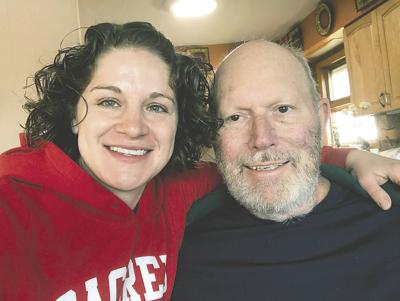
While Steve Blaha of Hillsboro was isolated in the hospital for nearly three weeks battling a severe case of COVID-19, his daughter Erin Muth found it deeply distressing not being able to easily communicate with him.
So, she decided to do something to help patients like him, as well as the families struggling to keep in touch with their sick loved ones.
Blaha was treated at SSM St. Clare Hospital in Fenton, where he spent much of his stay in the intensive care unit (ICU) on a respirator.
Nurses at the hospital helped the family talk to him over his cell phone, but that system wasn’t good enough, Erin said. “The nurses charged his phone, and we did a Facebook chat with him,” she said. “My kids got to sing to him, talk to him. He couldn’t see us, but he could hear us.
“A nurse said, ‘It would be nice if we had enough iPads to have one in each patient’s room, and that’s what started me down the road to getting them,” she said.
Erin, 34, a neonatal nurse, and her husband, Andrew, a doctor who works with the local VA near their Iowa home, are the driving force behind a campaign that has raised more than $25,000 to provide iPads to SSM Health care facilities in the St. Louis area.
More than 70 of the tablets have been donated, targeted for use in the rooms of COVID-19 patients who are under quarantine.
New methods
Blaha was a week away from his 65th birthday and retirement when he was laid low by COVID-19. He contracted the virus in mid-March and by the end of the month, he was in the ICU, comatose and under a “do-not-resuscitate” order.
“The doctors told us that, from a statistical standpoint, people at this stage of the disease didn’t make it,” said Erin, 34. “They said efforts to revive him would just prolong his suffering.”
Dr. Timothy Pratt, chief medical officer with St. Clare, said Blaha’s illness followed what has become a familiar course.
“He had the classic seven-to-10 day pattern,” Pratt said. “The tendency among some cases is to get worse very quickly, and within 24 hours to be intubated. Our information at that time was that roughly 95 percent of those intubated wouldn’t live.”
But something kept Blaha from crossing that last line, and he is now recovering at his home, working hard to regain the massive muscle loss and nearly 30 pounds of weight his illness cost him.
His family is convinced what turned the tide for Blaha was their support, expressed over a precariously jerry-built chain of communication involving nurses and cell phones.
Illness quickly turned grave
Blaha’s illness started with what he and his family thought was a sinus infection.
“He was feeling bad Sunday night, March 15. By Wednesday, he had fever,” Erin said. “By Friday, he was taking five-hour naps, and was not rousable.
“Early in the morning on Saturday, March 21, my mom took him to the ER at St. Clare, and they admitted him on oxygen. Things went downhill quickly, and the next morning they put him on a breathing tube.”
With each day, he required more medication, higher ventilator settings, and his kidneys began to fail.
“He was on three different medications to keep him sedated,” Erin said. “They even had him chemically paralyzed at one point because when he’d wake, he’d cough against the tube.
“His heart stopped at 5 a.m. on the 27th and they got him back, and that’s when they recommended we make him DNR (do-not-resuscitate).”
That evening, as he clung precariously to life, Blaha’s family communicated with him the best way they could.
“A nurse held his phone up to his ear so we could talk to him,” Erin said. “My mom had to meet somebody in the parking lot and they put a phone on a tripod so she could see him.”
And then, the unexpected happened. He began to improve.
“I feel like the interaction made the difference,” Erin said. “You could argue that the disease had run its natural course, but in my heart of hearts, I feel like the interaction with us gave him that little extra something it took for him to beat it.”
Linda Blaha, 65, has a similar belief.
“They say people remember what happened when they were in a coma,” Linda said. “I believe that. I’m also strong in my faith, and I believe if he was meant to come back, he would, whether he heard us or not.”
Blaha’s recovery, once jump-started, was rapid.
“He improved all week, and by April 4, he got his breathing tube out,” Erin said.” I woke up to a call from the nurse, and I heard him say good morning. He was hoarse, but it was him. It was 4:30 in the morning, and the nurse said she tried to hold him off, but he just couldn’t wait.”
Communication crucial
part of care
“It’s important for the family and the medical team to work together for the good of the patient,” Erin said. “Being able to see and hear family might help reduce patients’ anxiety levels. When my dad started to get better, one of the first things we wanted him to know was that we are all OK. He had been so out of it; for all he knew, we might have all been in the hospital or dead or whatever.”
Erin said her dad suffered bouts of confusion as he began to recover.
“That’s common with people who spend a long time in ICU,” she said. “Research shows that one of the best things to help that confusion go away is interaction with other people, and that’s exactly what coronavirus patients don’t get.”
Pratt said the onset of the coronavirus pandemic shifted the hospital’s way of thinking about patient and family communication.
“Communication is normally good between the family and the patient’s medical team,” he said. “But when this started, we suddenly became a very closed campus. With everything locked down, suddenly communication is cut off, and we have had to change a lot of things about our daily process.”
Hospital staff needed to embrace technology in a new way.
“Because we had such good in-person communication, we never really considered things like Skype, Zoom, all the modalities that are second nature now,” Pratt said. “Patients used those things to keep in touch with family members out of town, but it wasn’t something we routinely used.
“Erin realized how being able to communicate with his family was one of the things that turned it around for her dad, and she has been terrific about getting the iPads.”
Pratt said hospital staff members are grateful for the iPads, which add another dimension of care.
“There have been so many changes over the last 30 days in the way we treat this disease as we learn more about it,” he said. “We’ve got (the tablets) into service, and the staff is getting better at using them. We really appreciate her generous gift at a time when our processes are changing so rapidly.”
Snowball
Erin said she just wanted to help other families going through the same scary process. “If my dad had died, I wouldn’t have ever said, ‘I love you’ or ‘good-bye’ to him,” she said. “Maybe with these iPads, people will get a chance to talk to their loved ones. It might give them the will to survive, or at least the comfort of knowing everything is OK and saying good-bye before they go.”
Erin and her family donated the $8,000 needed to order the first batch of tablets.
“The hospital put me in touch with the SSM Foundation,” she said. “They are buying the iPads from Apple at a good price.”
The Muths contacted family and friends, who spread the word about their campaign.
“Everybody was super excited about it,” Erin said. “People needed a way to donate online, so we made a GoFundMe account and it was immediately a huge hit. Everybody posted it to their sites and linked it, and we got people donating who we didn’t even know.”
The original goal of $10,000 was quickly surpassed, then $20,000. The latest goal is $30,000.
The first 25 iPads were purchased, set up and in use at St. Clare by the time Blaha was discharged on April 10.
The next batch of tablets has been distributed to other local SSM health care facilities, including DePaul Hospital and Cardinal Glennon Hospital for Children.
“We got a letter from the president of the Foundation, thanking us,” Erin said. “And a lady wrote us and said that the iPad gave her a chance to say good-bye to her grandfather before he passed away.”
On the mend
Steve and Linda Blaha are sticking close to home these days. She also tested positive for the virus, but experienced only mild symptoms. Both are now considered non-contagious.
Now, Steve Blaha is working on regaining his strength and endurance, and occupational and physical therapists visit frequently to help him work on rebuilding muscle mass and regaining self-care skills.
“He is off the oxygen and using a cane only now,” Erin said. “He has a stationary bike.
“It’s coming back, but it’s baby steps. His goal is to be able to get into his golf cart and go down to the dock and fish, which is what he loves. He is hoping to do that this week.”
Once her husband feels up to it, Linda said, both of them plan to donate their plasma for use in treating newly diagnosed COVID-19 patients.
Steve Blaha’s birthday on March 28 passed with little fanfare, so the family is planning a big celebration in May, if circumstances permit, to celebrate not only his birthday, but his recovery and retirement. He has worked for 46 years at the Ameren power plant off Telegraph Road in south St. Louis County.
“He works on the maintenance crew,” Linda said. “Nine of the 13 people on the crew tested positive (for coronavirus), and four of those got sick enough to go on a respirator.”
Linda said she still finds it hard to believe how sick her husband really was.
“A guy like him – so robust, so healthy – it’s really weird,” she said. “We had a lot of trouble conceiving Erin; I call her our little miracle. And now this? It’s crazy; one family doesn’t get two miracles!”