
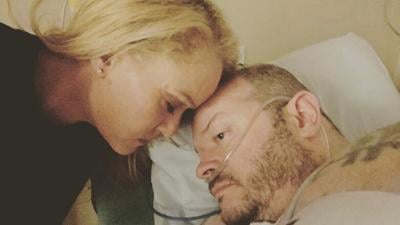
Former Arnold Police Officer Ryan O’Connor, 48, once again has proven he is a survivor.
Dr. Jeremy Leidenfrost, a cardiothoracic surgeon at St. Luke’s Hospital in Chesterfield, said today (Feb. 16) that O’Connor is recovering after being treated for COVID-19 and double pneumonia.
“Everyone is incredibly grateful that we took him on as a patient, knowing it was likely not going to be a good outcome. He proved us wrong,” Leidenfrost said. “We did it because we felt like we needed to, and he pulled through to everybody’s surprise. It is always a huge morale booster to the staff and everybody when things surprise you and end up going well.”
O’Connor was shot in the head by a burglary suspect in December 2017 and after a long hospitalization and extensive rehabilitation, he regained the ability to walk a little and talk.
He ended up in the hospital again on Jan. 16 with COVID-19 and double pneumonia, his wife, Barbara O’Connor, said in a text message.
Leidenfrost said Ryan O’Connor was transferred from another hospital to St. Luke’s and placed on an ECMO (extracorporeal membrane oxygenation) machine and a ventilator on Jan. 31 and was removed from the ECMO machine after 10 days and then was removed from the ventilator on Sunday (Feb. 13).
“The guy is alive because his wife is a fierce advocate for him,” Leidenfrost said. “She wanted to make sure there were no other options. I think a lot of people were willing to step up for him, knowing that he basically gave his life for public service. He was shot in the head and had a traumatic brain injury from that. I think a lot of people were willing to go the extra mile to just give him a chance.”
Arnold Police Chief Bob Shockey said it is amazing that O’Connor has twice recovered from a life-threatening situation.
O’Connor was shot while transporting burglary suspect Chad Klahs, 29, to the Arnold Police Station after he was arrested. Authorities said that after Klahs shot O’Connor, Klahs shot himself and died. The shooting happened on the Arnold Police Department parking lot inside a police SUV O’Connor was driving, and after the shooting, the vehicle crashed into a fence and propane tank.
O’Connor was 44 at the time of the shooting.
“He is a fighter,” Shockey said. “We are so glad he is on the road to recovery. He is a strong individual, and we are proud of him for fighting through this.”
Leidenfrost said Barbara reached out to him after her husband was not improving at the first hospital where he was being treated for COVID.
“His wife met one of our perfusionists (someone who operates a heart-lung machine) at a rehab years ago,” Leidenfrost said. “They connected. When O’Connor wasn’t doing well, she did her own research, and I think she read about ECMO and found out it is like a last resort to try to save someone with bad COVID-19, pneumonia.”
Leidenfrost said at first he was hesitant to treat O’Connor with an ECMO machine.
“(Ryan) had multiple organs down,” he said. “Not only were his lungs not working, but his kidneys were not working very well. Usually, we don’t put people on ECMO anymore for COVID-19 pneumonia who are also in acute renal failure.”
Eventually, though, Leidenfrost asked Barbara to have her husband transferred to St. Luke’s to see if there was something he and the rest of the staff could do to help him.
“I had to check with the nursing staff and nursing managers to make sure they would be able to get people in to take care of him,” he said. “ECMO is very resource intensive. It takes a lot of skilled nurses to take care of and know how to manage a patient like that. The nurses stepped up and agreed to come in and work extra.
“It was a hard decision to make. The risk of not surviving was so high.”
Leidenfrost said he did not know if O’Connor had been vaccinated against COVID. He also said he does not know why O’Connor responded to the treatment well and survived.
“We don’t know honestly,” Leidenfrost said. “There is no good data that shows who lives and who doesn’t.”
Leidenfrost said he expects O’Connor to remain at St. Luke’s for another week or so and then he will be transferred to a different rehabilitation facility or sent home to receive rehab treatment. He said O’Connor seems “pretty subdued” since regaining consciousness.
“I think he may be in some shock with everything that has happened,” Leidenfrost said. “He is pretty quiet. He doesn’t have a lot to say. I think he is incredibly grateful when his wife and kids come in. That really lights up his day.”