
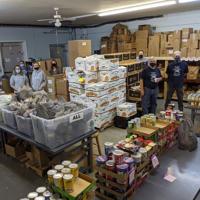
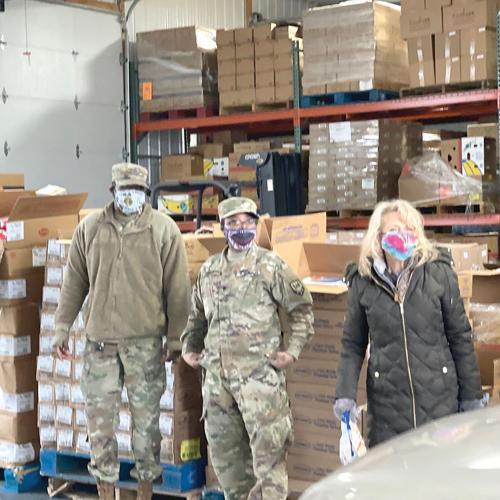
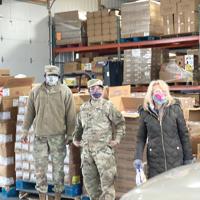

Volunteers at the Peace Pantry in Cedar Hill conduct drive-through distributions.
Leaders of area food pantries said the need for their help has continued to grow during the COVID-19 pandemic, and fortunately, donations and other sources of support have carried their organizations along.
Ed Fitzhenry, executive director of the Arnold Food Pantry, 2024 Key West Drive, said early in the pandemic people lost jobs, pushing up the numbers of families who came to his organization for assistance
“Initially, we saw a surge of new clients, people who lost their jobs,” Fitzhenry said. “We serve about 400 families. We had, maybe, a 20-percent increase in clients in March and April (2020).”
Those seeking help from the pantry decreased after a few months, however, he said.
“As the stimulus money started and free food giveaways from various organizations happened, we saw our numbers drop below normal,” Fitzhenry said. “Slowly, the numbers are creeping back up to normal.”
He said donations have helped sustain the Arnold Food Pantry during the pandemic, when in-person fundraising events have been virtually eliminated due to social-distancing regulations.
“We rely heavily on fundraisers,” Fitzhenry said. “We’ll have five or six in a normal year. All were canceled during the pandemic. But, the community – Arnold, Imperial, Barnhart, south (St. Louis) County – really upped their game with financial donations, as well as food donations. We also had grant opportunities.”
He said keeping volunteers has been a challenge, though.
“Many of our volunteers have stayed away,” he said. “We are thinned. But, we finally got some new volunteers. Many of them are people who are staying home from work and have more time to help. Now, as it seems like the pandemic is getting under control, we’re seeing a new influx of volunteers.”
Fitzhenry said he believes he sees more optimism at the Arnold Food Pantry that life could be getting back to normal in the not-too-distant future.
“We’re doing what we’re supposed to do,” he said. “People who need grocery items are getting them. We may have a fundraiser in June, although I suspect many people will remain leery of public events.”
Eureka Food Pantry
During the pandemic, the Eureka Food Pantry has adapted its rules to accommodate the families who need help, director Audrey Bell said.
The pantry operates out of the basement of the River at Eureka Church, 215 N. Central Ave.
“We normally allow people to come once a month (to the pantry’s food distribution),” Bell said. “But, because of the pandemic, we gave food to anyone who asked.”
Before the pandemic, the Eureka Food Pantry assisted about 150 individuals or families each month. Those numbers decreased during the early stages of the pandemic, but then began to return to normal levels, Bell said.
“In March 2020, we had about 70 individuals or families come for food. It stayed that way until summer, when our numbers started to come back up. We were seeing more families with multiple people.”
Bell said that since fall 2020, the pantry has averaged about 125 individuals or families coming to it for food donations.
She said the number of volunteers at the pantry remained fairly constant, but with different people.
“We had some volunteers who are elderly or infirm stop coming,” she said. “At the same time, we found there were others willing to help. When a volunteer dropped out, there was somebody waiting in the wings to take over.”
Similarly, while some sources of food donations dropped off during the pandemic, others took their places, Bell said.
“I’ve seen a whole lot more individual donations,” she said. “Neighborhoods held competitions (of food drives). Police and fire had competitions. We never had to close our doors.”
Peace Pantry
At the Peace Pantry, 8100 S. Industrial Drive, in Cedar Hill, board president Linda Schroeder sees the good that has accompanied the struggles brought on by the pandemic.
“I think the pandemic has helped the pantry,” she said. “It helped us grow together in a crisis. We lost some volunteers, many of whom are older, because of health concerns. But, others pitched in more time.”
Schroeder said early in the pandemic, the number of people seeking food from the pantry decreased. However, the numbers are increasing now.
“Weekly, we would get 200 to 250 families seeking help at the Peace Pantry (prior to the pandemic),” she said. “I think for a period of time our numbers dropped off. Our numbers are returning to normal.”
Schroeder said the Peace Pantry’s distributes food to those who qualify financially on Wednesday and Thursday, but on Fridays the organization gives out perishable items to anyone who lines up for drive-thru service.
“We give it out until we’re out,” she said of the Friday distribution. “We’ll have 600 families drive through.”
Schroeder said donations from the public and businesses have helped the program continue its mission during the pandemic.
In addition, funding through the federal CARES (Coronavirus Aid, Relief and Economic Security) Act has helped the Peace Pantry, she said.
“Because of the CARES Act, we were able to make improvements to our commodity room,” Schroeder said. “We were able to get a scanner to take temperatures. We got fencing around our garbage cans.”
She said the Peace Pantry is also working to help its clients who seeking COVID vaccinations.
“The only worry we have right now is we have many clients who can’t read and write,” Schroeder said. “We’re getting Northwest High School students to help those who need help to sign up for vaccinations.”
De Soto Food Pantry
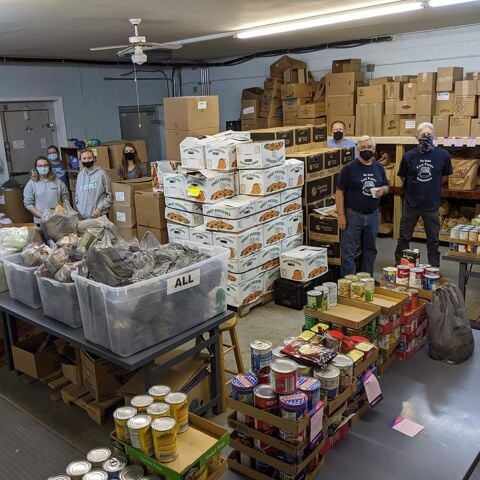
De Soto Food Pantry
Jan Bowden, director of the De Soto Food Pantry, 705 E. Stone St., said her organization also has weathered the pandemic, thanks to the generosity of donors.
“We didn’t have our normal food donation (events), like from the Girl Scouts and the Post Office,” Bowden said. “But, local businesses have been helping. De Soto is really good about that.”
She said the De Soto Food Pantry, like the other pantries, saw its number of volunteers decline during the pandemic.
“We normally have around 20 volunteers,” she said. “A lot of our volunteers are older and they have concerns of getting COVID.”
She said “five or six” of the pantry’s older volunteers stopped participating because of COVID concerns.
Bowden said the number of clients who come to the De Soto Food Pantry has risen and fallen over the course of the pandemic.
“We would do 150 to 160 families before it hit,” she said. “We’re at about 125 families now. It’s fluctuated. I’m not sure if people are afraid to come out or, maybe, it’s because of stimulus.”
Eureka Food Pantry
During the pandemic, the Eureka Food Pantry has adapted its rules to accommodate the families who need help, director Audrey Bell said.
The pantry operates out of the basement of the River at Eureka Church, 215 N. Central Ave.
“We normally allow people to come once a month (to the pantry’s food distribution),” Bell said. “But, because of the pandemic, we gave food to anyone who asked.”
Before the pandemic, the Eureka Food Pantry assisted about 150 individuals or families each month. Those numbers decreased during the early stages of the pandemic, but then began to return to normal levels, Bell said.
“In March 2020, we had about 70 individuals or families come for food. It stayed that way until summer, when our numbers started to come back up. We were seeing more families with multiple people.”
Bell said that since fall 2020, the pantry has averaged about 125 individuals or families coming to it for food donations.
She said the number of volunteers at the pantry remained fairly constant, but with different people.
“We had some volunteers who are elderly or infirm stop coming,” she said. “At the same time, we found there were others willing to help. When a volunteer dropped out, there was somebody waiting in the wings to take over.”
Similarly, while some sources of food donations dropped off during the pandemic, others took their places, Bell said.
“I’ve seen a whole lot more individual donations,” she said. “Neighborhoods held competitions (of food drives). Police and fire had competitions. We never had to close our doors.”