


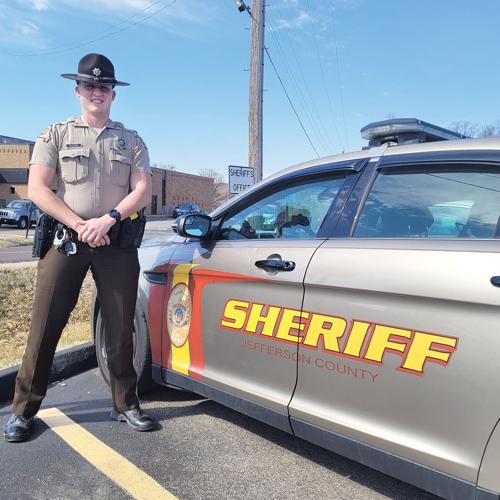
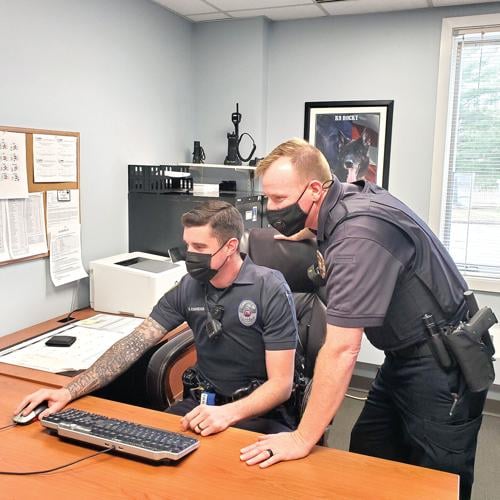

Jefferson County Sheriff’s Office deputy Noah Hillberry
As the COVID-19 pandemic set in across the region, law enforcement officers, firefighters, paramedics and emergency medical technicians had to figure out how to protect the public they serve, as well as themselves.
Jefferson County’s first confirmed COVID-19 case was reported on March 23, 2020, and St. Louis County’s first confirmed case was announced March 8, 2020.
As more cases were reported, there were restrictions on gatherings and how businesses could operate, and through it all, first responders never stopped protecting the public, although they, too, had to make some adjustments.
“We still had a job to do, and (the COVID-19 pandemic) didn’t limit our ability to do the job, whatsoever,” Jefferson County Sheriff Dave Marshak said.
Eureka Fire Protection District Chief Greg Brown said it’s been a difficult year, but things are starting to look up.
“Our world has been turned upside down,” he said. “It has been very tough to keep things moving and going forward, but I think we are at a point where we are seeing light at the end of the tunnel. The vaccines, while there have been problems getting them out, they are becoming more consistent and opening up additional tiers. I think we are heading in the right direction.”
Law enforcement

Arnold Police officers Brian Eskridge, left, and Sean Kennedy work in the Police Station while wearing masks to stem the spread of COVID-19.

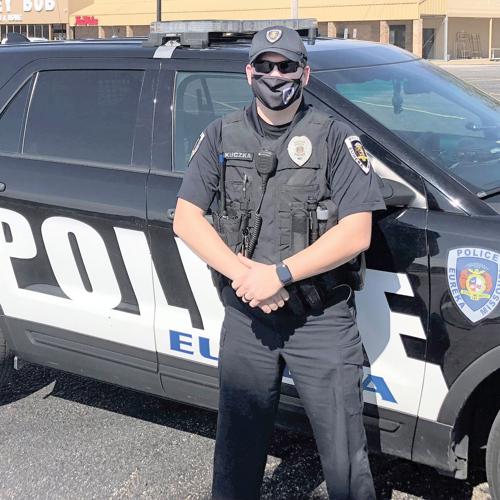
Eureka Police Officer Joseph Kuczka
Festus Police Chief Tim Lewis said first responders are trained to deal with all kinds of situations, but COVID-19 was difficult to combat because at first so little was known about the virus.
“It was on-the-job training,” said Lewis, who oversees 29 officers. “We train for catastrophes, car wrecks, plane crashes, shootings and things of that nature. Those are actions that happen and are tangible events. What was unique about this was the silence of it and you never knew where the attack was coming from.”
Byrnes Mill Police Chief Frank Selvaggio said the pandemic has been the longest lasting negative event in his 40-year career. He said early in the pandemic, he set strict operating parameters for his officers about limiting contact with the public and each other when possible and wearing personal protective equipment.
Selvaggio said as the year progressed and more information about the virus became available, some restrictions have relaxed.
“We were taking minor reports over the phone for things like a stolen license plate off a car,” said Selvaggio, who oversees 12 officers. “Now, we are of the mindset that officers can go to the residence or business as long as it has been established there are no positive COVID cases. The officers wear masks and stay outside to get the information.”
Most law enforcement officials said taking reports by phone instead of in-person for non-violent, non-life-threating calls was likely the most obvious change in procedures residents would have noticed.
Other changes police departments made were less obvious to the public.
At the Arnold Police Department, officers went through roll call in the parking lot, and there were limits on how many officers could be in the station at the same time, Major Brian Carroll said.
He said officers worked split shifts to limit the number of possible exposures if anyone contracted the virus, and officers tried not to be the first people to enter a home or business for non-emergency medical calls.
Carroll said Arnold’s 55 officers are still required to wear face masks while dealing with the public, but the department recently lifted a restriction against officers eating inside restaurants while on duty.
“I think we have gotten through this pretty well,” Carroll said. “It is amazing to see our officers step up and volunteer to cover shifts when needed. For a few weeks I literally carried a schedule in my back pocket waiting for the next phone call to place an officer in quarantine. Through the help of everyone, we were somehow able to maintain our mandatory staffing to cover our streets.”
Eureka Police Chief Michael Wiegand said one of the harder things for officers to deal with during the pandemic has been limiting social interaction with residents.
“Our job is to go out there and say, ‘Hi,’ and make sure everything is OK,” said Wiegand, who oversees 26 full-time and one part-time officer. “In the last five months, officers are more out doing their job again and being more hands-on with precautions.”
Law enforcement officials said their agencies have upgraded technology and used it better to allow officers to work more efficiently. They said more laptop computers were being installed in patrol vehicles, videoconferencing software like Zoom was being used more and foggers and other sanitizing equipment were being used to make Police Stations and vehicles as sterile as possible to limit the spread of the virus.
Despite all those changes, police work carried on.
“Overall, many things remained the same as we continued to respond to calls for service, conduct investigations and make arrests,” Marshak said.
Fire districts
Rock Community Fire Protection District Chief Jeff Broombaugh said it was hectic trying to keep up with all the latest information at the start of the pandemic.
“Things just kept evolving and one day things just fell into place and we found a groove. I couldn’t tell you exactly when that happened,” said Broombaugh, who oversees 74 employees. “I think we did a fairly good job getting through it without a major impact to the district.”
Both Broombaugh and Brown at Eureka Fire said communication between first-responder agencies as well as with health departments have improved throughout the pandemic.
“The level of partnership we have now with the departments of health is greater than it was,” said Brown, who oversees 46 full-time and 40 volunteer firefighters. “A tremendous amount of learning has gone on through this that will make us better on whatever type of event we have next.”
Broombaugh said the fire district closed firehouses to the public and switched to offering safety instruction virtually, and both those changes were difficult.
“That was a big impact on us,” Broombaugh said. “Our public education programs were not allowed in the schools. We missed a lot of opportunities to educate our youth. The firehouses have always been an open place where people could visit. They like to see the firetrucks and firemen. It was hard to shut them down. Hopefully, we can get back to having them open soon.”
Broombaugh and Brown said it is too early to say if any adjustments made during the pandemic will become permanent. One of the bigger operational changes was only having one emergency responder enter a home or business during a medical call to assess the situation before either calling more people in or handling it individually.
“We have done a tremendous amount of things differently,” Brown said. “I think the time for retrospection will be there in the future, and we may change things.”
Ambulance districts
Rock Township Ambulance District Chief Jerry Appleton said his district had to get creative at the start of the pandemic to keep its 36 full-time and 15 part-time EMTs and paramedics safe.
“We had to buy raincoats when gowns were not available,” Appleton said. “We bought everyone personal respirator masks off Amazon because masks were in short supply. We improvised and made it work.”
Joachim-Plattin Ambulance District Administrator Curt Stueve said his district also struggled to find personal protective equipment at the onset of the pandemic, but that has subsided.
Stueve said his district also found new ways to treat patients to be safer during the pandemic, and he believes some of those techniques will remain after COVID-19 becomes less of a threat.
“We changed how we open the airway, and we bought some different equipment for that,” said Stueve, who oversees 41 full-time and 40 part-time EMTs and paramedics. “We will continue to use them because they work better. They are easier and faster to insert.”
Appleton and Stueve said paramedics wear masks on every call and put masks on every patient, and neither sees that ending soon. Stueve said like the fire districts, only one paramedic or EMT will enter a home or business to assess if more help is needed before others come in.
Appleton said cleaning and disinfecting efforts, which were always a priority, have become more intense, and he expects that to remain in place after the pandemic.
“When there were fluids after a call, we cleaned up really well,” Appleton said. “On typical calls that are not as bad, you didn’t think about infection as much. Now it is after every call the truck is wiped down and disinfected. That will probably stay with us forever.”
All the officials at the first responder agencies said they are proud of how their staffs stepped up to continue protecting the public during an uncertain time.
“It is easy to forget about others and think only about yourself,” Appleton said. “Fortunately, our staff and others never did that. They take this job seriously, and they serve the community. I am proud of them.”