
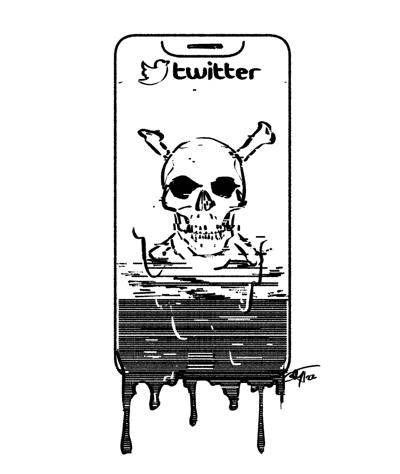
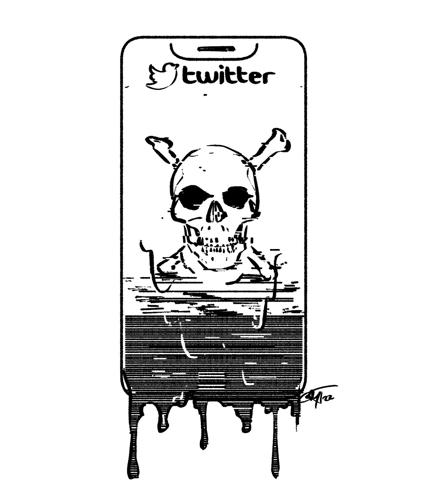
The simultaneous celebration and handwringing following Elon Musk’s announcement that he will purchase Twitter has stirred a debate about the meaning of free speech.
The billionaire Tesla CEO has described himself as a “free-speech absolutist” following the announcement that he will pay about $44 billion for the social media platform, which reportedly has more than 200 million users. He talked about making Twitter a private company, no longer beholden to stockholders.
Musk has said he plans to restore “free speech” to Twitter by easing up on content removals and account bans put in place to restrict hate speech and misinformation. He said he also plans to “authenticate all real humans,” presumably a pledge to eliminate spam accounts or “bots.”
This sounds great for someone like me who has committed his professional life to journalism with the belief that free speech is an imperative right.
However, I’m also concerned about all this.
Far too often, the First Amendment is misconstrued to mean that everyone is allowed to say whatever they want, however they want, wherever they want.
In reality, the freedom of religion, speech, and the press and rights of assembly and petition only means the government cannot punish its citizens because of what they say.
The amendment reads: “Congress shall make no law respecting an establishment of religion, or prohibiting the free exercise thereof; or abridging the freedom of speech, or of the press, or the right of the people peaceably to assemble, and to petition the Government for a redress of grievances.”
To oversimplify this, the First Amendment only says “Johnny Law” can’t toss you in the “clink” because the government doesn’t like what you are saying.
What the First Amendment has never protected is public backlash – however that plays out – or lawsuits for libel, a knowingly false, published statement that damages a person’s reputation.
The public backlash portion of unfiltered, unmonitored speech is where Musk’s reported vision for Twitter may, and possibly should, fall apart.
Twitter can, and frankly should, be held accountable for how its platform is used to spread information. Keeping obvious and blatant lies from spreading around the world at the touch of a button should be a burden of the company that makes it possible. Twitter also should have checks in place to make sure its platform does not play a part in encouraging violent or criminal acts.
Jean Maneke, attorney for the Missouri Press Association, said Twitter is pretty much immune from being on the hook to pay for damages in a libel case, and it would likely not be held accountable even if one of its users explicitly calls for violence and then someone carries out that violent act.
“A federal law often referred to as Section 230 provides that a hosting entity is not responsible for content it does not regulate, just like a bookstore is not liable for the books it sells because it does not control what others publish,” Maneke said. “That is the present state of the law that protects those who allow comments, such as newspapers that permit readers to comment on stories.”
So if someone commits a violent act because someone posted something on Twitter, the company likely would not land in hot water.
“There would need to be significant changes in federal law before someone could win a case like that, unless there was evidence of concerted action between Twitter and the person posting that statement,” Maneke said.
But even if Twitter is on solid legal ground to allow people to say virtually whatever they want, even under the First Amendment it is still illegal to cry “Fire!” in a crowded theater when there is no fire. So doesn’t the company have an obligation to prevent things like libelous statements flying freely on its platform or information that can do harm from being spread on its product?
At least 26 civil society groups believe that Twitter is so obligated, and they have asked some of the nation’s biggest brands, including Coca-Cola, Disney and Kraft, to pull their advertising on Twitter if Musk does not keep most, if not all, content moderation policies in place.
“As top advertisers on Twitter, your brand risks association with a platform amplifying hate, extremism, health misinformation and conspiracy theorists,” a letter signed by groups such as Accountable Tech, Media Matters for America and Ultraviolet said. “Under Musk’s management, Twitter risks becoming a cesspool of misinformation, with your brand attached, polluting our information ecosystem in a time where trust in institutions and news media is already at an all-time low. Your ad dollars can either fund Musk’s vanity project or hold him to account. We call on you to demand Musk uphold these basic standards of community trust and safety, and to pull your advertising spending from Twitter if they are not.”
Even as a private company, Twitter will only survive through advertising dollars.
While “completely free speech” may sound great, the reality is that speech is and must be monitored. Rules should be in place to prevent harm and those promoting lies should be stopped.
Believe it or not, the principles of reporting provable facts and making every effort to be correct and fair is what has guided newspapers like the Leader since the inception of print, and it should guide any entity that is used to spread information, like Twitter.