
Another school year has started, which means another boogeyman has slipped into the hallways of our schools.
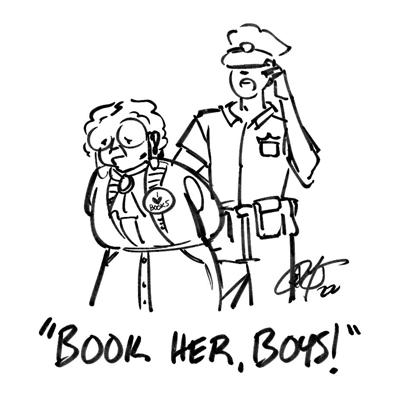
A Missouri law banning “explicit sexual” images in school materials went into effect Aug. 28. This law makes it a class A misdemeanor for school employees to share with students materials deemed “explicit,” an offense that calls for up to a year of jail time and a fine up to $2,000.
Certainly, school libraries are not stocking pornography on their shelves. So what exactly is this new law banning?
Many people think this law has been worded intentionally vaguely and subjectively so it may be used as a weapon to target specific groups, especially LGBTQ youth.
For some people, seeing any representation of LGBTQ relationships, such as flirting, hand-holding and kissing, is considered explicitly sexual, despite the same exact behaviors for heterosexual relationships being deemed perfectly appropriate for children to see or read about. Many anticipate this law will be used to try to erase any mention of LGBTQ relationships from libraries.
Who will be the arbiter on what is “explicitly sexual?”
Obviously, not every book is meant for every child of every age. What’s fine for a 14-year-old may be too advanced for an 8-year-old. Thankfully, schools already have processes for book reviews – protocols that do not involve throwing employees in jail.
As someone who’s worked in a school library, I can tell you that librarians can’t read every single book in their libraries, even if they did nothing but read books all day (but their jobs require far more than that).
Contacting your school librarian to say, “My son brought home this book and I think that the themes are too mature for his age. I’m particularly concerned with the dialogue on Page 57. Could you please review it for grade-level appropriateness?” is much more effective than saying “Here’s a list of 100 books that neither me nor my child has ever read, but I heard on Facebook that they’re bad, so I demand you don’t let anyone read them or I’ll have you put in jail.”
This is not the first time that we have been told that schools are trying to psychologically damage our students.
Two years ago, we were told the same school nurses who have been checking kids for head lice and giving out ice packs and Band-Aids for boo-boos for decades suddenly had a radical agenda to perform mind control on kids via mask wearing. We were told they were intentionally prepping our children to be compliant to Big Brother and it had nothing to do with a raging global pandemic.
Last year, we were informed that high school history teachers were imparting college-level critical race theory lectures to students. We’ve all met a high school history teacher, right? A lot of times, he’s a middle-aged assistant football coach whom students know they can get off-task for half of the class period by mentioning the Cardinals game that was on last night.
Who will be next year’s boogeyman? Maybe they’ll tell us that lunch ladies are covertly converting students to Satanism with every carton of milk.
To be sure, Missouri’s schools have real problems. We rank 50th in the nation – that’s dead last, for those who weren’t paying attention in Social Studies class – in starting teacher pay. Teachers spend on average more than $500 of their own money on school supplies for their classrooms because of low funding. About a fourth of Missouri’s 550 school districts have gone to a four-day week because of budget shortfalls and staff shortages. Schools are canceling bus routes because of lack of bus drivers. Districts are converting janitors’ closets into classrooms because buildings are bursting at the seams. But politicians and talking heads know that fixing these problems takes thoughtful solutions and lots of money.
But if you want to rile people up, claiming that the schools are full of boogeymen is easy and free. You do the math.
Missouri already is having enough trouble retaining teachers. Chasing them with torches and pitchforks isn’t going to alleviate that problem.
Take a look at the staff page of your local school’s website. Most grew up within 30 minutes of the school, with a decent portion being alumni of that district. Teachers are people from your local community. Their political ideologies reflect those of the community. They are not sleeper agents placed in your schools by radical extremists.
If you want to know what’s going on in your child’s classroom, review their homework with them. If you want to know what’s in the books they’re reading, read the book along with them.
If you’re concerned about what will be in your child’s curriculum, go to Meet the Teacher events and parent-teacher conferences.
If you are concerned about the agenda of your school board, attend board meetings or run for the board yourself.
If you want to have more of a say in your child’s educational experience, join the PTA, volunteer to help with sports concession stands, chaperone field trips, help coach a sports team or sponsor a club.
There are many ways for parents to be involved in their child’s education, but unfortunately, too many parents opt out – especially those parents howling the loudest that schools have ulterior motives.