


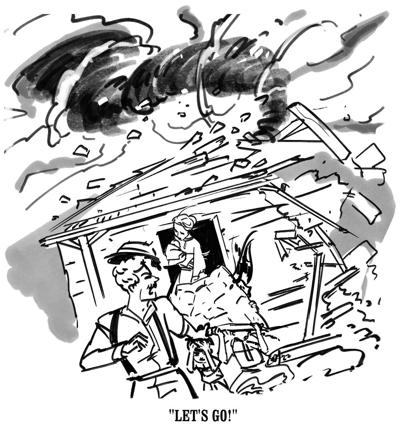
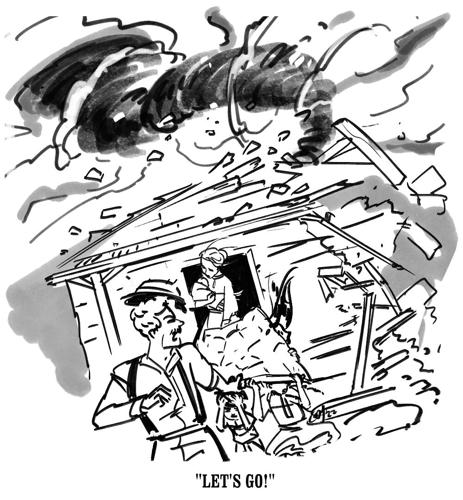
The nervous father stood at the front door of his home, eyeing the sinister green-and-purple cloud bearing down from the west. His wife pulled their five children, one a babe in arms, into a tight huddle in a corner of the room.
All was still, until suddenly it wasn’t.
Vicious winds tore into the farmhouse, lifting its roof, and pulling off shingles and attic beams.
As gaping holes opened in the ceiling, my great-grandfather, William Francis “Frank” Akins, decided he’d better get his family out.
So, he and my great-grandmother, Rhoda, pulled a feather mattress off a bed, and told the kids (ages 9, 7, 4 and 2) to get beneath and run with them for the door. Carrying her baby, and struggling to keep her end of the bedding over the children, Rhoda was hit by a falling log at the doorway. The resulting back injury plagued her for the rest of her life.
But, life there was. Slammed by rain and with the young ones still protected by the mattress, the family made their way down a hillside (about 17 miles south of where I live now) to Frank’s parents’ home, a way station for them until they could rebuild.
Both great-grandparents lived another quarter-century, and all those children much longer than that.
Learn a little about your family history and you discover all kinds of ways you might never have been born at all.
Earlier this year, while reading my Great-Aunt Mabel’s diary, I learned that her brother Lewis Akins (my grandfather) nearly died in the 1918 flu epidemic.
The tornado came before that. Mabel’s daughter, my late cousin Nancy Apple, wrote vividly about it. That day in spring 1894 was a narrow escape for Lewis (and future me). Probably scared out of his wits, he was the 4-year-old under the mattress.
We’ve come a long way since parents could only watch the sky to gauge weather conditions. But not as far as scientists (and the rest of us, I’m sure) would like.
According to a New York Times story I read last week, efforts to warn people about incoming tornados date back to the 1940s, and prediction capability has continually grown since then, with Doppler radar, weather satellites and supercomputers added to the mix.
But while a lot is known about the building blocks for ferocious storms, scientists want to know more about what turns the key and causes a tornado to actually form. That information would increase the window of time people have to get to safety.
So, storm chasers, as they have for decades, continue to release weather balloons skyward when conditions are ripe for funnel clouds, hoping to learn the secret.
Meanwhile, emergency officials keep boosting methods to warn citizens when they are in harm’s way. That’s important for Missourians. According to the National Oceanic and Atmospheric Administration (NOAA) our state ranks 10th in the country for tornadoes, with an average of 45 a year (using data from 1991 to 2010). Texas is first, with 155 annually, and Kansas second, with 96.
Efforts are underway in Jefferson County “to warn more people, more quickly,” said Travis Williams, county 911 Dispatch chief.
About 45 percent of county households (including both incorporated and unincorporated areas) are signed up to receive Code Red warnings via phone or email for flash flooding, severe thunderstorms and tornadoes.
Williams invites all residents to sign up at Jeffco911.org (go to Resources, Code Red, and click on the Code Red link to go to the Community Enrollment page to enter your information).
He looks forward to a year from now, when the 911 board plans to switch to a new “mass notification system” service that will allow the agency to contact residents about emergencies through their cell phones even if they have not signed up for Code Red.
That kind of thing works. My cell phone told me loudly a few years ago that a tornado was whirling near my Festus home. Adrenalin got me to the basement lickety-split, armed with blankets in case I needed cover (no featherbed available). Thankfully, I was able to return upstairs after a tornado-free hour.
Warren Robinson, the county’s director of emergency management, advises a “multi-layered” approach to weather protection.
Obviously, people should sign up for Code Red, he said, and move to the new warning system when it becomes available.
But another good way to be aware of weather conditions is to purchase a NOAA weather radio that provides up-to-date information, he said.
“Just punch in the code for our county – every county has a code – and make sure the radio can be used with a battery pack,” Robinson said.
I priced weather radios on Google and saw choices ranging from $15 to $60, available at many stores or online shopping sites.
Someday, Robinson hopes, the unincorporated area of the county will have sirens located in choice spots to provide warnings to people who are outdoors. Word is expected in 2023 on a grant request to help with the cost of a study to determine the best locations, with, fingers crossed, future funding toward a big installation project. Most of the county’s municipalities already have siren systems.
As noted in Leader staffer Steve Taylor’s Sept. 15 story, a severe-warning system for the unincorporated area remains on county government’s capital program and strategic plan.
Don’t neglect to learn how to protect yourself in the event of severe weather and refresh those tips from time to time.
And it won’t hurt to stay on the lookout for green and purple cloudbanks.