
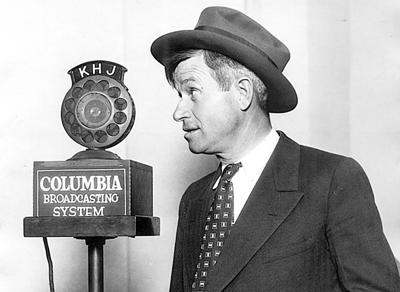
Where is Will Rogers when we need him?
And boy, do we need him.
As you faithful readers know, in this space we often seek inspiration from the past to cope with the difficulties of the present. Today’s poisonous politics, driven by a win-at-all-costs mentality, leave us desperately seeking an antidote, an escape hatch, a pressure-relief valve – something or somebody to open the rhetorical windows and let in some fresh air, the non-partisan kind we can all breathe deeply.
Especially if it makes us laugh at ourselves, not our perceived political enemies.
In America’s 243 years we’ve had precious few public figures gifted in the art of political humor. You certainly won’t find it in our late-night talk-show hosts. Oh, they can be wickedly funny, but almost entirely on the cheap, with mocking and derision. They’d rather stir the gut than tickle the brain.
We reached a new low at last year’s White House Correspondents Dinner, when so-called comedian Michelle Wolf was so toxic, she single-handedly ended the group’s decades-long tradition of comic hosts. This year’s headliner will be a historian, Ron Chernow, biographer of Alexander Hamilton and other luminaries of the ages.
Which brings me to Will Rogers (1879-1935), one of the most extraordinary figures ever to capture the nation’s attention and hold it for years across multiple media. An entertainer by trade, he appealed across lines of race, class and culture.
For starters, he was both a cowboy and an Indian. Born on a Cherokee reservation in Oklahoma, he learned rodeo-roping skills from a black cowboy, Dan Walker, and honed them into a wildly popular vaudeville act in the early 1900s. (Check them out on YouTube in a 1922 video called “The Ropin’ Fool.”)
Rogers would start his stage act, while getting his ropes ready, with the same aw-shucks line: “All I know is what I read in the newspapers.” (We like the sound of that here at Leader World Headquarters.) That would trigger a steady stream of simple-but-clever takes on the day’s news.
A sampling of Rogers’ wit:
■ “Too many people spend money they haven’t earned to buy things they don’t want to impress people they don’t like.”
■ “Everybody is ignorant, only on different subjects.”
■ “The only difference between death and taxes is death doesn’t get worse every time Congress meets.”
■ “Be thankful we’re not getting all the government we’re paying for.”
■ “There’s no trick to being a humorist when you have the whole government working for you.”
■ “There is no more independence in politics than there is in jail.”
■ “Everything is changing. People are taking their comedians seriously and their politicians as a joke.”
And this one, the favorite of all journalists:
■ “I don’t make jokes. I just watch the government and report the facts.”
Rogers advanced from a stage performer to syndicated newspaper columnist (writing more than 4,000 columns for 40 million subscribers) and top-rated live radio commentator. He even branched into the movies, making 71 films.
By the 1930s he was by far the most popular public figure in the country; his humor helped the world cope with the daily degradations of the Great Depression.
He never lost the “common man” touch, despite his wealth and fame, earning credibility and good will with a lot of charitable work, including a cross-country fundraising tour for the American Red Cross.
The National Press Club named him “Ambassador at Large of the United States” after he toured Asia and Central and South America in 1931-1932.
Rogers helped people appreciate the blessings of American life – individual liberty, the rewards of hard work, looking out for your neighbor – while framing politics as the necessary evil of a democratic society. And how do you abide such? By laughing at it, and at ourselves.
Political humor has never been the same since his death in an airplane crash at age 55. Many comedians have tried to follow in Rogers’ footsteps, with limited success. The one who came closest was Bob Hope. He gleefully skewered presidents of both parties and made so many USO tours to entertain our men and women in the military that Congress made him the first honorary veteran of the U.S. armed forces in 1997, three years after he retired at age 94.
But the cowboy philosopher from Oklahoma still stands alone. In the U.S. Capitol, near the entrance to the House of Representatives, a life-size bronze statue of Rogers has stood since 1939 – placed, it is said, “So he can keep an eye on Congress.”
Presidents rub the statue’s feet for good luck on their way to delivering the State of the Union address. (I don’t know if Donald Trump did that last year or plans to later this month for his second “SOTU.”)
Look sharp when you see congresspersons interviewed on TV and often you’ll see Rogers, from the waist down, looming in the background. That would be a good time to recall what he said in 1930 about how he wanted to be remembered:
“When I die, my epitaph, or whatever you call those signs on gravestones, is going to read: ‘I joked about every prominent man of my time, but I never met a man I didn’t like.’ I am proud of that. I can hardly wait to die, so it can be carved.”
For the likes of us, he left too soon.