


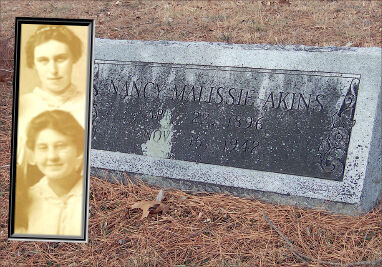
Come Nov. 16, it will be 80 years since my great-aunt, Nancy “Malissie” Akins, 46, jumped off the Eads Bridge in St. Louis to her death in the Mississippi River below.
Four women who had been driving across the bridge that Monday morning saw it happen and one got out of the car and ran toward the tall, slender woman in an attempt to stop the tragedy. But it was too late.
That afternoon, about a mile downstream, the Coast Guard found Malissie’s “cloth purse with wooden handles” and her “black felt hat with four feathers,” but those items carried no ID and no body was found.
My mother told me her father searched the river constantly in the months afterward, looking for Malissie’s remains. But according to a news clipping, it wasn’t until July 29, 1943, more than eight months after Malissie jumped, that “a boy cutting willows” found skeletal remains on a river sandbar near Rush Tower south of Festus.
Anguished family members testified at a quickly scheduled inquest that they could identify Malissie from scraps of fabric matching her dress. She was buried a few days later after a funeral service that honored her life and gave her family some measure of closure.
But they never really healed from Malissie’s loss, partly because they never knew what had led to her desperate act.
Less than 24 hours before she ended her life, Malissie wrote a sunny letter to her sister, Mabel, commenting on the “pretty day” and passing along good news about the well-being of their nephews in service during World War II.
She wrote she’d been working a lot of overtime in her job at a hat factory, and that she’d send along a clipping of an acquaintance’s obituary. Did Mabel want some potatoes grown by their brother, Bryant?
No words whatsoever about personal distress in that letter, or in any of the missives she wrote every Sunday afternoon.
On Monday morning, Malissie boxed up some cookies to mail to one of her soldier nephews, but instead of heading to work after her stop at the post office, she went to the bridge.
In trying to figure it out, Mabel remembered that a 19-year-old Malissie “took to her bed for a long time” after her beau deserted her for a friend she had trusted, and noted that Malissie stopped teaching school after that and never dated anyone else.
Perhaps Malissie’s withdrawal from life after her heartbreak had been a nervous breakdown from which she never fully recovered.
Others recalled they had heard Malissie talking to herself “in a morose voice” while alone in her bedroom at the St. Louis home she shared with another sister and her family. After such episodes, Malissie would emerge “her usual cheerful self.”
My mother theorized that Aunt Malissie’s anxiety about her nephews at war undermined her mental health. And my cousin wonders if the mercury Malissie came in contact with as a milliner caused poisoning and mental issues.
Malissie left no note and nothing ever truly answered the central question of why.
Many things have changed over the last eight decades, but not the crushing bewilderment of grieving families in the same situation, whose loved ones did not reach out for help.
America is trying to do something about that.
In 2020, the Federal Communications Commission created a three-digit hotline number – 988 – for people facing a mental crisis to call, text or chat. The pre-existing 10-digit number – 800-273 8255 (TALK) has not gone away, but mental health experts hope having an easy-to-remember hotline will give more people access to life-saving counseling.
The American Foundation for Suicide Prevention reported that 1,230 individuals committed suicide in Missouri in 2020, ranking suicide 10th on the list of causes of death and the second-leading cause for state residents ages 10-34.
Meanwhile, data predict 90 percent of calls to the 988 number will resolve callers’ issues, with the remaining 10 percent put in touch with follow-up assistance.
The new number is scheduled to go into effect in Missouri on July 16, under the direction of a state task force.
Missouri Gov. Mike Parson put $28.5 million in the state’s proposed 2023 budget to boost the number of suicide prevention call centers from two to seven, each with trained staff. The intent is to provide 24/7 access to the new number everywhere in Missouri.
The state’s budget probably will not be finalized until near the end of the legislative session in May. When the dogfights over how our government’s money is spent begin in earnest, here’s an earnest plea Parson’s request for suicide prevention funding survives.
Would it have ended differently if such assistance had existed in Malissie’s time?
My late great-aunt Frances wrote a memorial poem for her sister. A portion follows:
“Dearest sister you have left us
For that place prepared on high
You have gone to that fair haven
Where no one can ever die
You have left us sad and lonely
Hearts bereft and full of pain
Yet we know some day in gladness
We shall be with you again.”
All of Malissie’s siblings are gone now, too, and most of the generation that followed. May it be as Frances fervently prayed.