
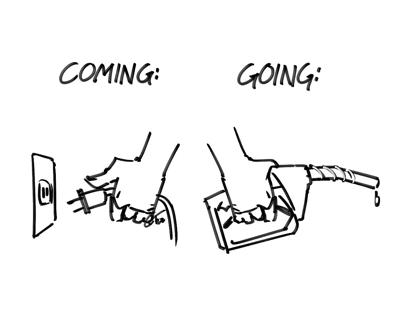
Last month I took a ride in a time machine – an all-electric vehicle.
It was an education and a taste of the future.
Most of you reading this may not live long enough to see it, but someday virtually all gas-powered cars will roll off into museums, classic-car rallies or junkyards, giving way to the all-electric vehicle (EV) revolution.
It’s slowly unfolding right before our eyes and I got a personal tutorial on the ins and outs and ups and downs of EV driving on a 700-mile road trip with my son-in-law.
More on that in a minute. But first, a word from our sponsor – planet Earth.
Climate change – the rise of global temperatures and sea levels from the greenhouse effect of carbon emissions – is no longer a future threat. It’s a right-now threat. If you don’t believe it, I’ve got some beachfront property in Florida I’d be happy to sell you.
The average car today spews 4.6 metric tons of carbon dioxide into the air per year. The U.S. has about 285 million vehicles on the road accounting for more than one-quarter of all our carbon emissions. And the U.S. is second only to China in carbon pollution.
Conclusion: We will not restrain or reverse climate change without the extinction of the gas-powered automobile. And the sooner the better.
The vast majority of young people (under age 35) understand this. After all, they try to picture what the world will be like in 20, 30, or 40 years, and they don’t like what they see. My son-in-law, Garry Polley, is 33. He and my daughter, Joanna, are both Fox High and Truman State graduates. They live in Prairie Village, Kan., on the western side of the Kansas City metro area, with their two daughters.
Garry, a software engineer, is a high-tech early adopter from the word go. Their house has smart systems for everything, with Alexa and Siri at their constant beck-and-call.
The yawning chasm between Garry’s tech savvy and mine was demonstrated a few months ago when they bought me an Apple Watch. It arrived with the watchband unattached. I put it on and started pressing buttons and swiping screens. But it kept falling off whenever I brushed against something or just flexed my wrist too much. So I ordered a traditional clasp watchband to replace “this darn-fool thing that keeps falling off.”
We paid a visit in KC and I showed Garry my problem. “Oh,” he said. “You put the watchband on upside-down.”
Duh.
On that same trip, Garry informed us that they were purchasing a Kia EV6, which after many hours of research he determined to be the best EV for them. They ordered the car and waited many weeks for it to make the long journey from South Korea to the West Coast and on to a Kia dealer in Oklahoma City. It was the closest dealer he could find that could deliver exactly what he wanted at the best possible price, which was somewhere north of $50,000.
On Sept. 21 Garry and I drove to OKC in their 2013 Honda Accord, which he traded in at the dealer. And there was the EV6, gleaming in the bright sun, outfitted with a sweeping dashboard full of touch controls and data readouts. The number that caught my eye indicated “miles remaining to zero power.”
After a long session with the finance manager, we set out with a full charge on a route carefully plotted along I-35 to use a fast-charging (Level 3) station in Wichita and another in Topeka (off I-335) if necessary. In light traffic, Garry tested the acceleration (superb, zero to 60 in maybe five seconds) and even briefly took his hands off the wheel to show the car’s pinpoint road awareness – a small sampling of what fully automated cars may be like in 20 or 30 years.
Then Mother Nature played a trick on us. We were driving into strong headwinds from a descending cold front. I watched the “miles left” indicator plummet as the car worked harder to maintain 70 mph.
The miles left got down to 10 when Garry pulled over in Gardner, Kan., 34 miles from home, and plugged into a Level 1 public charger. Level 1s are the slow kind that require 12 hours or more to fully recharge an EV’s big battery. So we waited inside a nearby soccer fieldhouse for the 45 minutes it took to get about 10 miles of charge, which was enough for us to limp to a fast-charger in Lenexa, where Garry got a full charge back up to 240 miles or so.
The EV6 – pardon my sounding like a salesman – is whisper-quiet and grips the road with tiger claws thanks to the 1,052-pound lithium ion polymer battery that fills the undercarriage.
The new owners pronounced themselves highly satisfied after Garry and I pulled into the driveway three hours late. But the wind-resistance factor was a surprise, probably the first of many as they adapt to the biggest advance in ground transportation since Henry Ford’s Model T.
Our next car, we have already decided, will be an EV. We just aren’t an early-adopter like Garry, so we’ll see how all the carmakers compete with their multibillion-dollar investments in this brave new world.
Just driving around Festus, I see Teslas all over the place. They are a story unto themselves.
But the license plate I saw on a Tesla parked at our local Panera said it all: RIP OIL.