


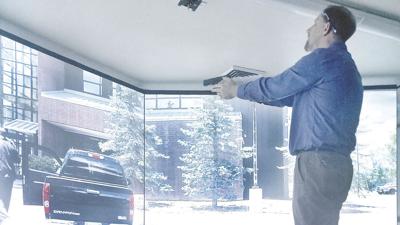
After a four-hour presentation by the Jefferson County Sheriff’s Office on how law enforcement officers determine whether to use force in the course of their jobs, it was time to see if I had learned anything.
I was handed a gun – don’t worry, not a real one. This was an electronic gun with an air canister, simulating a real weapon.
I was instructed to stand on an orange “X” that put me in the middle of three wall-sized screens in a simulator at the Jefferson College Imperial campus.
Next up, immersion into three scenarios an officer could face while on duty. Should I fire my weapon?
The first scenario called for me – the officer – to respond to the parking lot of an office building. The scene started with a supervisor pleading with a man in a pickup to leave the premises. The supervisor in the video tells me the man in the pickup had just been fired and his actions were making people nervous.
I summoned my best “dad” voice – the one I’ve been honing since my wife and I greeted twin newborns 17 months ago – and told the supervisor to step away from the pickup and asked the man inside to come out of the vehicle slowly, with his hands where I could see them.
It felt odd yelling at a screen, but the deputy running the program could change how the scenario played out based on what I said.
Before he got out of the pickup, I could see the man was pointing a gun at his head. He eventually got out, looked at me for a second, and with the gun still in his hand but at his side, he started to walk toward the building.
I hollered at him to stop, to put the gun down and come back, but he kept walking to the door.
I finally fired two shots, and he fell, ending the scenario.
I looked over at Lt. Col. Tim Whitney, Jefferson County undersheriff, who was the lead presenter at the Nov. 3 media training session – attended by me, another newspaper reporter, representatives from two local television stations and two representatives from the Jefferson County Prosecuting Attorney’s Office.
Whitney asked why I shot the man. I said the clearly upset man was carrying a gun and going into a building. I felt he was a danger to others, even though he never pointed the gun at me or made any statements about hurting others.
Whitney said I made the right call, although it would likely look bad that I had shot someone in the back.
The next scenario went much more quickly. A man was standing in an empty park with his hands behind his back. About a second into the scenario, he shot at me and started running. I shot back – I think I hit his shoulder – and the scenario ended.
For the second time, I had shot someone in the back, and was asked if I felt I was justified in firing the gun.
I said I felt I needed to shoot him because he had already shown a willingness to shoot at someone and was running with a gun in a park. I had no idea who he might encounter next and if he would shoot at that person.
Whitney again said it was the right call.
The final scenario called for me to respond to a domestic dispute. The scene showed another officer breaking up a fight between two men on the front lawn of a house. One of the men ran into the house, past three women standing on the porch.
While the officer asked the man who stayed behind for an explanation, the other man emerged from the house with a large knife. One of the women grabbed him from behind and did not let him leave the porch.
She eventually wrestled the knife away from him, and when he went back into the house, she put it down.
I didn’t fire a shot, because while the man could have harmed someone with the knife, I wasn’t going to shoot into a crowded area. (For the record, I am no marksman. Until our training day, I had never shot anything besides a Nintendo gun while playing Duck Hunt.)
Whitney again said it was the right call, because the risk of shooting and injuring or killing innocent people was too great, and no one was in imminent danger of being harmed.
The scenarios, and a long discussion about how officers are trained to use force – led by Whitney, Jefferson County Sheriff Dave Marshak and Capt. Gary Higginbotham, and organized by Sheriff’s Office public information coordinator Grant Bissell – gave me and my media colleagues an interesting peek behind the blue curtain.
What stood out to me was how rarely Sheriff’s Office deputies use force. Department records show that deputies had contact with people nearly 100,000 times in 2018. In all those encounters, force was used only 35 times.
I am now armed with more insight into how and why deputies make the choices they do in their dangerous line of work.
Yes, snap judgments are required, but those decisions are not made in a vacuum. They are preceded by rigorous training designed to help officers do the right thing at the right time.