
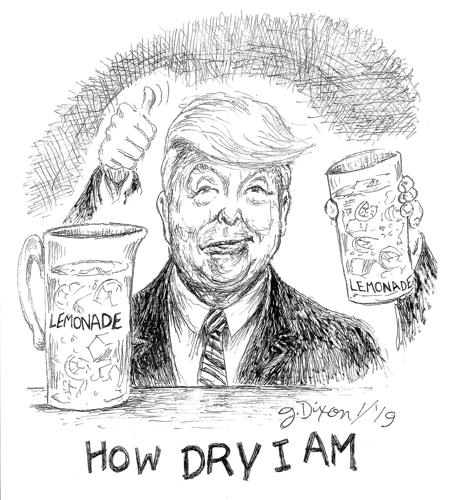
I knew I’d be a teetotaler as a first-grader, well before I knew what that word meant.
I don’t have a bazillion bucks. I’ve never been president of any organization. (They always pick me as secretary, go figure.) And my dark-brown hair has never wandered toward yellow or orange.
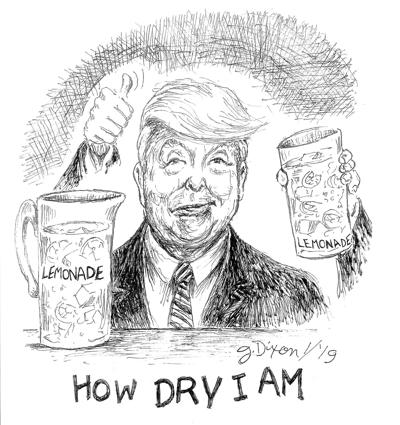
But Donald Trump and I have something pretty significant in common. We were shaped by family experience to abstain from alcohol consumption.
Trump watched his older brother, Fred, struggle with alcoholism and die from its effects in 1981, at only 43 years old. Fred advised his brother to stay away from liquor and our president says he paid attention. Never drank a drop.
The subject comes to mind because the U.S. Constitution’s 18th Amendment (enacting Prohibition) marked its 100th birthday last week.
The amendment, ratified by Congress on Jan. 16, 1919, was accompanied by enforcement legislation in the Volstead Act of 1920, which outlawed production, sale and transportation – but not consumption – of “intoxicating liquors.”
America’s experiment with keeping alcohol off its shelves and out of the hands of its citizens turned out to be a colossal failure. The victory of the “dries” over the “wets” lasted only 13 years, before the 21st Amendment repealed the 18th in 1933.
Prohibition was blamed for creating rampant black market crime and violence, harming an economy that was trying to recover from the Depression, turning legions of regular citizens who were wantonly breaking the law into cynics, and killing some unfortunates who unwittingly drank lethal homemade brew (although it should be noted that cirrhosis deaths fell by 50 percent in those years).
Prohibition was a brief blessing for my family on the paternal side.
My grandfather was one of four brothers all afflicted by alcoholism. Three of them died because of it, including my grandfather, who broke his neck at age 49 in a drunken fall down a flight of stairs.
The fourth brother nearly killed his family in a DWI car crash and instantly reformed, living an estimable life into old age.
My grandfather was gone before I was born, and I never heard much about him. I learned he had perfect pitch and passed down a beautiful tenor singing voice to my father. But on the other side of the scale, he was abusive and derelict under the influence.
Born in 1928, my dad remembered a peaceful family life in his early years, when his father brought home a paycheck and passed muster as a parent.
But when Prohibition was repealed, so was every semblance of normal life.
Although he certainly knew better, my own father fell under the sway of alcohol, first as a young adult, and then again in 1961, when I was 6. It took 22 years before he finally quit drinking for good.
A dead brother; a childhood lived in an alcoholic home. If Donald and I sat down for a chat, our memories could keep us going for a long time before politics interfered.
I try not to preach to others, although my kids would call me out on that. I acknowledge that Prohibition was just as bad as it was reported and that millions of people can drink safely, without harming themselves, their families or their communities. Some of my dearest friends are in that multitude.
But just saying no carries protections. You never get a hangover, you never drive drunk, and when you embarrass yourself, it’s because you were just dumb, not because a substance made you dumb.
Temperance, however, doesn’t necessarily protect you from the watchful eye of the law.
My husband, who also sticks to cola, has a story about that. When he told it to the Sunday school class he teaches, they LOLed.
A hot night last June found him driving home after participating in the Moonlight Run in Crystal City.
He thought he’d be home by 10:30 p.m., but had not shown by 40 minutes after that.
He’s married to a woman with imagination, and my hyperactive psyche had him collapsed on the street, paddles applied to his chest.
He knows this about me. So, when I called him, he decided to call me back, even though he was only three minutes from home and even though his phone was in the back seat.
He pulled into a sloping church parking lot and got out of the running car to retrieve the phone, but accidentally failed to put the car into park. Down it went, off the parking lot, across a street, and jumping a curb.
He was going to need a tow.
Two police cars responded within a blink and one of the cops approached. Taking in the odd situation of the car and the sweaty, disheveled man, she asked the obvious question.
“Have you had anything to drink?”
My husband recalled the buckets of water he’d inhaled at the race and gave an emphatic answer.
“Yes!”
“Well, how much?” she demanded to know, not yet reaching for the cuffs.
They sorted it out, and he slept at home that night, not at the jail.
Donald would laugh if I told him that story.
Turns out, Fred’s advice also kept his brother away from cigarettes. My dad suffered from that addiction, too, and died from lung cancer nearly a decade ago. If people could see how that plays out…
Another topic for the King and I.
Call me, man.