


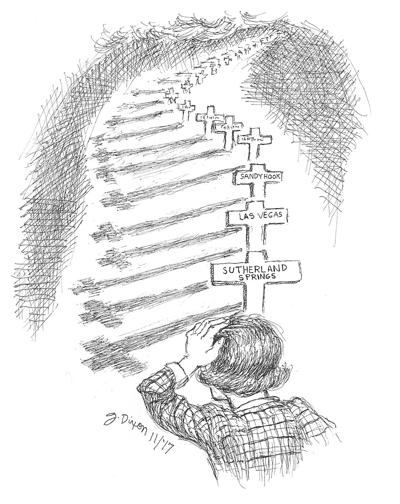
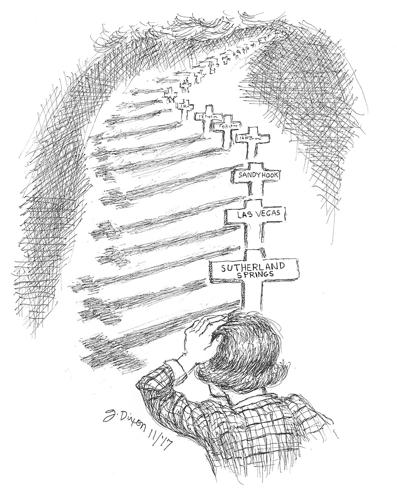
A heart-to-heart conversation with my mother-in-law not long after I got married came to mind after the church massacre in Sutherland Springs, Texas.
I told her of an excellent book I’d read about the Holocaust and urged her to read it. She replied that she no longer allowed herself to be immersed in tragedy.
“I know that it happened, and I grieve that it happened,” she said. “But I can’t change anything about it and it only makes me feel terrible to dwell on it.”
At the time, I admit that I judged her. Didn’t averting your eyes from ugliness help to create an environment that allows monstrous behavior to replay, generation after generation? Didn’t we owe it to the victims to keep their suffering in clear focus?
But as decades passed, I grew to understand. The older you get, the more tragedies you have to absorb, and the harder it is to be at peace. Looking the other way is a defense mechanism that seems necessary to simply carry on.
The Sandy Hook massacre in December 2012 pushed me over the line into my mother-in-law’s way of thinking. How to look at the sweet faces of 20 children, all 6 or 7 years old, and cope with their needless deaths?
The pundits seemed in agreement that no solution was achievable. The National Rifle Association’s monied hold on legislators was too effective and the gun culture was too engrained. Assault rifles with large-capacity ammunition magazines were going to stay available and crazy people were going to be able to buy them. Things were going to stay the same.
I felt a shift inside myself. If I couldn’t change what was happening, I was going to have to look away.
That self-imposed policy carried me in the five years since, as mass shooting after mass shooting took scores of lives. Even with Las Vegas, where 58 people were snuffed out and 546 were injured, I didn’t look at the obligatory photos of the dead or read their biographies. Helplessness only leads to despair.
But Sutherland Springs felt so close to home. Like many Jefferson County residents, I attended church that Sunday morning and I could picture what the congregation went through in a more literal way than with other massacres. I made myself read the heartbreaking stories of all 26 victims, many of them children and in one case, unborn.
Suddenly, it was personal, and just as suddenly, helplessness became unacceptable.
We must change the rules.
The Second Amendment guarantees the right to bear arms, and that right must be preserved. But citizens do not need weapons capable of killing many victims quickly. They do not need “bump stocks” that convert a semi-automatic weapon into a machine gun-like weapon.
Background checks should be applied for every purchase, not just those by licensed dealers, and people with mental health issues should be monitored better and prohibited more reliably from buying weapons.
Did you notice that Donald Trump labeled the Sutherland Springs massacre a mental health problem, not a gun issue, after he worked with Congress in February to loosen mental health restrictions on gun purchases?
That action wiped out a new regulation to put people who are receiving Social Security because of mental illness and people deemed unfit to handle their financial affairs on the national background check database.
The NRA opposed the regulation, which had taken effect in December 2016 and was predicted to add 75,000 names of troubled people to the database. It had to go.
We can make common-sense changes to our gun laws and not infringe on the rights of those who want guns to hunt, to shoot at targets or to protect their loved ones and property. We can offer a buy-back program to remove weapons whose only real purpose is to annihilate people as efficiently as possible. In the three massacres I cited, that’s exactly what the murderers did.
A recent NPR/Ipsos poll (conducted online Oct. 10-11) found majorities of people of all political persuasions in favor of more gun restrictions. Democrats were most in favor, but Republicans and independents still tipped toward a tighter ship.
Commentator Bill O’Reilly said after the Las Vegas bloodbath that the loss of innocent life in such massacres is the cost of freedom, and a Leader letter writer followed up with a matching opinion.
The freedom to purchase an assault weapon cannot equate to a church sanctuary strewn with bodies. If it does, the cost is too high.
Common arguments claim that the list of changes under discussion would not have stopped the recent massacres and that any restrictions will put the camel’s nose under the tent in a campaign to confiscate guns.
Not buying it. Better rules will have an effect and a desire to change our culture will, eventually, change it – without stripping people of their right to bear arms.
Folks, please try to make it personal. Put yourself or your loved one in the church pew, or at the concert, or in the schoolroom.
And then, demand action. It might take years and years to make a real difference. But please, let’s work together and let’s try.