


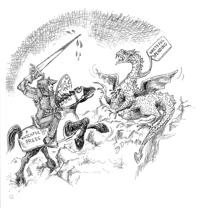

The ongoing, full-scale attack on the press by President Donald Trump is not only attempting to undermine a constitutionally authorized watchdog, it’s also hitting you in the wallet.
You can’t talk facts with rabid Trump supporters because facts don’t matter to them. Forget about his lack of experience, impulsiveness, fawning over foreign dictators, lack of ethics, habitual lying or immorality, because those things don’t matter to Trumpers, either.
To them, he is a heroic outsider who is “shaking things up” and “draining the swamp” of “elitist career politicians.”
To Trump and his supporters, coverage that they perceive to be negative is automatically inaccurate or biased. By that definition, then, all coverage should be positive and worshipful, like the “reporting” from Fox News, which has become the American equivalent of Channel One, the government-controlled Russian “news” channel that offers unblinking praise of whatever Vladimir Putin says.
Call that whatever you want; just don’t call it journalism.
Still, there have to be some things that even furiously divided Americans can agree on, so to get our heads all nodding together, let’s start with a few basic, unassailable facts, bad and good.
Car wrecks are bad. So are hurricanes, disease and the designated hitter.
On the other hand, air is good. Motherhood. Pizza. Having a comfortable income.
Still with me? Good.
So how is a siege on the press also a broadside on the average American’s financial well-being? Remember, we all agreed a comfortable income is a good thing.
Researchers from the University of Illinois at Chicago and Notre Dame University recently released the results of a 20-year study of communities that had lost their local newspapers. Specifically, the authors compared the cost of government borrowing in those communities with the costs of government in places that still had local newspapers covering the courthouse, city hall or school board.
The authors picked the 20-year period starting in 1996, presumably because that’s about when the internet started eating into the profits of newspapers and the revenue slide began.
Let’s be clear about one thing – people talk about the internet driving newspapers to extinction, with “old media” losing its grip on the news side of the business.
That misses the point by 5 miles. It’s true that websites and social media are more nimble than the printed page, and faster to get the news out, but that’s largely negated by newspapers with decent websites and social media presence.
Also, the printed word has been disadvantaged speed-wise for 100 years compared with radio and 70 years with television. This isn’t new. Our calling cards have always been depth and accountability, not speed.
No, the real wound was administered in advertising. Craigslist, eBay and other online sellers virtually killed the metropolitan newspapers’ classified sections, which were enormous profit centers, especially on Sunday. Employment websites took away Help Wanted ads. Real estate and automotive ads shrank as those industries consolidated. Together, those categories were the guts of the classifieds.
That’s where the damage was done.
Large and mid-sized daily newspapers have suffered mightily from this revenue drain, often gutting their newsrooms and helping fulfill the doomsayers’ prophecy.
Smaller, hyper-local papers like the Leader have done better because they have content that can’t be found online, except on their own websites, and they can still deliver an audience to advertisers. (Leader Publications, established in 1994, has added newsroom staff, new publications and coverage areas over the years – with zero layoffs in 24 years, knock on wood.)
The study showed that in places such as Jefferson County, where there is still a healthy newspaper with real reporters, public entities that borrow through bond issues or other means do it more efficiently and less expensively than in counties and towns where the newspaper has folded and no reporters are watching the henhouse.
“Negotiated” bond sales, rather than bid ones, are much more common if there are no local reporters watching, the study found. Not surprisingly, these cost taxpayers more.
The economists who conducted the study titled it, “Financing Dies in Darkness? The Impact of Newspaper Closures on Public Finance.” It was presented at the 2018 Municipal Finance Conference, hosted by the Brookings Institute.
They summed it up this way:
“The loss of monitoring that results from newspaper closures is associated with increased government inefficiencies, including higher likelihoods of costly advance refundings and negotiated issues, and higher government wages, employees and tax revenues.”
There is also – news flash – a higher tendency toward graft and government corruption in communities with no newspapers, the study found.
So kindly consider that the next time Donald Trump raves about the press being “the enemy of the American people.” Or if you come across an anonymous online screed, bravely posted from the safety of a mother’s basement, that gleefully predicts the end of this or any other newspaper.
To all you taxpayers who have a few more bucks in your pocket than you would otherwise, you’re welcome. It’s our pleasure to watch those guys for you.