


When our children were young and playing together a little rambunctiously, my sister had a phrase she often used to admonish them about their rowdiness.
“Simmer down, now,” she’d say, in a silly, mock-Southern belle accent. “Y’all just simmer down.”
What she meant was, “Bring the intensity down a few notches, OK? I appreciate your enthusiasm, but you’re blowing the ears off my head here. Chill out a little, and things will work out much better for us all.”
Recently, my 3-year-old grandson was playing with a toy and somehow got his finger stuck. It took me a moment to diagnose the problem, since he was running in a circle around the family room, screaming at the top of his lungs and waving his hand wildly in the air.
I found myself saying, “Come on, buddy – simmer down, now.”
I wanted him to understand that I couldn’t help him – no one could help him – while he was bellowing and flailing. Only when he calmed down a bit were we able to work together to extricate him from the jam he was in.
I find myself wanting to use that same phrase on many people these days, especially when it comes to political discussions. You hear them ranting and practically foaming at the mouth, gesturing wildly and getting red in the face, as they thump their trusty that-guy-over-there-is-the-devil tubs.
They look a lot like my grandson did with his finger stuck in a Lego.
I keep wondering: What happened to civil discourse? What happened to the American propensity for polite but spirited argument? What happened to, “I may not agree with what you say, but I defend to the death your right to say it?”
I am dismayed at how little interest people seem to have in hearing from someone with an opposing viewpoint.
If I had a nickel for every time I’ve heard someone who leans politically to the left say, “I just can’t talk to him; he voted for Trump,” I could buy a Cadillac. With all the options.
And if I had a pebble for every time I’ve heard, “You can’t talk to liberals; they’re a bunch of snowflakes,” from those on the right, I could build my own mile-long beach.
I can’t be the only person who sees merit in beliefs and policies on both sides of the political divide. Surely there are more people like me who think abortion is morally wrong but same-sex marriage is not; who like to own and shoot guns but don’t think all people should necessarily have unfettered access to all kinds of weapons; who want a clean environment but view over-regulation as oppressive.
Surely there are more people like me who want to explore different points of view on topics of interest to us all, and maybe find a middle ground so we can move forward with effecting real change.
I can’t be the only one who is desperate for true discussion and not the hurtful, disdainful, dismissive messages I see fired back and forth constantly.
But identity politics has virtually destroyed the art of argument.
I loved being on the debate team in high school (Fourth place in state, 1974. Just saying.) I liked to listen to the opposition, seeking holes in their logic and looking for ways to counter their position and buttress my own. But, in order to respond to their message, I had to HEAR it first. I had to listen carefully, taking in not only the words but the subtext, the context, sometimes even the body language. Active listening requires work.
And it requires a little humility as well.
It’s tough to admit you might be wrong – to hold your mind open to the possibility that another point of view, another approach to a problem, might be equally or even more geared toward success than yours. Whether you do so gladly or grudgingly, admitting there is another way of looking at things is vital.
And attempting to see the world through another person’s eyes doesn’t require you to believe what they believe or condone their actions. It simply means you quit passing judgment long enough to try to truly understand what makes them tick.
I’d like to be able to talk again, really discuss things, among intelligent and caring people. It’s how we got this country in the first place, after all, through spirited arguments between our founders as they shaped this bold, new experiment in democracy.
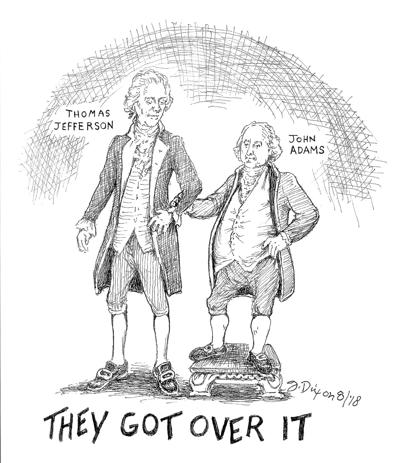
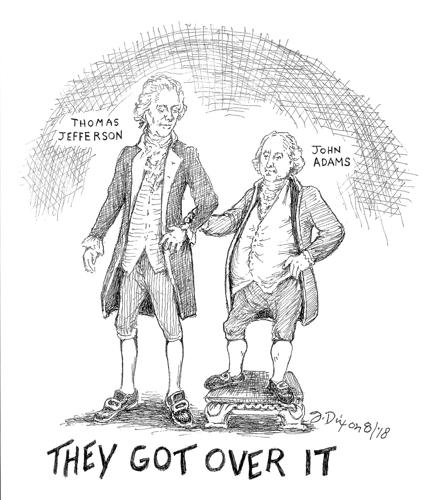
Think of John Adams and Thomas Jefferson – those Founding Frenemies – who differed in so many ways. Jefferson, a tall, elegant redhead with a calm demeanor, was suspicious of a powerful central authority for the new nation, while Adams, a short, round, balding man given to emotional outbursts, favored the idea of a strong central government. They went long years without speaking, but eventually picked up their friendship in letters that covered a wide range of topics.
In the end, they agreed on some things, and agreed to disagree on others. But, because of their open-mindedness, each wound up with a clear understanding of the other’s position, and consequently, a deeper understanding of his own.
Neither of them could have made those discoveries with their mouths open wide, caterwauling about how, “My team is the best and your team is headed straight for hell in a handbasket.”
They were wise enough to know that, sometimes, you just need to simmer down.