
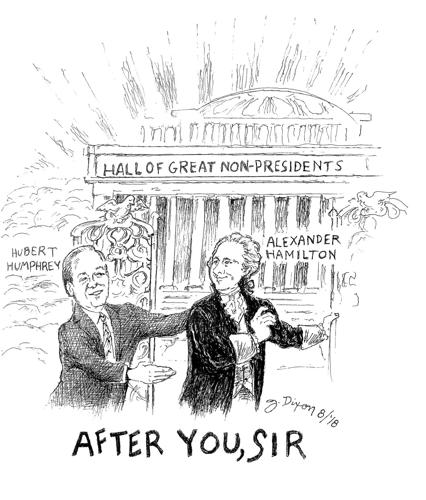
History has its eyes on you… So goes one of the many great songs in the smash-hit musical “Hamilton,” the best show I have ever seen on stage.
“Hamilton” brings to life our most underappreciated Founding Father, the only one who didn’t live long enough to help shape his legacy. Alexander Hamilton, creator of the American capitalistic economy we still enjoy today, somehow knew history had its eye on him.
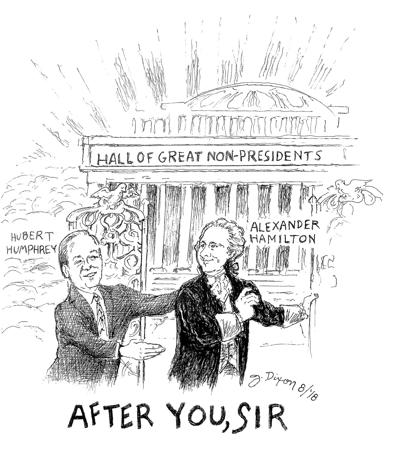
So did another politician who came along 150 years later, also with a surname starting with “H.” In fact, his initials were H.H.H. – Hubert Horatio Humphrey.
And I think he ranks, like Hamilton, among the most important Americans ever who did not rise to the presidency.
Most readers not yet 40 probably have never heard of Humphrey; he died in 1978 at age 66. Next week marks the 50th anniversary of his gaining the 1968 Democratic nomination for president, the apex of his political career.
He was vice president for four difficult years (1965-1969) under President Lyndon Johnson and served 23 years in the U.S. Senate. Weighed down by his forced support of the Vietnam War, Humphrey narrowly lost the presidency in 1968 to Richard Nixon.
Patrick Martin, our retired founding editor and publisher here at the Leader, had a framed photo of Humphrey on the wall behind his desk. It was there not out of any particular admiration but more as a curiosity, kind of like old Uncle Hubert just keeping an eye on us.
When Pat retired last year and packed his things, he bequeathed Hubert to me. Now HHH hangs over my desk. After learning more about the man, I’m proud to have him there as a genuine inspiration.
Everybody complains today, justifiably, about dysfunction in our politics and government, at all levels. Partisanship overwhelms all sense of unity, civility, compromise and just doing something about all our problems. We look back with amazement at that time in the 1960s when Congress and the president actually worked together for meaningful change.
Right there in the middle of it was Hubert Humphrey.
He led the charge in the Senate for a torrent of monumental new laws, like the Civil Rights Act, the Voting Rights Act, the Nuclear Test Ban Treaty and the creation of the Medicare, Medicaid and Head Start programs. We would be a very different country today without those initiatives.
Humphrey, a bona fide consensus-builder, earned the nickname “The Happy Warrior” for his dogged pursuit of progressive action on social issues. Yes, he was unashamedly liberal, but liberalism was different then – much more practical and much less ideological.
Two episodes in Humphrey’s life, 30 years apart, tell you what kind of American – what kind of human being – he was.
At the 1948 Democratic National Convention, Humphrey led a minority faction that wanted the party to endorse landmark civil rights legislation, including federal anti-lynching laws, prohibition of the poll tax and desegregation of the armed forces. But party bosses (including President Harry Truman) and southern-state Democrats were dead-set against it, fearing it would split the party wide open.
At that time Humphrey, then mayor of Minneapolis and running for the Senate, was a rising star in the party. His political future was at stake.
“For me personally, and for the party, the time had come to suffer whatever the consequences,” he said.
He delivered a ringing eight-minute speech at the convention that literally changed the course of American political history by forcing Democrats to take up the cause of civil rights.
“There can be no hedging, no watering down,” he said. “To those who say that we are rushing the issue of civil rights – I say to them, we are 172 years late.
“The time has arrived for the Democratic Party to get out of the shadows of states’ rights and walk forthrightly into the bright sunshine of human rights. People – people – human beings – this is the issue of the 20th century.”
It still is today, 70 years later. How we need leaders who see people as fellow human beings, not as “illegals” or “elites” or pick your label.
Minnesotans returned Humphrey to the Senate in 1970. He was diagnosed with bladder cancer in 1977. His colleagues in the House of Representatives thought so highly of him, they gave him the honor of addressing them in session – something no other non-member except the president had ever done.
In his final weeks, confined to a hospital, Humphrey spent his days visiting other patients, listening to their struggles and cracking jokes to cheer them up.
“He taught us how to live,” said his protege, Walter Mondale, then the vice president. “And finally, he taught us how to die.”
In 1979 and 1980, Humphrey was posthumously awarded the two highest honors, outside the military, that an American can receive: the Congressional Gold Medal and the Presidential Medal of Freedom.
“I have done my best,” he said in his presidential-election concession speech. His best was the best for America. Rest in peace, Uncle Hubert.