



Every year at hurricane season, I think of my husband’s late parents.
Cancer took my mother-in-law, Vera Lou, in 1986 and a heart attack took my father-in-law, Norm, five years after that.
However, it was Hurricane Katrina that robbed them of their peaceful resting place in Biloxi, Miss.
The storm roared along the Mississippi coast in 2005, smashing homes, businesses and the mausoleum that held my in-laws’ remains. Along with dozens of others, they were washed out to sea. Some remains were recovered, and my husband’s DNA was tested to see if our loved ones were among those.
It was not to be. His parents’ nameplates remain on their crypt at the now-refurbished mausoleum, but in more than the usual sense, they are not there.
Ironically, my in-laws’ Mississippi story had a lot to do with another historic storm – Hurricane Camille.
It struck in 1969, when my husband’s 84-year-old grandmother, Vera Moore Squires, lived in a small home on Miramar Road, just across I-90, in view of the Mississippi Sound. Along with several neighbors, she decided to ride out the storm.
Homes were flattened all around Grandmother Squires, and neighbor families died that night, Aug. 18, among the 259 killed by the storm. Her home was badly damaged, but she survived, floating on her bed, wearing the eyeglasses that she managed to retrieve from the nearby floating bedside table.
After Grandmother died in 1980, Vera Lou and Norm inherited the house on Miramar. And in retirement, they spent years repairing it from Camille’s swipe and expanding it into a lovely home. Nearby, Norm built an apartment complex.
The property changed hands after their deaths, but we kept tabs on it as we continued to visit other relatives in Biloxi.
A year after Katrina, we made a sobering visit to the mausoleum, still mangled and wrecked, with no staff on site. Then, we stopped by the old Miramar neighborhood. A pair of boxer shorts was tangled high up in a tree somehow left standing on the corner, but only slabs remained where the apartment complex and Grandmother’s house once stood.
The experience was a sad reminder of nature’s power and the essential powerlessness of humans who, alive and even dead, are in the path.
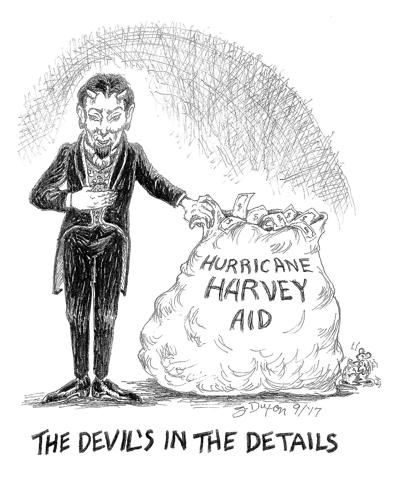
Hurricanes Harvey and Irma sent that message again, emphatically, in recent weeks. Hurricanes viciously kill and destroy. They play for keeps and shouldn’t be played for politics.
But that’s what happened earlier this month when Congress agreed to send a $15.25 billion aid package to Texas in Harvey’s wake.
The first vote came in the U.S. House, where representatives voted 419-3 to allocate $7.9 million for Harvey relief. Bipartisan support with an exclamation point.
But then the bill moved on to the Senate, where the aid amount nearly doubled and Democrats tacked on an extension of the government’s debt ceiling – the ability to borrow money and keep the government running – until Dec. 8.
This made the bill odious to conservative Republicans, who generally want to reduce the national debt and don’t want to go on record voting for an extension of the debt ceiling. So, Republicans had the choice of standing by that principle and voting against Harvey relief (appearing oh, so callous), or swallowing the bad to get the good.
To make it especially bad for Republicans, the Dems set a short extension rather than a long one, guaranteeing a messy showdown later this year when 2018 elections are close on the horizon. Republicans would rather not be out front on drastic action – shutting down the government or cutting beloved programs, right when the next election cycle goes into high gear.
Despite those political provocations, the vote in the Senate was 80-17 in favor, after President Donald Trump said he supported the Democrats’ proposal. Both Missouri senators, Democrat Claire McCaskill and Republican Roy Blunt, were in the majority.
The measure went back to the House, where the Republicans made a slightly stiffer show of resistance in a 316-90 vote to pass the measure. All 90 nays were Republicans, including all six Missouri Republicans, and all three whose districts have a piece of Jefferson County – Jason Smith (District 8), Blaine Luetkemeyer (District 3) and Ann Wagner (District 2).
Wagner, whose district takes in northeast Jefferson County, explained her vote in a prepared statement.
“Tying reckless spending policy to desperately needed emergency disaster relief sums up what people, myself included, hate about Washington politics.”
Constituents probably can identify with that feeling, even if they disagree with Wagner’s vote.
Shame on the Democrats for using urgently needed hurricane relief as a political bargaining chip.
Shame on those Republicans who voted against the aid package, refusing to put aside ideology at such a trying time.
And, kudos to President Donald Trump for doing what he said he’s there for – making a deal.