
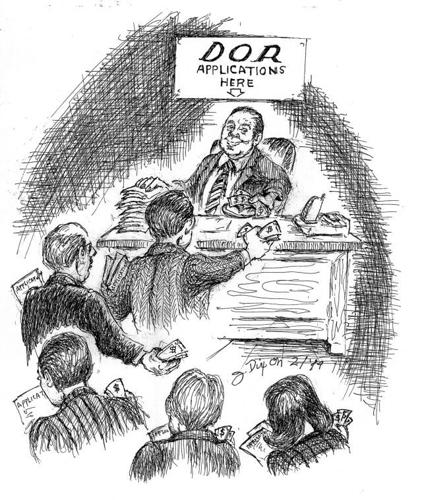
Published in the Feb. 27 Leader newspaper
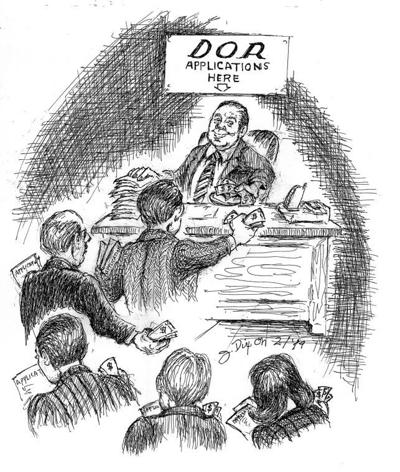
Missouri’s institutionalized kickback system has come razor-thin close to kicking a Jefferson County charity out of business.
The Arnold Jaycees, which is a non-profit organization if not an out-and-out charity, has run the license office in that town for 40 years but was notified it no longer would as of March 7.
The organization used the fees it collected over those decades to make more than $500,000 worth of donations to the community. The donations went to a wide range of causes, from playground equipment for several schools to funding a community skate park to purchasing dogs for the police canine unit.
A month ago the Jaycees were notified they would no longer run the office. The competitive bid had been awarded to a Jefferson City pair who incorporated a for-profit company in 2011 named License Office Services LLC. The company now runs the Des Peres and Creve Coeur fee offices in St. Louis County.
There is still hope for the Arnold Jaycees. Late last week, the Missouri Department of Revenue (DOR) announced it had canceled the contract with License Office Services for the Arnold fee office “due to issues that have been raised,” according to a DOR spokesperson.
Well, that explains everything – “issues that have been raised.”
The Jaycees have gotten an extension to run the office until May and plan to apply when DOR reopens the bidding.
License Office Services also was awarded the Cape Girardeau office, though that office’s former operator, the Southeast Missouri State University Foundation, has filed an appeal with the DOR.
Gov. Jay Nixon, shortly after taking office in 2009, announced that the 183 fee offices would be awarded in competitive bidding. For decades, they had been awarded as political plums to supporters of the party in power, though some non-profits, such as the Arnold Jaycees and the Twin City Area Chamber of Commerce, had kept the offices for decades in spite of having no political positions.
The Twin City office recently was awarded once more to the local chamber, which submitted the only bid. For whatever reason, License Office Services LLC was not interested.
The DOR bidding process actually began late in the single term of Gov. Matt Blunt. The kickback scheme began gently, with one of the elements on the application awarding bonus points for “charitable” giving.
After the Nixon administration took over, the question morphed from how much will you give to charity to how much of the gross will be kicked back to the state.
Subtle, huh?
In Arnold’s case, License Office Services said it would “rebate” 1 percent of the fees it collects in fiscal 2016 and 2 percent at the start of fiscal 2017. Based on the most recent fiscal year, that initial 1 percent rebate would have meant $1,767 going back to Jefferson City.
Woo-hoo. That’s versus a half-million dollars that stayed in the community over the last 40 years.
The Jaycees, in submitting its original bid, did not make such an offer, which was optional. According to the guidelines and scoring system used by DOR, however, non-profits and community service organizations could earn an extra five points with their good deeds. It’s not clear how that stacks up against the power of a kickback.
According to the DOR’s own press releases, it is willing to sell itself pretty cheaply. For example, on Feb. 14, it awarded the office in Kingston, a town of 300 that is the county seat of Caldwell County, just northeast of Kansas City.
The awardee, Melissa Prater of Kingston, included a 0.12 percent – roughly 1/8 of 1 percent – “rebate” in her bid. Based on the 10,500 transactions and $35,000 in fees the small office generated last year, the “rebate” will generate a whopping $42 for the state of Missouri.
That would have been barely enough to send a consolation bouquet to the Arnold Jaycees!
In some of those rural offices with low volume, the DOR is probably lucky to get any bids.
The Twin City office stacks up as one of the busier ones, with 70,000 transactions in fiscal 2013, averaging $3.10 per transaction and bringing in $217,500 in fees.
Using that same average, an office that did 10,000 transactions in a year would earn only about $31,000.
Out of its $31,000, that small office would have to pay rent, utilities, supplies and equipment mandated by DOR, plus salaries for any employees. Bottom line, both DOR and the people who live in Kingston are lucky to have an office there.
Meanwhile, the DOR is doing its part – $42 at a time – to help our state get fiscally healthy. And Arnold good causes that received $500,000 over the last four decades came that close to losing a benefactor. And still might.
That sounds about par for the course.