
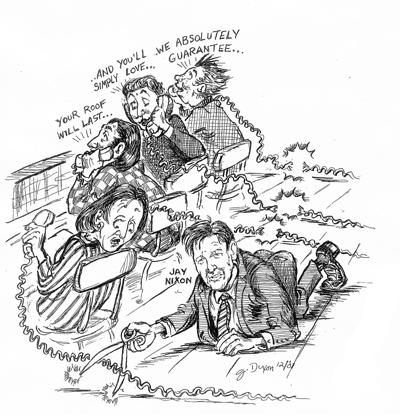
Wow, has it really been 30 years since a fresh-faced lawyer bounded into the Courier-Journal office on Festus Main Street and declared he was running for Missouri Senate?
Actually, no. It’s been 31 years, nearly 32.
I remember that because Jeremiah “Jay” Nixon of De Soto was not yet old enough to serve in the Senate – he was 29.
“But I will be (30) by the election,” he said, excitedly. Clearly, this was a young man with a plan – and in a hurry.
Nixon, who will turn 61 on Feb. 13, leaves Jefferson City on Sunday after eight years as governor, which followed 16 years as attorney general and six years in the Senate.
Yes, he won that 1986 election, besting two longtime and better-known Democrats, Sheriff Walter “Buck” Buerger and then-Presiding Commissioner Ralph Krodinger in the Democratic primary election. In those ancient days, winning the Democratic primary was the same thing as winning the election.
Nixon became the first politician ever in Jefferson County to spend the unheard of sum of $100,000 on that race. That wouldn’t pay the postage bill for nasty campaign fliers today. In the last Senate race, in 2014, Republican Sen. Paul Wieland and Democratic challenger Jeff Roorda spent just under $1 million each going for a job that pays $35,915 per year for four years.
Nixon was seated in the Senate in January 1987, succeeding the always-entertaining Jack Gannon, then got busy. Within a few months, he announced he would run for the U.S. Senate in 1988.
Other Missouri Democratic pols thanked him for his service and got out of his way, for Nixon had volunteered for a suicide mission – taking on Republican John Danforth, an extremely popular and even more extremely wealthy incumbent.
I bet my old newspaper buddy Jack Lovelace that Nixon would get less than a third of the vote. Jack countered that a mannequin could get more than 33.3 percent. The bet was made, Nixon got 32 percent and I collected.
Nixon returned to the Senate and assured Jefferson County voters that he really wanted to serve there, so they re-elected him in 1990. He promptly began his next assault on higher office, running for attorney general in 1992.
The butt-kicking he’d suffered against Danforth in 1988 at least had gotten Nixon’s name on the statewide ballot, as well as earning him points with party bigwigs who had to find a sacrificial lamb for that race.
Nixon won a four-man primary election, then bested Republican David Steelman in the general election to become attorney general.
Thus began one of the contradictions of Jay Nixon. With his sights trained ever higher, Nixon was an extremely visible attorney general. He put out press releases by the bushel, trumpeting successful lawsuits against people and companies who violated Missouri law and were forced to pay fines.
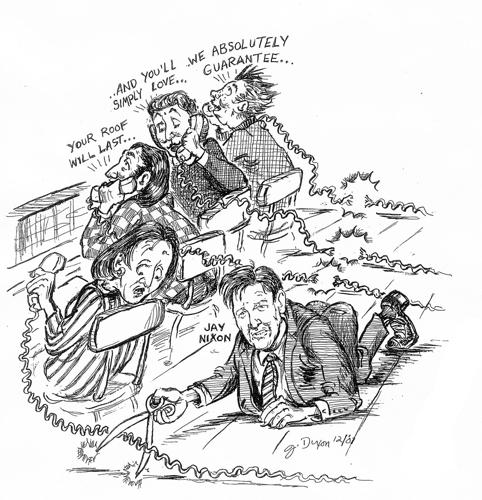
He fought for a no-call list law in Missouri, got it and then harangued those who would violate it. The no-call list was one of Nixon’s great successes – in its early days, it actually seemed to work. By the time Nixon ended his stint as attorney general in 2009, technology had made it possible for untraceable off-shore call centers to resume their torture of anyone with a land line. But it was great while it lasted.
As attorney general, Nixon embraced the odd lawsuits that would bring him publicity, such as the time he went after Miss Cleo, an alleged fortune teller, for violating the no-call law.
After Miss Cleo protested that she hadn’t defrauded anyone and expressed surprise that anyone would think she had, Nixon observed, “She should have seen this coming.”
Badda boom! Eventually, Miss Cleo paid a $75,000 fine.
Nixon had extreme good luck in 2008 when, after he announced he would run for governor, incumbent Republican Matt Blunt decided not to seek a second term. Nixon won the nomination and the election.
That was the good news. The bad news was he had a Republican House and Senate not the least bit interested in giving him any legislative victories, and a Republican lieutenant governor in Peter Kinder who spent eight years sniping him publicly.
Nixon led with his chin, making license office reform an early priority.Missouri’s fee offices had been patronage plums for political insiders, but some were operated by civic groups that used the profits for their do-good work, such as the Arnold Jaycees and the Twin City Area Chamber of Commerce.
Nixon made no friends when those agencies and their supporters thought they were going to lose their funding. Quietly, the “reform” movement left such license offices largely alone.
Surrounded by political enemies, Nixon went into a bunker mentality soon after assuming the governor’s office. Even his department head appointees were not allowed to speak to the press and Nixon himself was wary and inaccessible.
He visited Leader World Headquarters once in eight years.
Seemingly focused on higher office once again, the Jaybird was sometimes mentioned as a possible vice-presidential candidate, the thinking being that a relatively conservative Midwest governor might make a nice balance to whichever coastal left-wing whacko the Democrats were likely to run.
Then Ferguson happened.
The Michael Brown shooting in August 2014, along with Nixon’s disastrous, stammering press conferences and the days of rioting and property destruction in Ferguson while National Guardsmen and police watched, effectively ended Nixon’s political career.
Goodnight, Gracie.
Heck of a run, though. Not many plot out their life strategy in their 20s and make most of it happen at such a high level. Jay Nixon did it.