
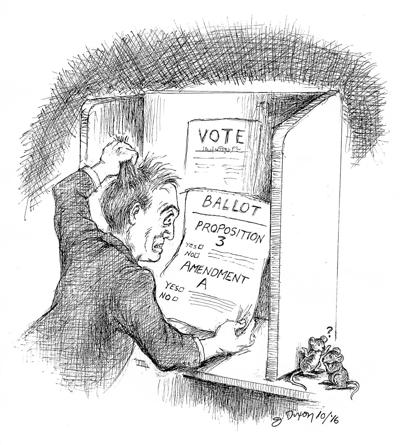
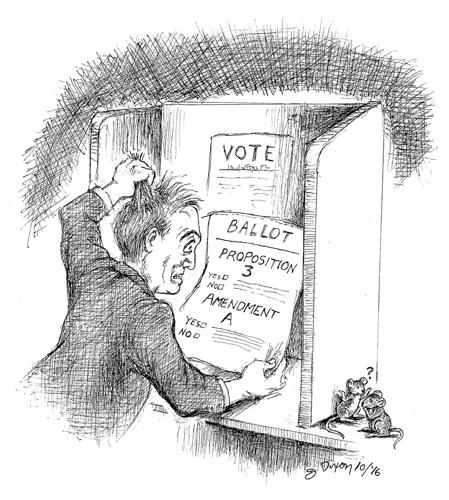
It isn’t just the top-of-the-ticket madness that we will deal with Nov. 8, friends and neighbors. We also have a Missouri Bizarro, Upsidedown World vote to cast.
Actually, votes.
There are five constitutional amendments and one proposition on the statewide ballot. Of these, Proposition 3 is a constitutional amendment that would raise cigarettes taxes by 60 cents per pack to 77 cents. Amendment A is an initiative petition that would raise tobacco taxes by 6 cents a pack.
Both measures are sponsored by tobacco companies. Both are opposed by health advocacy organizations including the American Lung Association, the American Cancer Society and the American Heart Association.
Welcome to Upsidedown World.
The explanation, actually, is fairly straightforward. Proposition 3 is being pushed by Big Tobacco, which for years has been fighting increased taxes on cigarettes in Missouri, which has the lowest rate in the nation at 17 cents. The national average is $1.65.
With Proposition 3, Big Tobacco is proposing the 60-cent increase be eased in over four years.
Big Tobacco’s proposal also has a measure to increase by another 67 cents per pack the product of off-brand companies. Let’s call them Little Tobacco. Big T would like to gut punch Little T and make it harder for them to undermine Big T’s name-brand cigarettes,
Proposition A, as you might guess, is sponsored by Little Tobacco.
Both measures are opposed by the health people who don’t really care who gets the tax money. They want the price increase to be painful and sharp so youngsters will not take up the habit, and smokers will give it up. They say a gradually introduced tax increase won’t accomplish either of their goals.
They also are worried about a section in Proposition 3 that prohibits any of the money from going to cloning or embryonic stem cell research, or toward tobacco research.
As bizarre as it seems that the tobacco companies are eager to tax themselves and the health people don’t like these proposals, that may be the simplest part of this situation. Here’s where it gets tough, so hang in there with me.
Because there are two similar proposals on the same ballot, there are some officials suggesting that Article III, Section 51 of the Missouri Constitution may come into play.
That section states that when “conflicting measures” are approved in the same election, “the one receiving the largest affirmative vote shall prevail.”
Nanci Gonder, spokeswoman for Attorney General Chris Koster, told the Associated Press that the section may not apply. She also said if both measures pass, the courts may have to decide if one or both go into effect.
Chuck Hatfield, a lawyer and spokesman for one of the Little Tobacco companies, took the does-not-apply stance. He said to be in conflict, one measure would have to be opposite from the other, such as if one ballot question asked whether to institute a tax while another asked to ban the same tax. In that case, he said, most votes wins even if both are approved.
Ballotpedia, the online listing of all elections in the known universe, disagrees with Hatfield and states that in the Missouri case, only one tax can be enacted if both are approved, and that it will be the one with the most votes.
It’s hard to know how to vote if you don’t know how to tote up a win or a loss.
The health people, unconcerned about the revenue implications, say just vote NO until a bigger tax can be tackled.
I’m not sure if any of those people have ever been to Missouri, where we rarely sit around and puzzle out a ballot issue this way: “Well, I’d like to vote for this tax, but I don’t think I will because I’d rather vote for a BIGGER tax increase.”
So if the health people are urging us to vote NO because they want a bigger tax later on, it would almost tempt me to vote YES. On the other hand, it could just be a liberal commie conspiracy to get me to vote yes by telling me to vote no.
Oh, the humanity!
Knowing where the money would go might help some voters decide. Big Tobacco’s Proposition 3 is estimated to raise between $263 million and $374 million per year, with the bulk of it going to early childhood education. Just a sliver would go to smoking cessation programs, so maybe there’s a clue.
Proposition A is estimated to bring in between $95 million and $103 million annually to be earmarked for transportation infrastructure.
Can’t you just picture the photo op? “Ladies and gentlemen, I cut the ribbon and present to you, the Brand X Bridge!”
Maybe the hardest part of all is trying to determine who is the least trustworthy – tobacco companies or people trying to separate us from our money.
Of course, for the 79 percent of Missourians who don’t smoke (though that’s only 74 percent or so in smoky Jefferson County), it gets down to philosophy and fairness. Or maybe it gets down to finding a new way to fund education or build bridges. Or maybe it gets down to being healthy and not wanting our kids to take up smoking.
If your head isn’t spinning by the time you go to vote, dear reader, you’ll have to decide what it comes down to.
Good luck with that.