


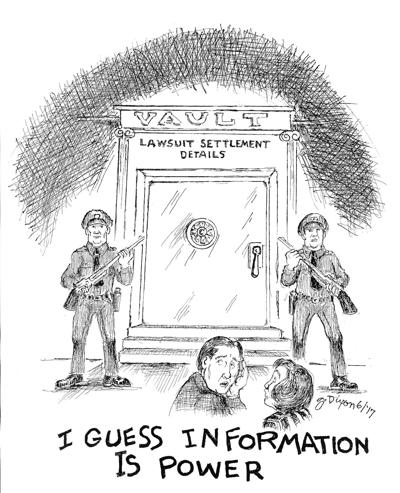

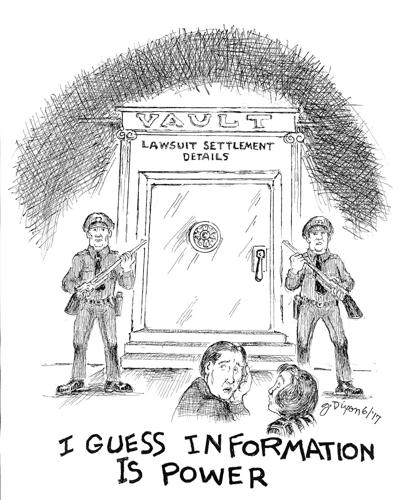
The settlement announcement for the Michael Brown civil suit last week had a familiar stink to it. A U.S. District judge said the details of the settlement, including the amount paid to Brown’s parents, would not be made public, saying that revealing the information would have an adverse impact on the plaintiffs.
As for the taxpayers, well, I guess he figured they could go jump.
Within a few days, a lawyer for the city of Ferguson spilled the beans. The city was one of the defendants in the case stemming from Brown’s 2014 fatal shooting by a Ferguson cop.
The stench coming from the judge’s initial attempt to keep the $1.5 million settlement secret brought back the odors of the Fox C-6 School District’s insurance company’s 2016 settlement with three district residents who sued for defamation allegedly made online by current and former Fox administrators.
The conflict with the three residents was the opening salvo in the Dianne Critchlow caper, an 18-month sideshow from the now retired superintendent whose spending habits eventually triggered a state audit of the district’s books. Despite a scathing report from State Auditor Nicole Galloway about improper use of district funds, county and federal prosecutors did not seek charges.
The lawsuit was defended by the district’s insurance company. Because the district was not named as a defendant, the settlement was not made public, as required under Missouri law when tax money is used to settle a lawsuit.
Oh, the contortions! Somehow, the district’s insurance company agreed to defend the current and former employees, even though exclusions in the policy seemed to indicate such behavior would not be covered. More magic occurred when Fox swore up and down it paid no deductible on the settlement, even though the policy plainly said there would be a $10,000 deductible per incident.
The very best head-shaker was that Fox didn’t know any of the details of the settlement because it wasn’t a defendant. After weeks of requests from the Leader, the district reluctantly asked its own insurance company for a copy of the settlement. The insurance company refused to give it to the district, which had hired the company and paid the premium for the coverage!
The Leader then filed a complaint with the Missouri Attorney General’s office, asserting that the secret settlement violated Missouri’s Sunshine Law, which required disclosure. The AG’s office, in effect, said there wasn’t enough evidence of a violation to pursue action against the district. The Missouri Press Association attorney who wrote most of the state’s Sunshine Law strongly disagreed. In fact, she considered it to be pretty much an open-and-shut violation of the law.
At the minimum, the whole thing was a mountain-sized crock of evasion and tap-dancing. The settlement figures never were made public.
Like the Brown case and settlement, this one wound up in U.S. District Court. Perhaps there’s something in the water at the Thomas F. Eagleton United States Courthouse in St. Louis.
The difference in the Brown case was that the city of Ferguson was named as a defendant, whereas the Fox district was not.
Fox officials reading this column may be wondering, “When is this guy going to let this go?”
Short answer: Probably never. To quote the immortal Bluto Blutarsky, “Nothing is over until we decide it is.”
People were paid off by a school district’s insurance company, which was paid premiums from tax dollars. The public should know the amount of the payoffs.
Despite its flaws and loopholes, the Sunshine Law is probably the favorite of all laws here at Leader World Headquarters. Most of those who are inclined to ignore it, such as your public officials, are keenly aware of its weaknesses.
The worst is the exemption for litigation, which is generally invoked by an elected official who doesn’t want to give up information or hold an open meeting “because we might get sued.” That is not a legitimate reason, of course – there has to be an actual lawsuit for it to apply – but the burden and expense of proving them wrong in court is shifted to the citizen or media member who disagrees.
So, the Sunshine Law has enough problems without being potshotted by federal judges.
All we know is, this whole “enemy of the people” narrative about the press that has become popular in the last year or so is about as self-destructive a tactic as you can imagine for someone who wants to live in an open-information republic.
That movement emboldens politicians to stretch the law to the breaking point if they think the watchdogs who call them on it have become so demonized, unpopular and demoralized that they’ll just give up.
It starts with stuff like withholding information about how your money is being spent to pay for the misdeeds of your elected officials. It’s our belief most taxpayers want to know that.
Our conservative friends are fond of quoting the sainted Founding Fathers, so we’ll end with a thought from Thomas Jefferson, maybe the foundingest of them all.
“Were it left to me to decide whether we should have a government without newspapers, or newspapers without a government,” he said, “I should not hesitate a moment to prefer the latter.”
Amen, Brother Tom. You’re my kind of founder.
Truly open government is something to ponder as we celebrate the Fourth of July weekend and all that it symbolizes.