


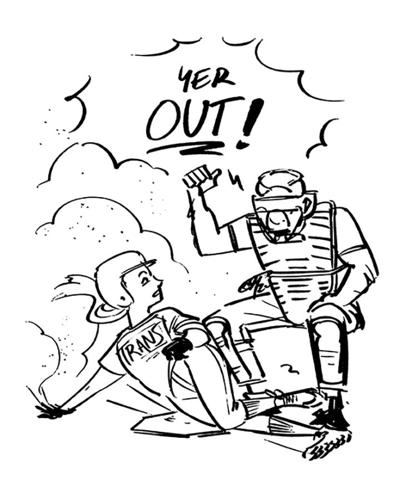

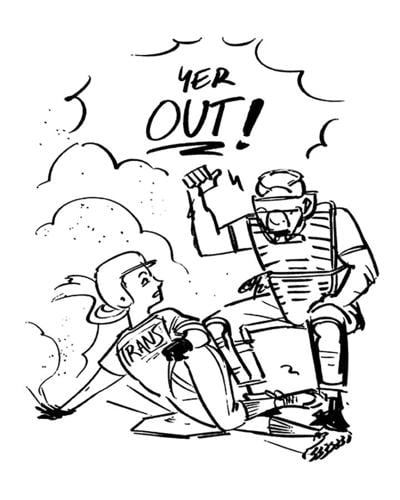
It’s hard to see through the heat and smoke of the controversy over transgender athletes competing in women’s sports. Emotions and gut feelings have the upper hand on deliberation and factual analysis.
But I will try.
At this writing, 15 states have enacted bans on transgender female athletes (males transitioning to females) from participation on girls’ or women’s athletic teams at the middle school, high school or collegiate levels.
Missouri lawmakers are angling to add the Show-Me State to that list.
On April 28, two Missouri House bills on unrelated subjects (HB 1973 and HB 2140), both having transgender bans tacked on as amendments, were approved and advanced to the Senate, which has its own transgender-ban bill, SB 781, still in the pipeline. HB 2140 includes a provision making the ban subject to a public vote and to follow-up study.
Before I go any further, let me say I don’t discount emotion and gut feelings when it comes to your daughters and granddaughters, or mine, having fair and open opportunities to compete in sports. Everyone’s goal, I would hope, is to balance fair competition with inclusion.
But the legislation, as we’ve seen it so far, isn’t the answer. It is problematic for at least four reasons.
■ It may violate federal law. The landmark Title IX provisions, enacted 50 years ago, prohibit discrimination, based on sex, in education programs and activities that receive federal funds. With the U.S. Supreme Court’s Bostock v. Clayton County decision in 2020, which defined “sex” as including gender identity, the state transgender ban could well be on shaky ground legally.
■ Research on the actual medical science behind the issue is limited and inconclusive. The basis for bans is the belief that transgender female athletes, being former males, automatically have physical advantages (strength, speed, endurance) over biological (“cisgender”) females.
Relatively few studies on hormone-suppressed trans females have been conducted; some have found little to no significant advantage on most measurables.
Much more research is needed, especially with states enacting complete bans based on assumptions and anecdotes rather than hard scientific evidence.
■ Sports-governing authorities already have set their own guidelines. The agencies and associations that govern sports are way ahead of state lawmakers on this issue. They include the Missouri State High School Activities Association
(MSHSAA), dozens of national sports-specific federations – for example, USA Soccer and USA Track and Field – and the International Olympic Committee.
Of the 52 sports federations tracked by the website transathlete.com, 28 have no transgender policy, presumably because they have yet to detect a need for one. These include the national governing bodies of archery, basketball, bowling, field hockey and softball.
The other 24 have adopted a range of eligibility requirements for transgender females, the most common being proof of reduced testosterone levels through hormone suppression treatments.
In 2015, the International Olympic Committee settled on a standard requiring 12 months of reduced testosterone levels (below 10 nanomoles per liter) before a trans female can compete in women’s sports. The 10 nml/L standard has gained wide recognition because years of experience have shown it correlates with trans female athletes competing on a par with cisgender females.
It’s worth noting that some federations impose much stricter requirements on trans female athletes. USA Swimming withholds eligibility until the athlete has kept testosterone below 5 nml/L for three years.
Lia Thomas, the University of Pennsylvania trans female swimmer who became a national lightning rod for controversy in March as the first trans athlete to win an NCAA title (500 meter freestyle), will have to meet that standard to compete for a spot on the 2024 U.S. Olympic team.
■ In Missouri, the proposed transgender ban is a solution looking for a problem. MSHSAA has governed interscholastic sports in our state since 1926. It adopted a transgender policy in 2012 and updated it in 2019 to reflect current medical terminology.
The policy requires transgender student-athletes to apply, through their school, for eligibility to compete according to their gender identity. Trans female athletes have to document undergoing 12 months of hormone suppression therapy “for diagnosed gender dysphoria and/or transsexualism,” quoting from the MSHSAA Handbook.
I asked Jason West, the association’s communications director, how many transgender student-athletes have completed the application process and gained eligibility. Answer: Seven, with five currently in school.
Seven kids in 10 years. MSHSAA’s latest head count shows 287,401 students from 736 junior high and high schools participating in sports and other activities. The five active transgender athletes represent 0.00174 percent of all the kids playing sports in our state.
No, girls’ sports teams in Missouri are in no danger of being overrun by transgender females flexing their muscles and stealing college scholarships. Although you wouldn’t know it from the title of the Senate bill: the “Save Women’s Sports Act.”
Jason told me “a few” legislators reached out to the MSHSAA office, “asking if the association has any policies regarding transgender student eligibility.” He said, “Sharing the current policy with them is the extent of our consultation.”
So, the lawmakers cooked up these bills, seeking no input – other than a copy of the policy that’s been publicly available for 10 years, right there in the handbook – from the very organization that has administered school sports in this state for 96 years.
One can wonder if such urgent, driving inquiry goes into other laws disgorged by the great sausage factory in Jefferson City.