


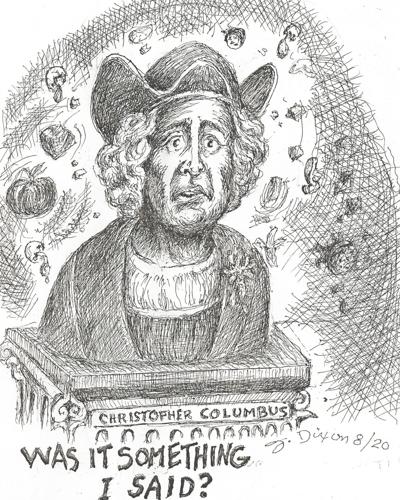
The famed Italian explorer, one of the first historical figures most of us learned about in elementary school, died more than 500 years ago. Now his legacy melts before our eyes with the removal of statues, busts and other memorials in his honor.
Some simple online research reveals that Christopher Columbus is probably the second-most commemorated figure on Planet Earth (I’m guessing he runs a distant second to Jesus Christ.) You can find statutes and various other monuments to ol’ Chris in 26 U.S. states and 31 other countries. The head count in the U.S. is at least 171, including three memorials in Missouri and an amazing 38 in New Jersey, a state with a large Italian-American population.
At last count, 35 of the U.S. monuments have recently been removed or are scheduled to be removed, or have suffered decapitation or outright destruction by angry protesters. And before you start pining for the good old days when people respected public memorials, I remind you that their sometimes violent removal is as old as our country. When the Declaration of Independence was read in New York City for the first time, on July 9, 1776, a gang of rowdy patriots hauled off a statue of King George II and melted it down to make bullets for the fledgling Continental Army.
But should Columbus really get the heave-ho?
Sometimes monuments are slam-dunks. The sports world is full of them. We honor Stan Musial with a 10-foot-tall figure in bronze (alas, not looking at all like “The Man” at bat) outside Busch Stadium. The Chicago Cubs commemorate Ernie Banks the same way, as do the Pittsburgh Pirates with Roberto Clemente.
It gets more complicated when you move out into society. The Founding Fathers were slave owners. No getting around that. But if you focus more on what they achieved publicly, rather than who they were privately, you find a basis for honor.
“The signers of the Declaration of Independence were brave men… they loved their country better than their own private interests… they were statesmen, patriots and heroes, and for the good they did, and the principles they contended for, I will unite with you to honor their memory.”
You know who said that in 1854?
Frederick Douglass, the former slave and original champion of Black civil rights and a man worthy of great honor in his own right.
Back to Columbus. His four pioneering voyages across the Atlantic Ocean, between 1492 and 1502, connected Europe and the Western Hemisphere in the first extension of western civilization to “the new world.” As such, he ranks among the greatest explorers of all time.
But the famed mariner, under Spain’s sponsorship, also was the first to give “colonization” a bad name. He and his brothers Bartolomeo and Diego ruled the island of Hispaniola (today divided between Haiti on the west and the Dominican Republic on the east) with such brutality that the Spanish government removed them from power and imprisoned all three of them upon their return from the third voyage.
Yes, Columbus was a cruel conqueror by any historical standard. But the man was literally a pivot point in human history. Hence all the monuments.
And how about the place names? There are nine U.S. cities named Columbus (in Georgia, Indiana, Kansas, Mississippi, Montana, Nebraska, Texas and Wisconsin, in addition to the capital of Ohio), plus six Columbias, including our own 120 miles west of us. And of course, there’s the District of Columbia, our seat of federal government.
One of the largest religious organizations in the world, the purveyor of those wonderful fish fries during Lent, is the Catholic Knights of Columbus. Do you want to be the one to demand they change their name?
Leave be the monuments and memorializing. But not the history books. Let our schoolchildren learn the full truth about Columbus, the great explorer and great exploiter of humanity.
I liken the Columbus controversy to a smaller one about a more recent heroic figure, one with local connections: Charles Lindbergh. His daring 33-hour solo flight across the Atlantic Ocean, from New York to Paris in 1927, electrified the world. But 13 years later he led an “America First” movement that sought neutrality toward Nazi Germany and opposed U.S. involvement in World War II. That stance cast a shadow over his public image for the rest of his life.
None of that, however, detracts from his remarkable achievement, a moment in time when he put wings on mankind’s quest to conquer the air. Astronaut Neil Armstrong, the first man on the moon, stood on Lindbergh’s shoulders to make the “one small step for man, one giant leap for mankind.”
Would it be nice if our heroic-deed-doers were honorable people, too? Of course. But good luck finding real saints among us flesh-and-blood types. Maybe the best we can do is to raise our children and grandchildren to dare and dream like Columbus, but play the game of life like Stan Musial played baseball.
I will let another of our heroes, Abraham Lincoln, have the last word.
“I like to see a man proud of the place in which he lives,” wrote our 16th president. “I like to see a man live so that his place will be proud of him.”