


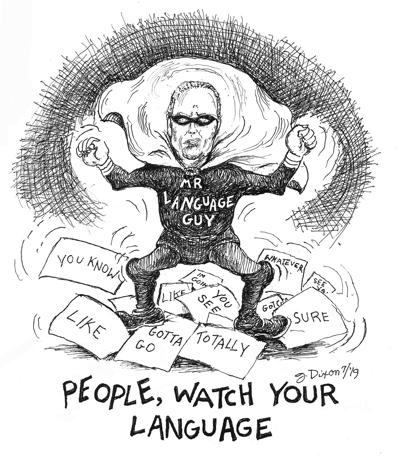

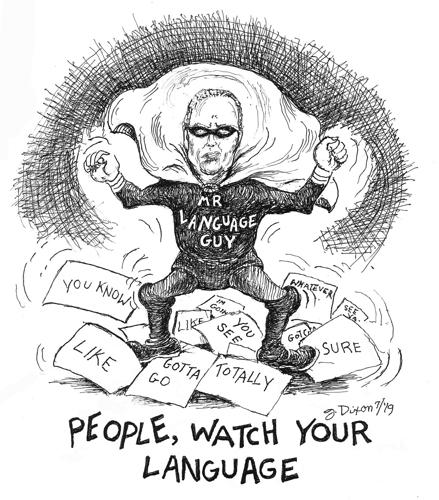
I come to you today with a combination rant – the return of Mr. Language Guy, who somehow has partially morphed into Cranky Old Man. Buckle up – it could be a bumpy ride.
And yet, it started off as an innocent idea, a noble one even – a defense of the proper and healthy use of the word “like.”
In my kidhood, our biggest concern on this topic in Baby Journalism School was learning the difference between “like” and “as.”
Correct example: “I’m as helpless as a kitten up a tree.” (Johnny Mathis, 1959).
Doubly incorrect example: “I’m like, helpless like a kitten up a tree.” (Every living soul under the age of 30 and quite a few older ones).
Which brings me – improbably – to texting. I admit to being a late adapter to this form of communication, which has had the unfortunate side effect of tying the tongues of today’s youth. They refuse to answer a telephone, they text each other across the table rather than speak and seem to be in a state of terror if they must use the spoken word.
That all sounds pretty bad, which it is, but this cloud has had one enormous, sky-filling silver lining. It has spared those of us who still speak and – especially, listen – untold billions of ear-cringing “like” assaults.
Even with those subtractions, though, the attacks continue.
“I’m like (now start your thought)...”
“Totally, then he was, like……”
“Then I’m like….”
Continue for 124 more lines, all starting the same way. Oh, the horror. If you are in a confined space and cannot escape, resist the urge to produce and use any weapons that may be on your person, or even to use your bare hands. We must remain civilized.
I have no sure-fire answers, but a notion or two that might make a dent.
Speech classes used to record students (or more recently, shoot video) and then make them listen to or watch themselves. This can be excruciating for the speaker, but it also can be embarrassingly effective. I had a similar public encounter several decades ago.
A well-dressed older woman, who had overheard me interviewing someone in a restaurant, stopped me on the way out and pointed out in a teacherly way that I constantly used the phrase “you know” where a pause was needed for a verbal comma. I was mortified, but also cured on the spot, touched by a linguistics angel.
So it can be done, with a proper approach and motivation. I’d start with jail time, but that’s just me.
Mr. Language Guy and those like him are tilting at a formidable windmill. What does it matter, a gentler soul might ask, if millions of people start billions of sentences every day with “I’m like,” even if they are not remotely like what they say next?
To answer that question, I’ll go to an expert, which is defined as anyone who lives more than 50 miles away. My expert is the Academy of Linguistic Awareness, which could be a made-up thing from someone’s basement, but which has a website, so – expert.
It has a brilliant poster which is headlined, “Don’t Sound Stupid – Stop Saying Like.”
A subhead next to the picture of an open-mouthed woman reads, “Is it, like, because I, like, say ‘like,’ like so much?”
No answer needed.
There are numerous blogs and columns online which usually follow the theme of, “Ten Things Never to Say at Work” or “20 Phrases that Make You Sound Less Intelligent Than You Are.”
Nearly all of them have Like Abuse near or at the top of their lists.
Sadly, while these authors are kindred spirits of Mr. Language Guy and therefore 100 percent correct, the reality is that we are sadly outnumbered. Like Abusers are the grains of sand on the beach and those who (self?) righteously call them out are the rarest of polished stones made wise by their decades in the surf of life.
Young people, of course, always have opted for slang to distinguish themselves from their clueless elders and to try to speak in a code that oldsters cannot break.
If it were only teeny-boppers in the Like Abuse ranks, that wouldn’t be so alarming. We could wait them out.
But I now routinely hear people in their 40s, 50s, 60s and older let loose a string of Like-begun sentences, and its evil cousin, “I’m going,” when in reality they are not going anywhere. I wonder whether it is unconscious or if these grandmas and great-uncles are trying to sound cool.
They do not.
So let us start with mature Americans who say they speak English. Please do not begin sentences with, “I’m like” or “I’m going.” It doesn’t make you sound cool – it makes you sound like you’re trying to be your teenager’s best friend, which is both pathetic and bad parenting.
Longer term, you are contributing to the degradation of our language, which is the first step to oblivion.
Rome wasn’t lost in a day. It was lost when Latin speakers began to start sentences with, “Ego sum similus.” A little-known fact, but possibly true.
Like it or not.