


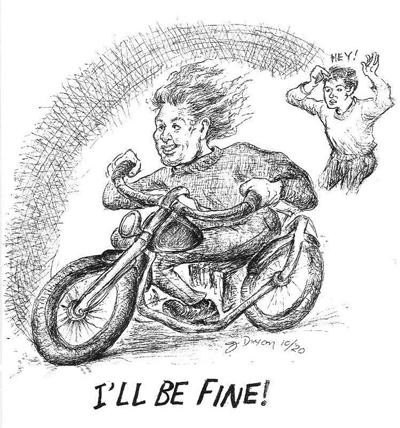
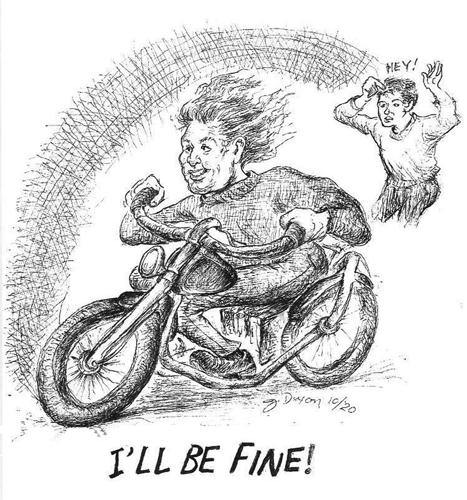
My husband gasped as we sped down I-55 in Jefferson County a few weeks ago.
“Look at those guys on their motorcycles!” he hollered, from behind the wheel of our Ford Escape. “They’ve only got their hair to protect them!”
Take it from Mike Roth, a motorcycle rider for more than a half-century, and the husband of my friend, Chris.
No matter how thick someone’s hair is, it’s not going to be enough in the event of an accident aboard a motorcycle.
The three riders Gordon observed were all helmet-free – legal in Missouri as of Aug. 28 – their hair flying wildly in the whipped-up breeze. It was a sunny, late-summer day, and it didn’t take much imagination to sense their palpable joy.
A sight like that doesn’t warm Mike’s heart. It “spooks” him.
It takes him back to the day in 1969 when his life would have ended, but for his motorcycle helmet.
“It was one week after my high school graduation,” he said. “I was riding my motorcycle when a lady made a left-hand turn right in front of me. She said she didn’t see me.
“My head hit the steel post between the front and back doors and dented the side of her car.”
Mike suffered a broken leg and separations of both shoulders, and spent the summer before he started college in casts and on crutches.
But he was alive.
“I am 100 percent convinced that my helmet, which was basically destroyed, saved my life,” he said.
Over the last several years, he has followed with dismay the Missouri Legislature’s repeated attempts to overturn our state’s helmet requirements.
And after Gov. Mike Parson signed it into law on July 14, it has happened.
“They say it’s about personal freedom,” Mike said. “But, to me, it (requiring helmets) is something that is almost not even an argument. I am living proof that it works.
“And what about my personal liberty, when I’m driving down the road and I have to see brains scattered all over the place because someone didn’t wear a helmet?”
Missouri passed its original helmet law in 1968, along with 46 other states that had to require helmets if they wanted to keep receiving federal highway dollars.
But as Congress backed away from that threat over the decades, the states followed suit.
According to the Insurance Institute for Highway Safety, only 18 states and the District of Columbia still have universal helmet laws. Three states have no helmet laws at all (Illinois, Iowa and New Hampshire), and Missouri is among the other 29 states that have kept some restrictions.
In our case, House Bill 1963 – overwhelmingly approved by the General Assembly, with unanimous support from all legislators representing Jefferson County and Eureka – requires helmets for riders under age 26 as well as proof of insurance for anyone who chooses not to wear a helmet.
Interestingly, though, law enforcement is not allowed to stop a motorcyclist to check if the rules are being followed. So, if you’re looking for real teeth in this law, you’re out of luck. You might as well be on aisle six in a denture store.
Mike has statistics on his side. California first required helmets, then didn’t, then reinstated them in 1992. The next year, motorcycle fatalities decreased by 37 percent.
Nebraska saw a 22 percent decline in serious head injuries among motorcyclists in 1990, the year after it went back to requiring helmets.
And the National Highway Traffic Safety Administration (NHTSA) cites two 2008 studies that found a decrease in risk of death of 37 percent to 42 percent for helmeted motorcyclists compared with their bare-headed cohorts. The “wind in their hair” folks are also three times more likely than helmeted riders to suffer traumatic brain injuries.
Mike noted that some people claim helmets increase the risk of neck injury, but more than a dozen studies refute that, the NHTSA says.
In 2019, 118 people on motorcycles died in Missouri – bad news because it reflected a 10 percent increase in motorcycle deaths while the overall rate of traffic fatalities was down by 5 percent.
Odds are, you will hear further bad news regarding the number of Missouri motorcycle fatalities a year from now.
That’s what happened in other states, and they switched course after seeing more deaths, more hospitalizations and higher insurance costs for all.
Missouri could reconsider, too, if the evidence is striking enough. No one wants that to happen, but if it does, facts are facts.
Mike is a missionary with an exclamation point on his point of view. He’s nearly 70 and has been battling stage 4 melanoma since 2017. He values every day.
And riding a motorcycle continues to be a joy. In summer 2018, the year after his diagnosis, Mike took an 11,000-mile solo bike trip to California, up the West Coast, to Glacier National Park in Montana. After chemotherapy, brain surgeries and ongoing immunotherapy, can you imagine the guts that took?
“It (motorcycle riding) is an absolutely wonderful mode of transportation,” he said. “You get a feeling of freedom, with the wind in your face and an overall view of the world, without windows and roofs.”
He vows he’ll be out there on the roads for as long as he’s able. You might even see him.
He’ll be the one wearing a helmet.