
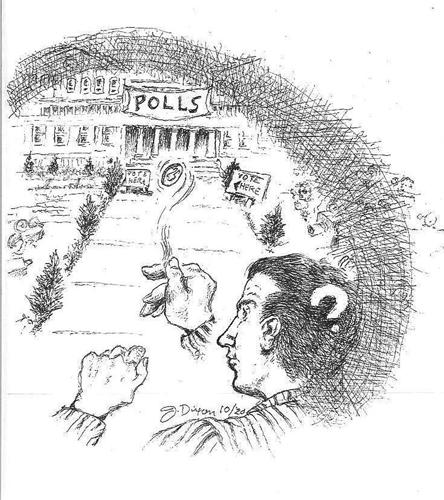
We have 12 days to go in this interminable election season that began Jan. 20, 2017. That was 1,366 days ago.
And to think God made the world in six.
An organization named the Center for Responsive Politics estimates that $11 billion will be spent on the 2020 election, $5.2 billion of that on the presidential race.
Presumably, that $5,200,000,000 will be spent by both sides trying to reach and convince undecided voters to back their slates.
As has been noted countless times, we are living in a polarized era. Minds are made up, have been for some time, and neither reason nor dynamite can change them.
If that is the case, and I think most Americans would agree on that if not much else, what are the campaigns doing with all that money?
I decided to undertake an unofficial survey, at no cost to anyone except my own time, to try to “take the temperature” of the average voter and see how this biblical flood, this fractured Hoover Dam of cash, was going to influence his or her vote.
Lacking experience in polling, energy, a staff and a reliable back, this was going to be a daunting task. Turns out it wouldn’t have mattered if I’d had all those things. What might have been helpful would have been a platoon of detectives, or maybe the entire Missing Persons Bureau of every police department in the land.
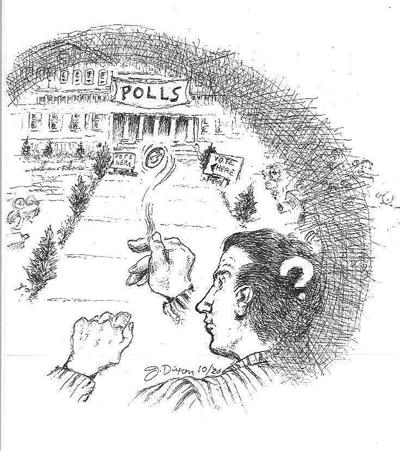
I couldn’t find any Undecideds.
With their privacy under assault for the past decade or two, people have gotten increasingly touchy about answering their phones or coming to the door unless they know who it is.
I sympathize with them. A month or so ago, a piece of one of our kitchen appliances snapped off. It seemed like a simple repair, so I went on the Internet to try to find the part, which naturally was unavailable. Now, every time I log on, I want to throw a log through the screen because I get assaulted with pop-up ads and pitches from the maker of the faulty appliance – like I’d buy anything else from those guys.
The meanness factor is also making people less approachable and more cautious. Election season used to see a full-throated, or at least full-lawned, expression of political beliefs. Yard signs were common.
Today, people are reluctant to make a public display of support for their favored candidate, presumably for fear that some lunatic from the other side will not just vandalize the sign, but might throw it or a brick through their front window – or worse.
So, with people not answering their phones or doors and few yard signs to guide us, how do we find the elusive Undecideds?
Rumors did trickle in. Supposedly there was an old farmer in Frumet who hadn’t made up his mind. There was a woman in De Soto and another in Danby who were friends and stewed on the phone every day about what they should do. A poker club in Arnold that just liked to argue claimed all six members were undecided. Single voters in High Ridge and Crystal City rounded out the roster.
All told, there are about 11 Undecideds in Jefferson County, the best I could figure. Here’s where the math gets interesting.
There are 3,143 counties in the United States. Some are in huge cities but most are rural. Jefferson County has about 225,000 residents, sixth most in the state. The average county in the U.S. has 100,000 people, so Jefferson County is 2.25 times the average size.
Stay with me now.
The $5.2 billion being spent on the presidential race, divided by 3,143 counties, comes to $1,654,470 per county. But Jefferson County is more than twice as populous as the average, so its share of that spending should be $3,722,558.
Swinging those 11 voters is going to cost one campaign or the other $338,414 per voter.
Does that seem efficient?
We have many problems in our country, some of which could be fixed with that kind of money.
Of course, that is naive. The people who give the big dough in political campaigns are not wasting – they are investing. They spend in the hope – some might say the knowledge – that the outcome will give them influence to make back many times what they’ve given.
That’s why the corporate big dogs frequently donate to both sides. It’s like going to the track, betting on every horse in a race, and still getting a good enough return on investment to make it worthwhile.
It’s also why meaningful campaign finance reform in Congress or any statehouse is the impossible dream. We are asking those who benefit most from the cash floods to shore up that dam.
Either by loophole or denial, they’re going to beat it every time.
When it comes to those votes, there are zero Undecideds.