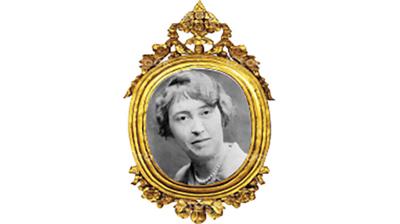
I’ve been spending a lot of quality time lately with my great aunt, Sarah “Mabel” Akins Kingsland.
Which is a little strange, considering she died 39 years ago and I have no recollection of ever meeting her.
Our paths must have crossed at family reunions, but the old Akins aunts – soft, round and white-haired by that time – blended together in my then-teenage mind. The one named Mabel left no impression at all.
Born in 1898, she passed away on Dec. 13, 1982, at age 84, remaining a mystery to me.
My cousin, Carolyn Huskey Scott, who selflessly spends much of her time sifting through and preserving family history, thought I should get to know her maternal grandmother, so she emailed me the journal Mabel kept from age 15 to 20 (March 1914 to December 1918).
The 105-page document turned out to be a treasure. I was riveted by Mabel’s description of everyday life in a bygone era, as she progressed from girlhood to womanhood and from dedicated student to capable teacher.
Mabel, one of seven children raised on a Bloomsdale homestead, traveled by train throughout Jefferson County, north to St. Louis and south to Cape Girardeau, where she attended a year of “normal” school, training to become a teacher. Her journal told me of her excellent grades at every juncture of her education and how she studied algebra with a handful of students during morning recess at “dear Stony Point School.” It was a subject not typically taught in public schools of the time.
I hadn’t looked ahead, so when the journal abruptly ended on Dec. 23, 1918, with no word of farewell, I felt bereft. Mabel had captured my heart, and it broke a little when I realized she was leaving me.
No more accounts of “apple-peelings” and games like “Drop the Handkerchief” at neighboring farms. No more recounting of family sing-alongs that could last for hours, or mentions of the neighbor boys who had clipped locks of her hair and bought her lunch baskets at community celebrations.
No more references, either, to her constant prayers for “dear boy Bryant,” the brother who had gone off for service in World War I, soon after he had finally decided to become a Christian.
During those years Mabel saw her first “picture show” – “Lord Loveland Discovers America” – a 1916 silent movie starring Arthur Maude and Constance Crawley, and enjoyed the pastime of “Kodaking,” traipsing through the countryside with friends, using their Kodak cameras to take photographs when the mood struck.
Especially poignant for me were mentions of Mabel’s brother Lewis, 9 years her senior. He was my grandfather and died long before I was born. My mother had idolized him, but she hadn’t shared many details of his life and had no photographs. He never seemed real to me.
But in Mabel’s journal, Lewis came to life. He’d been the fond big brother who’d bought his teenage sister an organ (for $20, equivalent to about $500 today!), who’d courted and married my grandmother, Bertha, during the journal years, and who was always inviting Mabel to come and stay for a while at the newlyweds’ home, where two “sweet” babies soon joined the family. Lewis and Bertha eventually had nine children; my mother, Flossie, was sixth, born in 1926.
One account of family fun involved “doing stunts” in the yard, when 28-year-old Lewis fell twice, causing all to erupt in laughter.
While many of Mabel’s days were filled with light-hearted fun, times were challenging in ways that resonate today.
Contagious disease played a prominent role in navigating life. While in 2022, we worry about catching and spreading the novel coronavirus, Mabel’s relatives, school chums and eventually, her students, had a much longer list of illnesses to contend with, now mostly vanquished with the help of vaccines.
During the five years of her journal, diphtheria made several deadly passes through the community, typhoid fever severely sickened a teacher, and Mabel herself caught mumps, chicken pox and the grippe (an old-fashioned name for influenza).
School was constantly closed to protect children and their families (and teachers, too), although usually spread happened anyway.
The great influenza pandemic of 1918-1920 came close to canceling her, although Mabel didn’t put it in those terms.
One by one in the fall of 1918, she and her brothers and sisters caught the flu and became desperately sick, spending weeks in bed and requiring the help of neighbors. Among the 675,000 Americans who died in the pandemic, people in Mabel’s young-adult age group were hit hard.
Sickest of all the Akinses was Lewis, who developed pneumonia and nearly died. His hard-fought survival made possible the path to my own birth in 1955.
Mabel rejoiced that everyone in her large family eventually recovered; she could hardly fathom it.
I wonder how she would feel about the miraculous vaccines available to all Americans in the 21st century.
I am so grateful for the vaccines I received as a child, for the shingles vaccines I got last year, for my annual flu vaccine and the pneumonia shot I got just the other day, and yes, for my triple vaccine that continues to give me good protection against hospitalization and death from COVID-19.
By now, most of us have lost someone we cared about to this scourge. And by now, anyone who is paying attention will recognize that the large majority of those with tragic outcomes did not get vaccinated against the virus.
We possess the kind of help Mabel and her generation could only dream about.
Please, everyone, don’t let it go to waste.