
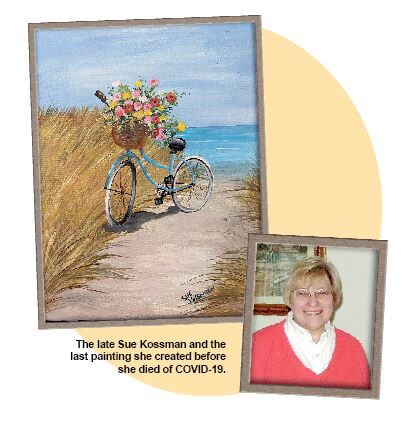
Art Kossman of Imperial says his wife, Sue, knew he was “the one” long before he saw the light.
He’d gone to a dance at St. Louis University, where he was studying electrical engineering, and asked an appealing girl to join him on the dance floor.
“She had no business being there,” Art says with a chuckle, noting that Sue was just 16, four years his junior. But the two clicked immediately.
He’d be asking this one out, he decided. Not such a big deal, since he had no plans to break up with his other two girlfriends.
Eventually, though, Art’s “sometime date” became his one and only.
No surprise to Sue.
“She went to college for one year, and a friend told me she was writing ‘Sue Kossman’ in her notebook instead of her maiden name,” Art says, chuckling again over another sweet memory.
Married in 1972, the Kossmans added three daughters, seven grandchildren and a great-grandchild to their family – their heart.
Art describes Camp Kossman, which Memaw and Papa put on for a decade.
“We would take all seven of the grandchildren, starting when some of them were still in diapers, and cram as much as we could into a week – and then wonder why we were so tired when it was over.
“We had shirts made up for each of them and they got to take turns designing them each year. It was a great time and hopefully created as many wonderful memories for the kids as it did for Sue and me.”
I’m sure you’ve noticed the use of the past tense.
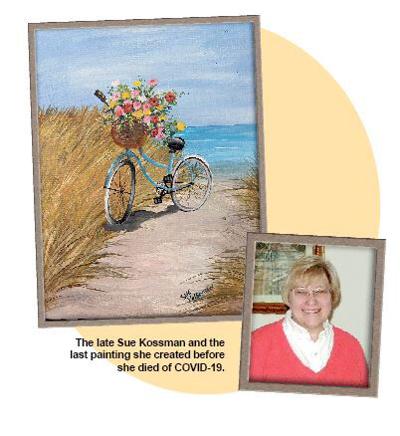
Sadly, Sue Kossman, 69, died Nov. 21 after fighting COVID-19 for 18 days. It was a searing loss for those who loved her.
“We were very compatible personality-wise,” Art says. “The best way to say it is, we complemented each other. She was an amazing person in so many ways. She had a lot of creative ability and was a talented painter. She was a great wife, mother, grandmother and great-grandmother.”
Sue came down with what seemed to be a sinus infection on Nov. 4, but did not respond to treatment. Hospitalized on Nov. 10 with COVID, she was soon placed on a ventilator to fight pneumonia. She suffered a hole in her lung but seemed to be improving, then died after a massive heart attack.
Galvanized by his grief, Art, like many others battered by the pandemic, has a message he feels compelled to share.
“I mean, standing there all day watching my wife die, and the manner in which she died – if somebody saw that, they would do everything possible to keep that from happening to anyone else,” Art says.
“It’s a bad way to die.”
He doesn’t want to argue about vaccines or talk about politics. He just wants to save others from the path he and his family were forced to walk.
“I understand people have the right to make the decision (about whether to be vaccinated),” Art says. “That is their God-given right. But if you decide not to take the vaccine, then you have an increased level of responsibility to those around you. You need to wear a mask and socially distance.
“There are vulnerable people around you, and you don’t know who they are. Let’s help take care of each other.”
Art knows a lot about the danger of virus vulnerability. Sue suffered from polycystic kidney disease (PKD), and so do two of the couple’s three daughters.
Fourteen years ago, a 28-year-old member of the couple’s church donated a desperately needed kidney to Sue, then 55, and Sue had been taking medications to suppress her immune system (to not reject the kidney) ever since.
“Because of Sue’s situation, from Day One, we always took the virus totally, totally serious.
“Deadly serious,” Art says.
“For that first year, I basically kept Sue in lockdown. I did all the shopping, we attended church remotely. We didn’t go out to dinner, didn’t have friends over, we got the vaccine (first dose, second dose, and more recently, the booster).”
With that protection in mind, the couple returned to church and “loosened up” a little, Art says. But Sue continued to mask up.
“We had the air (at home) purified; it’s supposed to kill COVID germs. We wore masks. All that obviously makes this even harder. What could I have done different? What did I miss?”
Art learned something during Sue’s battle. When tested for COVID antibodies at the hospital, given her circumstances, she scored very low, despite the vaccines.
He wants immune-compromised people to know about that. Isolation, masks and social distancing were Sue’s best weapons.
Most of all, he simply wants to tell Sue’s story, hoping it helps someone else make critical, maybe life-saving, decisions.
The Kossmans are a family of faith. Art says he has felt God’s hand throughout – from the miraculous gift of the 14 extra years he had with Sue after the kidney transplant, through her death and in the sorrow since.
“Our youngest daughter had the best description of what we’re going through,” Art says. “We are confident we’ll see her again one day, but this sucks.”
Sue Kossman is one of 367 Jefferson County residents stolen by the virus (counted by the Jefferson County Health Department as of the Leader’s press time).
It’s grievously sad and sobering to acknowledge that each one of those deaths is somebody’s Sue.