


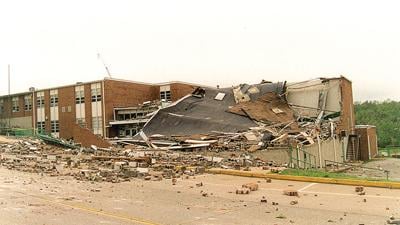
Twenty years ago this month a tornado ripped through the city of De Soto, demolishing the junior high school and causing at least $50 million in damage.
A 42-year-old De Soto man drowned when his vehicle was swept off the road by flash flood waters from the rain that accompanied the May 6, 2003, storm.
Dennis Butcher’s body and his vehicle were recovered from Joachim Creek 11 days after the storm. Officials estimated that at least 3 feet of water swept over Main Street at the height of the flash flood, and Mr. Butcher’s car apparently went through one of two large culverts that carry stormwater from Main Street under the Union-Pacific railroad tracks. Dozens of people had been searching for the car, which was partially submerged, partially covered by a gravel bar and shaded by overhanging trees, making it difficult to spot.
Aside from a minor cut to an emergency worker, no other injuries were attributed to the storm.
On almost every street, trees were snapped in half or overturned from the roots up; roofs were blown off or damaged; debris was everywhere.
“We had every chain saw in town running,” said De Soto Public Works director Kevin Warden, who at that time was superintendent of the city’s water and sewer departments. “Everybody made sure their own family was safe; then they came in and got started. We worked for days and days.”
The state emergency management agency later reported six homes were destroyed, 20 sustained major damage and 137 had minor damage. In addition, 58 multi-unit apartments and four duplexes were damaged.
About 1,500 customers remained without power for several days.
The De Soto School District was hit worst. The storm destroyed the junior high school gymnasium and the roof over the junior/senior high complex. It also tore air-conditioning units from the roofs.
The roof on Vineland Elementary was damaged, and water infiltrated the high school, junior high school and Vineland. School officials were forced to cancel the remainder of the school year.
Wind wasn’t the only culprit in producing storm damage.
Todd Melkus, current De Soto city manager, was a Jefferson College student when the storm hit, bringing torrential rain with it.
“There was something like 7 inches of rain that fell in a matter of a couple of hours,” he recalled. “You can never be prepared for that amount of water, no matter what kind of infrastructure you have in place.”
Brown scum lines marked the height of flash flooding that carried a home on Second Street approximately 100 feet from its foundation.
More than 500 emergency workers – firefighters, paramedics and police – representing more than 50 departments throughout the St. Louis area rushed in to offer assistance, and neighbors also pitched in to help each other.
Jefferson County was among 11 Missouri counties declared a federal disaster area. Shortly after the storm, the De Soto City Council hired Storm Reconstruction Services of Tuscaloosa, Ala., to clean up 100,000 cubic yards of storm debris. The Federal Emergency Management Agency (FEMA) paid 85 percent of the $139,799.83 cost of the three-phase cleanup effort, which ended in early July. Residents hauled another 150,000 cubic yards of storm debris to the city’s sewage treatment plant, where it was burned.
“We got a permit from the DNR to burn debris,” Warden said. “There was just so much. We had this massive fire going for weeks.”
The FEMA disaster recovery center, set up shortly after the storm in the fellowship hall of Redeemer Lutheran Church, closed on June 21, after helping residents with applications for disaster relief.
Officials said 1,706 applications came in from Jefferson County. Statewide, more than $6.5 million in FEMA grants were approved, along with $19.3 million in Small Business Administration (SBA) loans.
Warden said, despite all the damage, the city was lucky.
“It was sad to see how much damage (the storm) caused, but we were very fortunate there were no injuries beyond the gentleman whose car got swept away,” he said. “We had no major road damage, no bridges damaged. We have since purchased a generator for the well. The storm helped us learn a lot about what we needed to be ready for when disasters happen.”
Warden said the one bright note from that time was how people came together to deal with the aftermath.
“Everywhere you looked, there were people helping their neighbors,” he said. “People came from other areas. They called to offer equipment and supplies.
“It just showed what people are like here in De Soto. There’s a lot of pride.”
Although it’s hard to predict when a storm like this one will strike, De Soto residents and officials are better prepared for what it can bring.
Many of the homes devastated by the floodwater in 2003 have been purchased by the city, and ongoing efforts toward flood control and stormwater mitigation are in the forefront of city planning.
The Citizens’ Committee for Flood Relief received a $70,000 grant from the National Fish and Wildlife Foundation to build a 1-million-gallon stormwater retention pond near the North Sports Complex. The group is working to obtain more grants for similar retention projects in other areas, such as the former De Soto Shoe Factory.
The city has developed a flood resiliency and mitigation plan called Resilient De Soto. Public meetings have been held to engage community members in planning further flood control strategies, and efforts are ongoing to help relocate some of the more than 300 homeowners whose houses remain in the floodplain.