


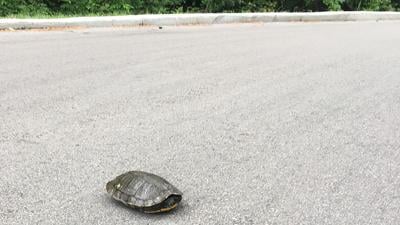
The deluge of overnight rain certainly played a part, but I was surprised to see so many box turtles crossing the road during a recent morning trip through central Missouri. This is the time of year when they are most active, and the good news was that most of them I saw along the county roads and state highways were still moving.
I have known several people who stop to “save” the traveling terrapins, but that level of concern has real potential for danger, especially on thoroughfares with blind curves, rolling hills and high-speed drivers. Putting yourself in harm’s way may seem noble, but the danger level is too much to risk.
Being alert to the possibility of turtles in rural areas is the best advice. “Keep your eyes on the road” is solid guidance for all motor vehicle operators all the time, but this time of year, it is exactly where you should be looking to see turtles on the pavement. They don’t move fast, so they are not going to dart out in front of your car. They are likely to freeze in place, allowing ample opportunity to steer safely around them to insure your tires don’t take them out.
Because the ornate box turtle and three-toed box turtles are land-dwellers, they are more likely than their aquatic cousins to be seen on roadways. In low-lying wetlands and near river or stream crossings, snapping turtles and sliders could be on the move as well. In the spring, male turtles are looking for potential mates or staking out new territory. Female box turtles seek out potential nest sites. The cold-blooded creatures also are attracted to the heat that blacktop can hold on a sunny day.
Missouri’s two box turtles are fairly easy to distinguish from one another. Their names spell out the most noticeable differences. The three-toed box turtle has that many toes on its hind feet, while the ornate box turtle has four toes on its back peds. The ornate turtle looks much more decorated, with numerous bright yellow lines on its dark shell. The carapace of a three-toed turtle is plain olive brown with indistinct color streaks.
The locations where you are likely to find the two provides a hint to their individual identity. Ornate box turtles are more common in grasslands and prairie habitat. Three-toed box turtles are considered a woodland species. Neither are exclusive to their own preferred spaces, but in simple terms if you find one in the forest it is likely a three-toed box turtle. In fields and pastures, the ornate turtles are more common.
The places you won’t find them in Missouri also are coincidental. They both are found statewide with a few wide-set exceptions. Three-toed box turtles are rare in the far northwest edge of the state. The ornate box turtle could be anywhere except for the Bootheel in the southeast corner.
While box turtles can be easy to find, there are concerns about their declining numbers. The aforementioned vehicle encounters present an immediate risk, but they also are threatened by habitat destruction. The slow movers usually have a limited home range, so even small developments can disrupt many lives. Projects that convert hundreds of acres of woods into subdivisions or business projects displace dozens of box turtle homes.
Another challenge they face is being loved to death. Too many get moved from their preferred turf to be relocated as pets. These captive conditions are dangerous because of the turtles unfamiliarity with the terrain, and lack of food sources they are accustomed to finding, which can lead to starvation. Even worse than moving them from one place to another, there is also a developing market for box turtles as pets in Europe. Box turtles in Missouri are protected from being kept or sold as pets.
In addition to the dangerous human connections, box turtles also face many natural threats. Adults can protect themselves fairly well in their shells, but turtle eggs are often eaten by skunks, raccoons, snakes, and others. Young hatchlings are also susceptible to predators.
Those natural perils have always been a part of the turtles’ existence, but humans can do something about their impact on the species. In an informational video from the conservation department, Kristie Hilgedick provided advice for drivers about turtles they may encounter.
“Thousands of turtles are killed each year while crossing roads and highways,” she said. “You can make a difference by driving with more care and attention.”
When you are out and about on the highways and byways this spring, follow the conservation department’s advice, and “give turtles a brake.”
John Winkelman has been writing about outdoors news and issues in Jefferson County for more than 30 years and was the Associate Editor for Outdoor Guide Magazine. If you have story ideas for the Leader outdoor news page, e-mail ogmjohnw@aol.com, and you can find more outdoor news and updates at johnjwink.com.