


Guys like to play with fire. I know this from years of observation and plenty of personal experience. I have helped to build brush piles nearly as big as a barn, and on at least one occasion, burned an old barn that more closely resembled a brush pile.
The desire to stoke flames may trace back to some caveman ancestry, and I know I've been willing to poke a fire from a very young age. I vividly recall my uncles warning me that I risked wetting the bed for playing with the fire. I also remember that barely deterred me.
These days I can hardly sit around a campfire without looking for ways to rearrange the logs and coals to generate more heat or flame. For me, finding the perfect place for the next piece of firewood is an art form or a modern marvel of structural engineering.
Fortunately I have never been a party to a fire that got out of control, but I have personally seen the devastation that a wildfire can do. Two different farms where I have hunted were scorched by blazes about 20 years ago, although those incidents were nothing like the destruction seen in California, Colorado and elsewhere in recent years.
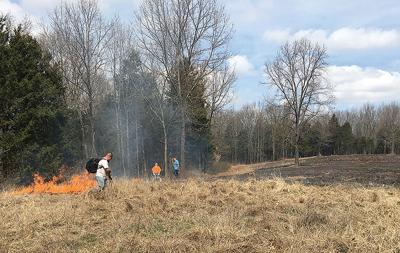
While the scars of the fires we experienced two decades ago can still be found in the woods, the blackened forests recovered and actually benefited from the burning. We annually use fire as a tactic to manage native grass growth in the largest farm field. None of us has formal training for this, but certification is available.
The state Department of Conservation is planning several upcoming workshops in the St. Louis region offering training in the proper use of prescribed fire for land management. The program in Jefferson County is planned for 10 a.m. to 4 p.m. Friday, March 18, at the USDA Service Center, 10820 Hwy. 21 in Hillsboro. Online registration is required at short.mdc.mo.gov/4ZC.
Fire can be a tool for controlling growth in grasslands, glades, prairies and woodlands. Workshop participants will learn how to safely use fire to benefit natural habitats.
The prescribed burn certification consists of an online training program that can be completed at the participant’s own pace, but must be finished prior to attending the in-person field event. After signing up for the field portion, information will be sent on how to complete the required online portion of the training.
The field event portions of the workshops are all scheduled from 10 a.m. to 4 p.m. and each has its own registration link. Other regional sessions are planned in Lincoln County on Wednesday, Feb. 23; in Franklin County, Friday, Feb. 25; and in Crawford and Warren Counties on Friday, April 1.
The workshops are free to private landowners but cost $25 for contractors. Advanced online registration is required. Upon successful completion of the field events, participants receive permanent certification.
I am sure there is nothing in the curriculum that addresses the other application of fire on the farm. We always pack out the trash, but over time we’ve needed to get rid of old furniture or other flammable materials. The cabin fire-ring has burned up a variety of items, from dresser drawers to dog houses. An old sofa awaits its turn on the burn pile when the weather conditions are favorable and enough responsible adults are available to keep the blaze in check.
John Winkelman is Marketing Director for Liguori Publications near Barnhart, Mo., and Associate Editor for Outdoor Guide Magazine. If you have story ideas to share for the Leader outdoor news page, e-mail ogmjohnw@aol.com, and you can find more outdoor news and updates at johnjwink.com.