


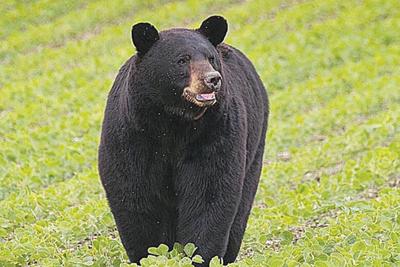
Jefferson County is included in the state’s first-ever bear hunting season, but area residents should not expect anyone to actually be in the woods here hoping to bag a black bear beginning in late October.
Technically, as many as 150 hunters could set up between Fenton and Fletcher or Flucom, but realistically they would never get off a shot. Jefferson County gets a bear visitor or two almost every spring, but by fall they are long gone. An annual appearance could happen any day now, until about June.
I’m sure there are exceptions that prove the rule, but we only see young male bears here early in the year when they are seeking new territory and mates. Before summer, they always turn around and go back to the more comfortable, less crowded habitat of the deep Ozark woods.
Jefferson County is included in Bear Management Zone 2, which is bounded on the east by the Mississippi River, the Arkansas border to the south, U.S. Highway 63 to the west and a combination of Interstate 44, state Hwy. 47 and the Missouri River to the north. St. Louis city and county are also in BMZ 2, but no one would or should be hunting there either.
The state could issue up to 150 permits in the zone, but the season will end once a quota of 15 bears is harvested in the zone. Hunters are required to call a toll-free number each day before hunting to make sure the quota has not been reached.
BMZ 1 is the smallest of the three management zones, but it has the largest quota and number of permits. Its borders are Hwy. 63 on the east, the Arkansas, Oklahoma and Kansas state lines, and a combination of I-44 and Highways 360 and 60. Up to 200 permits will be issued there for hunters to take up to 20 bears.
BMZ 3 is everything else south of the Missouri River. Even though it is the largest geographically, the area is limited to 50 permits and a harvest quota of 5. The hunting season is scheduled to open Oct. 18 and close Oct. 27, but will close early if harvest quotas are met.
Bear hunting permits will be issued through a random drawing and only Missouri residents are eligible. Hunters may apply for permits online from May 1 through May 31. A non-refundable $10 application fee is required. Hunters chosen in the drawing will pay an additional $25 for their actual hunting permit.
The season does have special regulations, but most rules are similar to those in deer hunting season. The archery deer hunting and fall firearms turkey hunting seasons will be open simultaneously with the bear hunting season.
Bear hunters are required to wear an orange hat and orange vest, shirt or jacket while hunting. The allowed firearms are similar to those permitted during deer hunting season, and shooting hours are identical, from one half hour before sunrise to one half hour after sunset.
Baiting for bears is illegal in Missouri. Bait is any type of food used to attract animals to a specific area. It includes grain, fruit, pet food, or anything that may contain food waste. Only lone black bears may be harvested. Bears traveling with other bears are protected, including female bears with cubs.
Hunters who successfully harvest a bear must use the state’s telecheck system to report their kill prior to 10 p.m. the day of the harvest. In addition, hunters must submit a premolar tooth to the state Department of Conservation within 10 days. The tooth will be used to determine the bear's age and for additional research. Hunters will receive an age report from the department.
The state approved the bear hunting season following several years of public comment, including informational open houses in 2019 and a public-input process in the spring and fall of 2020.
“As our black bear population continues to grow, a highly regulated hunting season will be an essential part of population management into the future,” said state biologist Laura Conlee, in a conservation department press release. “The timing and length of the season, allowed hunting methods, and a limited permit allocation coupled with a limited harvest quota will ensure a sustainable harvest of our growing bear population.”
The state is estimated to have between 600 and 1,000 bears. The numbers in the state are increasing about 9 percent per year and so is the range that bears call home, including, on occasion, Jefferson County.
John Winkelman is Marketing Director for Liguori Publications near Barnhart, Mo., and the Associate Editor for Outdoor Guide Magazine. If you have story ideas to share for the Leader outdoor news page, e-mail ogmjohnw@aol.com, and you can follow John on Twitter at @johnjwink99.