


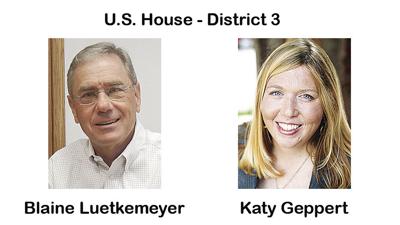


Republican Blaine Luetkemeyer of St. Elizabeth is seeking his sixth two-year term in the U.S. House of Representatives, but faces two opponents in the Nov. 6 general election: Democrat Katy Geppert of St. Charles County and Libertarian Donald V. Stolle of Arnold.
Stolle did not return a Leader candidate questionnaire.
District 3 covers northern Jefferson County and extends north and west past the St. Louis area, covering much of east-central Missouri.
The pay for U.S. representative is $174,000 a year, plus allowances. The term is for two years.
LUETKEMEYER, 66, lists his address as P.O. Box 147, St. Elizabeth. He and his wife, Jackie, have three children and six grandchildren. He is a farmer and small business owner. He also worked as a bank loan officer and insurance agent and was director of the state Division of Tourism from 2006-2008. He was a state representative from 1999 to 2005. He received a bachelor’s degree in political science with a minor in business administration from Lincoln University in Jefferson City. He was a trustee for the Village of St. Elizabeth and is a member of St. Lawrence Catholic Church, the Knights of Columbus, the National Rifle Association, the Missouri Farm Bureau and the Eldon Chamber of Commerce.
Social media: Website: BlaineforCongress.com Facebook: Blaine Luetkemeyer Twitter: @LuetkemeyerB
GEPPERT, 36, lists her address as P.O. Box 3, Defiance. She and her husband, Tyler, have two children. She is a research chemist at Bunge North America. She received a bachelor’s degree in chemistry from Quincy University in 2004 and a master’s degree in chemistry in 2010 from St. Louis University. She is involved with Alpha Omicron Pi, where she has been the advisor of the Delta Kappa Chapter since 2009, adviser of the Epsilon Sigma chapter since 2017, and a foundation ambassador since 2013.
Social media: Website: katygeppertforcongress.com Facebook: Katy Geppert for Congress Twitter: @KatyforCongress
What are your thoughts on how to protect insurance coverage for those who have pre-existing conditions?
Luetkemeyer: One-quarter of Americans have preexisting conditions. While many people buy insurance through their employer, individual purchasers face restrictions to coverage and unaffordable prices. Last year, I voted for the American Health Care Act to replace Obamacare with a system that allows Americans and their doctors – not the government – to control their healthcare. The bill lowered premiums and made it illegal to discriminate against those with pre-existing conditions. While the Senate ultimately failed to pass it, I will continue supporting plans to improve our health care system.
Geppert: We must protect the provisions within the Affordable Care Act that ensure coverage for pre-existing conditions. Because the Affordable Care Act prevents insurance companies from denying coverage, increasing premiums and limiting benefits to those with pre-existing conditions, I would demand that if anything were to change within the Affordable Care Act, the provisions around pre-existing conditions do not change.
What should Congress do to address the opioid crisis?
Luetkemeyer: Every day, 115 Americans die of an opioid overdose, leaving families devastated and communities broken. This year I have supported more than 50 bills in the House addressing this crisis through treatment and recovery, addiction prevention and community safety initiatives. These bills are the product of extensive conversations with doctors, patients, law enforcement and local officials with the goal of getting those already addicted help and putting an end to the unnecessary spread of opioid use.
Geppert: Congress needs to address the opioid crisis by addressing some of the root causes – overprescribing opioids for chronic pain and availability of cheap, illegal opioids. The former can be mitigated by passing legislation that legalizes medical marijuana as an alternative choice for pain relief and by mandating prescription drug monitoring programs. The latter can be addressed by making sure customs and border patrol have the resources to search for shipments of illegal drugs coming over the border and through the mail.
What steps should the federal government take to protect the integrity of our elections?
Luetkemeyer: Free and open elections are the foundation of our democracy, so maintaining the integrity of those elections is of the utmost importance. In March, I supported, Congress passed, and the president signed legislation that provides $380 million in state grants to secure our election infrastructure. These grants have helped states buy more secure voting machines and improve election training, which will increase cybersecurity and prevent identity fraud.
Geppert: Because each state handles its election procedures differently, the federal government should offer specialized assistance to all states that includes assistance from national security and cybercrime experts. We should mandate that each state ensure they have a hard copy of all completed ballots so an audit can be completed if an election is suspect.
How would you address the ongoing federal deficit and national debt?
Luetkemeyer: The biggest cure for the national debt is economic growth. A strong economy creates less dependency on government programs and increased tax revenue. Just 1 percent of GDP growth equals $3 trillion in revenue for the U.S. government over 10 years. The Trump Administration’s reforms, coupled with the Tax Cuts and Jobs Act, have unleashed the American economy and led to massive growth. Now Congress and the President must work together to keep spending low and ensure that added tax revenue pays down the debt. Future generations are depending on it.
Geppert: To curb the growth of both the deficit and the debt, we must work harder to make sure we are bringing in as much or more revenue than we are spending. To do that, we must take a harder look at our tax system, making sure people are paying their fair share of taxes as well as deciding what tax incentives are worth keeping and which ones need to be cut. We also must address what programs are worth keeping and which ones should be eliminated.
Why should voters elect you to this position? List your goals, if elected.
Luetkemeyer: Missouri has been home to my family for generations. We have been extremely fortunate to live in a community that values family, faith and hard work. Growing up raising hogs and cattle taught me to appreciate our land, and working with great people every day taught me to cherish the friendship and good-natured hospitality you find throughout Missouri. Serving my community at the state level and now in Congress is the best way to honor the people who have shown great faith in me and the state so dear to my heart.
Geppert: Voters should elect me because I will be there to listen to their concerns so I may actively represent them, not special interests. I would host regular, in-person town halls so constituents’ voices may be heard. I will work hard to earn the trust of my constituents. My goals, if elected, are to improve our health care system to make quality, affordable, health care available to everyone. I would like to work to improve our public schools to ensure a well-educated work force. I am also interested in ensuring a living wage for all workers.