




A nonprofit organization will be expanding its presence in Jefferson County in an effort to help more young victims of sex trafficking.
The Covering House was founded in 2009 by Dedee Lhamon of Waterloo, Ill., after she learned sex trafficking was a serious issue in the St. Louis area, with St. Louis ranking 13th nationwide for the trafficking of children at the time.
She also said access to recovery services was scarce at the time.
Laura Baker, administrator of community engagement at The Covering House, said community-based treatment services for sex trafficking victims were launched in St. Louis and St. Louis County in 2013, and then a residential facility opened in 2015 in an undisclosed location in Jefferson County, providing residential care for up to five girls.
She said the Covering House is licensed with the Missouri Children’s Division as a Level 3 facility for females ages 12-18. Level 3 means the facility is staffed 24/7 at a 2:1 ratio, but the youth are not locked down like a Level 4 facility.
Baker said everything is structured and the youth attend online classes to continue their secondary education. Students have individual and group therapy with multiple forms of therapy, including equine and horticultural. They also have outings every other week.
“We are the only residential (facility) in the state that does what we do,” she said.
Baker said the organization receives five to seven referrals every week from all over Missouri and beyond from Children’s Division, law enforcement, juvenile authorities, case managers and even youth residential facilities that don’t specialize in trafficking trauma.
“We have to make sure (each child is) a good fit for the program,” she said. “The residential program, on average when a kid comes to us, it’s for 12-15 months, depending on how they work through their healing. There are seven phases of healing. We have served over 120 kids – some weren’t with us the whole time.”
A new campus
Soon The Covering House will be able to help 10 youth, and there is potential in the future to expand to 15.
Baker said in 2020, a family donated 17 acres of land at another undisclosed location in Jefferson County and the organization kicked off a successful campaign to replace its current home with a larger one at the new location.
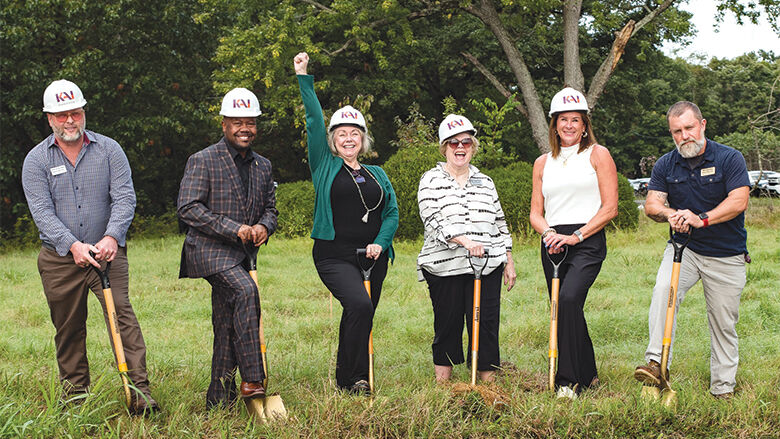
The contractor, St. Louis-based KAI Enterprises, has poured the concrete and the foundation is in place. Baker said its office, currently in Fenton, will move to the new location when the campus is completed by the end of 2025.

This is a rendering of a residential facility being built in Jefferson County for 10 youth sex trafficking victims.
Baker said the new house will have two wings, which means the organization could seek licensing to house boys. She said a residential facility for boys, especially younger boys, is needed.
More often someone they know
Baker said child sex trafficking isn’t just what you see in the movies or on TV crime dramas.
“It’s in every town, in every school,” Baker said. “We are working to educate the community.”
Most cases don’t involve kidnapping or physical force – most victims have been trafficked by someone they know – often a boyfriend or a relative.
She said it’s parents selling their son or daughter to a neighbor for money to buy drugs. It’s an adult grooming a young teenage girl or boy and then exploiting and pimping them out, saying “If you really love me, you will do this.”
The girls, with an average age of 15, have come to The Covering House from a variety of backgrounds, ranging from foster homes to two-parent homes. The organization has helped youngsters from Jefferson County and surrounding counties.
Baker said the first four girls at The Covering House came from more affluent families. One of the girls had accepted a friend request, thinking it was a cute 17-year-old boy she went to school with. Then the man sent friend requests to three of her friends. The “friend” invited them to a party they thought was being held by teenagers, but it turned out to be 40-year-old men. The girls were threatened and trafficked for four months.
In another case, Baker said, a mom sold a 4-year-old girl to a truck driver who trafficked her.
“She came to us when she was 12,” Baker said.
In some cases, parents make their children beg for money, and if they don’t come back with a certain amount, the children are abused or beaten, Baker said.
She said trafficking victims aren’t always happy to come to The Covering House.
“A lot of these kids, in their minds, they have been taken away from a person they think cares for them,” she said. “They are trauma bonded. It takes time to realize, ‘Oh my God, I was being exploited.’ But there are some kids who are happy to be here from Day One.”
When a girl arrives, staff members ask what her favorite meal is.
“We make it all for them,” Baker said.
The organization wants to make the girls feel like they are home and just be kids again, she said.
Baker said some people are intimidated by the victims because of the trauma they have experienced, adding that they are just teenage girls who like to do normal teenage girl stuff, like watch movies and make bracelets.
She said The Covering House has thrown a prom so the girls can have that experience, adding that before coming to The Covering House, some of the girls hadn’t even celebrated birthdays or Christmases.
Baker described how one girl at The Covering House decided to take off her shoes and run outside in the pouring rain because she felt safe and kidlike again.
“She wanted to dance in the rain,” Baker said. “It was the sweetest, most innocent thing.”
“We’ve seen a lot of kids grow and heal and mend, and just flourish under the care of our staff because our job is to make sure that they are ready to live their lives and get the childhood that they had stolen from them,” Lhamon said.
Baker said they are proud of the girls who are thriving after completing the program.
She said one young woman is now married with children and has a career and her own small business. She said another is in cosmetology school. One just recently got her first apartment. Another young woman who thought she would never graduate high school is taking college courses.
Fighting trafficking with education
Baker said The Covering House’s mission isn’t just about treatment; it’s about prevention. The organization offers free prevention and early intervention programs called Reducing the Risk and Trafficking 101, which can be presented to schools or other organizations. The programs have been presented at some Jefferson County schools already.
She said prevention and awareness are the keys to fighting trafficking.
Baker said getting the information in front of kids is the best way to prevent sex trafficking from happening.
She said the group educates schools, providers, parents and anyone dealing with children on red flags for grooming or sex trafficking.
Child sex trafficking is an underreported crime, so statistics are hard to find. However, in 2023, the National Human Trafficking Hotline identified 9,619 cases of human trafficking (sex and labor trafficking) with 16,999 victims. Of the victims, 2,535 were minors.
If you are a victim or you suspect someone is a victim of human trafficking, call 911 or call the 24/7 National Human Trafficking Hotline at 888-373-7888.
People may be vulnerable to trafficking if they:
- Have an unstable living situation
- Have previously experienced other forms of violence such as sexual abuse or domestic violence
- Have run away or are involved in the juvenile justice or child welfare system
- Are undocumented immigrants
- Are facing poverty or economic need
- Have a caregiver or family member who has a substance use issue
- Are addicted to drugs or alcohol
(National Trafficking Hotline information)
Editor’s note: The Covering House does not disclose its location to protect the victims’ privacy and keep them safe, especially since some of the criminal investigations against the sex trafficking perpetrators are still active.