




JEFFERSON CITY— The Missouri Supreme Court heard arguments Wednesday in three cases that could reshape how much power Missourians have to challenge their lawmakers through initiatives and referendums.
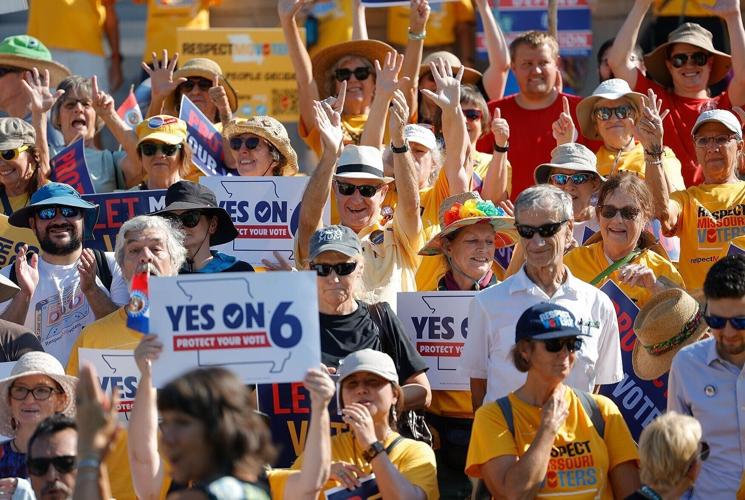
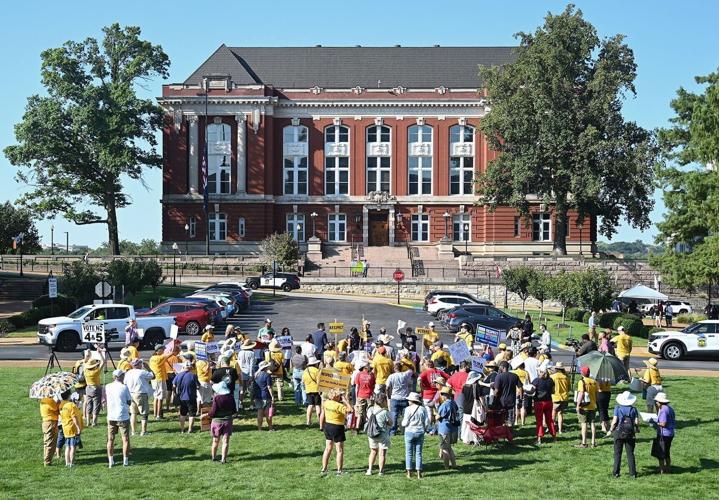
Outside the courthouse, supporters of the three measures called on the court to let voters decide their fate. The demonstration reflected the broader issue before the judges: whether Secretary of State Denny Hoskins can block a proposal from the ballot because he believes it is unconstitutional, even after supporters collect enough signatures.

Respect MO Voters gathers in protest on Wednesday at the Missouri Supreme Court House in Jefferson City. The campaign and allied groups showed support for lawsuits against Secretary of State Denny Hoskins.
Inside, the judges considered whether Missourians should be allowed to vote on the congressional map Republican lawmakers passed last year and whether a proposed amendment making it harder for legislators to alter voter-approved initiatives should appear on the November ballot.
The court faces a tight deadline. Its decisions are expected before Sept. 8, the deadline for the Nov. 3 ballot to be finalized.
Initiative hearing
The first hearing was on proposed Amendment 6, which would make it harder for legislators to alter voter-approved initiatives. The proposal would require lawmakers to have at least 80% majority support in both the House and Senate or in a public vote in order to change an initiative.
The citizens’ initiative seeking to place the question on the ballot received more than 367,000 signatures.

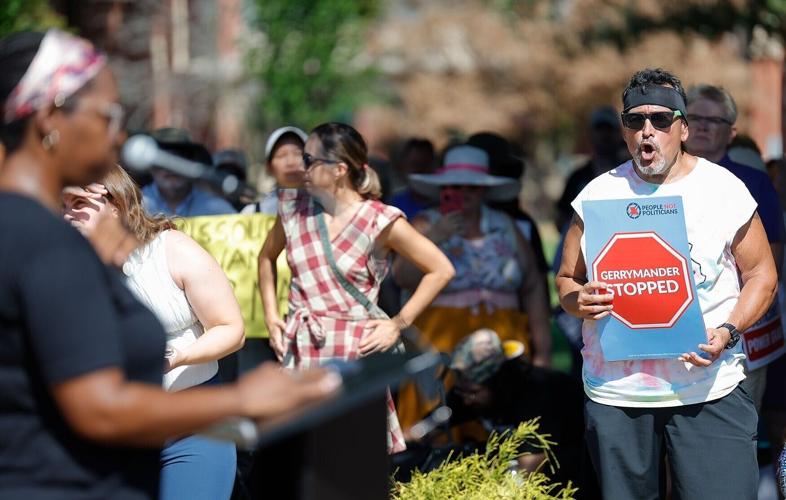
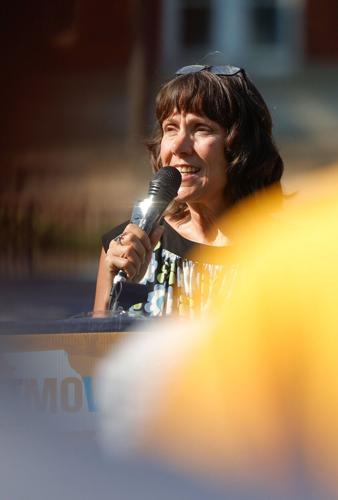
Toni Easter, co-founder of Respect MO Voters, gives a speech on Wednesday at the Missouri Supreme Court Building in Jefferson City. “Whatever happens today, we are not going away,” Easter said.
The proposed amendment was rejected Aug. 4 by Secretary of State Denny Hoskins, stating that it included more than one subject, which is prohibited under the state constitution. Additionally, Hoskins changed the ballot title of the initiative and certified it after it was submitted to his office.
Chief Justice W. Brent Powell questioned when the single-subject concern came from Hoskins and if a complaint of that nature should have been made before the signatures were collected from constituents.
Lawyers for the state argued that the secretary is allowed to have self-determination in changing ballot material like voter-based initiatives brought before him, especially if it is to protect against “anti-democratic” principles. They also stated that he is within his right in the Missouri Constitution to change his decision at any time.
Gerrymandered maps
The court then heard arguments over whether Missouri voters can use the referendum process to reject the congressional map passed by Republican lawmakers during a 2025 special session.
Opponents of the map submitted more than 300,000 signatures seeking to place the new maps before voters for approval. Hoskins rejected the referendum effort, arguing that congressional redistricting is a power reserved for the Missouri General Assembly and cannot be challenged through a public vote.

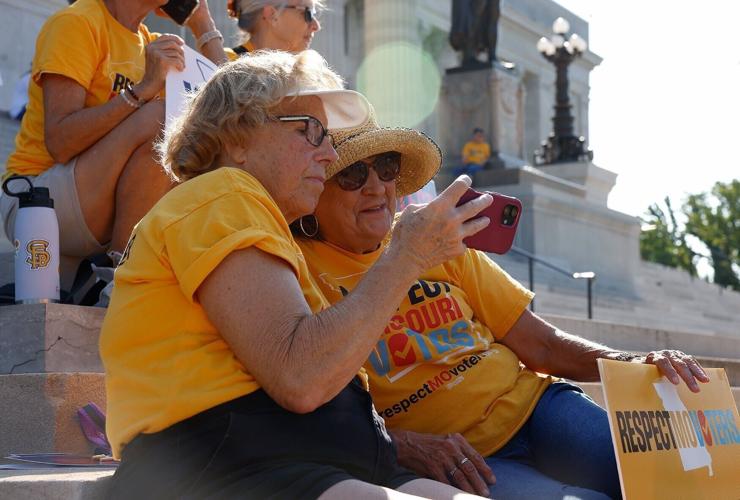
Sandy Terrell, left, and Vicki Fitzwilliam watch the livestream of the Amendment 6 hearings on Wednesday at the Missouri Supreme Court Building in Jefferson City. Both Terrell and Fitzwilliam volunteer for Respect MO Voters.
Attorney Chuck Hatfield, representing the referendum’s supporters, argued that the Missouri Constitution allows referendums on “any act of the General Assembly.” The Constitution excludes appropriations and emergency legislation, but the redistricting bill did not include an emergency clause.
Hatfield said the state was trying to find a reason to keep the referendum off the ballot after its supporters had already collected the required signatures.
“This is all after-the-fact stuff, trying to come up with some reason not to put the referendum on the ballot,” Hatfield said.

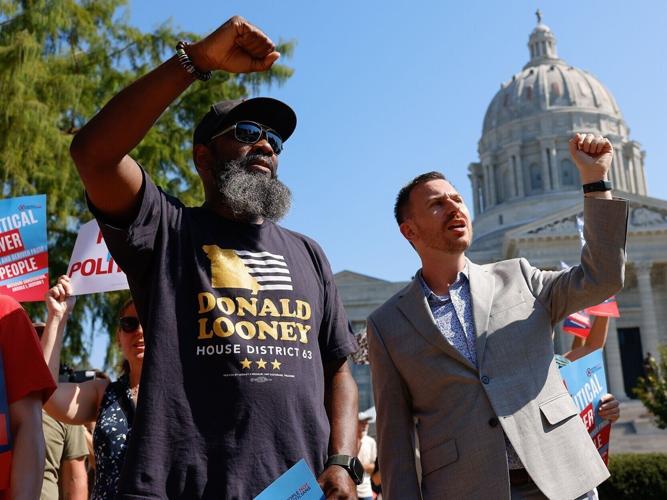
Donald Looney, left, and Keith Rose chant as Missouri Secretary of State Denny Hoskins exits the hearings on Wednesday at the Missouri Supreme Court Building in Jefferson City. Looney is a Democrat running for state representative.
State attorneys argued that the Missouri Constitution prohibits referendums on redistricting plans. They also warned that changing congressional districts after the Aug. 4 primary could create confusion and conflict with federal election law.
The primary was conducted using the new map. If the Supreme Court places the referendum on the ballot, it may also have to address whether the state should use the new boundaries or return to the districts used in the 2022 and 2024 elections for the November general election.
Hatfield argued Hoskins created the uncertainty by moving forward with the primary while the map remained under legal challenge. He said the state should return to the previous districts if the court determines that the referendum should have suspended use of the new map.
“The secretary of state will run an election on something that’s not the law,” Hatfield said. “It’s very dangerous for an election that is only a few weeks away.”

Frank Flores, right, reacts to Jamie Johnson’s, left, speech on Wednesday at the Missouri Supreme Court Building in Jefferson City. “Power belongs to people who organize,” Johnson, a former Missouri lawmaker, said. “We are insisting that the Supreme Court of Missouri protects our ability to be heard.”
After the hearing, Hoskins said his office would follow the Supreme Court’s ruling. However, he did not directly answer which map the state would use if the court restores the referendum but does not specify boundaries for the November election.
“We will comply with any court order given the parameters and the deadlines that we have,” Hoskins said.
Missourians rally
In the final case heard, Hatfield brought before the court a matter he said was less pressing, centered around the group People Not Politicians.
Spread all across the state, the group has been encouraging signatures for various initiatives to appear on the midterm election ballot. However, after gaining over 100,000 signatures, the amount needed for an initiative to be pushed through, the attorney general delayed the process by objecting to the ballot.
The organization had to go out and gather 100,000 more new signatures, differing from the people who originally signed.

Mark Abels claps after a group photograph on Wednesday at the Missouri Supreme Court Building in Jefferson City. Abels volunteers for Respect MO Voters, a campaign to pass Amendment 6. The court must come to a decision by Sept. 8, which is the deadline to finalize the Nov. 3 ballot.
Marc Ellinger, a prominent Republican attorney, and William Seidleck, representing the state Attorney General’s office, pushed for the entire case to be ruled moot. They argued against Hatfield that the signatures — no matter how many were collected — are either not valid or were not obtained within the correct time frame.
During and after the hearing, members of People Not Politicians and allied groups gathered in front of the Supreme Court building, equipped with a band and chants.
Richard Von Glahn, the group’s executive director, stated that the people have the right to a referendum and is confident that Proposition A will end up on the ballot this coming election.
“This charade they’ve been playing for months ends today,” Von Glahn said in response to the delays the group has faced from the state.

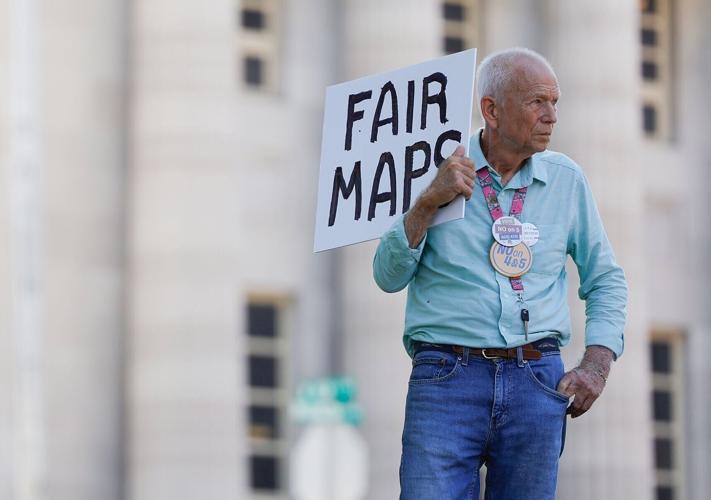
Steve Perry looks at the rallying crowd on Wednesday at the Missouri Supreme Court Building in Jefferson City. Respect MO Voters, People Not Politicians and Missouri Faith Voices were a few of the groups present at the protest.
Nurses, farmers, veterans and even a state representative showed their support for these cases.
Kenda Caloroso is a retired nurse from Kansas City who said she has been speaking out and volunteering for years. Frustrated with the people in power, Caloroso came to the rally to support People Not Politicians to “take charge of our futures, for our children, for my grandchildren.”
Will Westmorlin, an advocate and farmer in the group, stated that this is “not about red versus blue,” stressing that the signatures gained over the past months reached people of all demographics and areas of Missouri.