

Rockwood School District officials have been fielding numerous complaints from parents about what their children have been learning. In addition, racial issues have bubbled to the surface at St. Louis County’s largest school district, which has 20,998 students.
The latest display of unrest occurred at the May 6 Board of Education meeting. About 30 people shared their opinions about the district’s curriculum, mainly focusing on perceptions on how students are educated about diversity.
Superintendent Mark Miles said it is hard to pinpoint when the friction began, but conceded that starting this school year with distance learning led to many people taking strong stances.
Rockwood opened the year with students learning from home because of the COVID-19 pandemic.
“When we began the year virtually, there were a variety of opinions expressed about whether we should be all in-person, or all virtually,” said Miles, who announced his retirement and will be replaced by Timothy Ricker for the next school year. (See story, Page 3.) “It was always our goal to get students back to school as quickly as possible, but as safely as possible as well.”
Morgan Brown, 18, a senior at Eureka High School, said there was unrest at her school before the pandemic.
“The earliest I could probably pinpoint it would be at least my junior year, last year before COVID even started and honestly, possibly even earlier,” she said. “It definitely started off when we had that incident with the freshmen, and they posted a picture in blackface on their Snapchat stories.”
Brown said school officials did not do much to address the incident.
“They had assemblies for each class and kind of just sat everyone down and were like, ‘Racism is bad,’” she said. “Also, ‘Don’t say the ‘N’ word,’ and that’s kind of all they said about it.”
Danyelle Johnson of St. Louis, whose child attends Eureka Elementary School, said racism has been an issue in the district for a while. She said her son transferred from Eureka High to another school because of issues related to race.
“Virtual learning just brought it to the light,” she said of racial issues in the schools. “It brought a lot of things to light.”
Angie Nahlik, whose children attend Geggie Elementary and LaSalle Springs Middle schools, said she is worried about the future of the district.
“I think tensions were starting to rise when the COVID stuff started happening, and I think it’s just progressively gotten worse from there,” she said. “I just hate to see (Rockwood) fall apart because it is so wonderful.”
Tensions
The dispute about how students would be educated in the most efficient and safe way led to the creation of a Facebook group called Concerned Parents of Rockwood, which initially focused on the return to traditional, in-person learning.
As the school year progressed, some parents raised concerns about:
■ Certain books that dealt with race that were read in classes.
■ The removal of the “blue line flag” from caps worn by the Eureka High baseball team, which sparked debate about support of police officers.
■ A contentious school board election that led to the re-election of two incumbents but had voters taking sides along political lines.
■ Miles and Brittany Hogan, who was hired as director of educational equity and diversity this year, who have both announced their departures at the end of the year.
■ A leaked email that revealed a coordinator encouraged teachers to hide materials from parents.
■ A letter from the Rockwood National Education Association’s executive board that called on board members and Miles to protect them from “personal attacks and outright threats of violence.”
■ Whether the district teaches critical race theory.
Miles said the theory was a new concept for him and that there are many definitions of the term.
“Critical race theory is not part of our curriculum, nor is it part of the Missouri learning standards,” he said.
As these issues snowballed, Rockwood has hired extra security for its board meetings, and even assigned security guards for some employees who have been targeted in online messages and emails.
“I haven’t witnessed or seen everything that’s on social media, but I have not received any threats to my knowledge,” Miles said.
Communications coordinator David Morrison said the district hired Campbell Security Group, a private security company, to operate metal detectors at board meetings after the baseball cap controversy. Rockwood also has increased the number of Eureka Police officers at meetings since March.
Morrison said the district pays Campbell Security $200 a night, and officers are paid $30 an hour for attending board meetings. He said typically up to two officers are at a meeting and additional on-duty officers check in at the Administrative Annex during meetings.
The rising tension and perceived threats led to school board members issuing a statement May 6 calling for civility when discussing sensitive issues and defending Rockwood’s curriculum.
“This year, our district and our staff have been the subject of sometimes hateful and certainly hurtful social media posts, emails and voicemails,” read the statement signed by the seven-member board. “This is not acceptable. Harassment in any form is not acceptable. Racism in any form is not acceptable. It is an embarrassment, and it does not reflect who we are as a district.
“We want to be very clear: The Rockwood School District is not teaching critical race theory. We are committed to providing an equitable, welcoming and safe learning environment for all students, as outlined in The Way Forward (the district’s strategic plan). We value and embrace diversity and want our students to consider various perspectives.
“We have four weeks remaining in the school year. Let’s fill these weeks with positive celebrations of our student and staff achievements. There is so much to celebrate this year, despite the pandemic, and we want to focus on our students and staff as we move forward. While we do not have all the answers, we are confident that if we act with grace, love, compassion and empathy, and listen with open hearts and minds, we can make positive change throughout our schools and communities.”
Speaking out
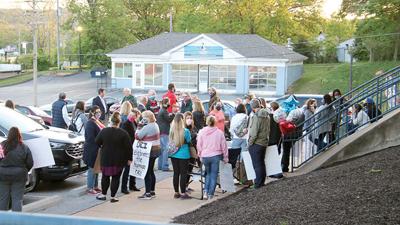
Johnson came to the May 6 meeting after seeing news coverage of an April 30 event at Brookdale Farms, where community members discussed how the district was addressing racial issues.
Johnson said she was shocked to hear parents say they do not want specific topics taught to their children.
“I just want to make the school board aware that we do need to have these conversations; there’s racism everywhere,” she said. “(Some parents) are afraid that their children are going to know the truth about their ancestors. They don’t want their children to feel privileged when they are.”
Lindsey Reed, the parent of an elementary student, said she helped organize the Brookdale Farms forum. She said the district did not help organize the event, which attracted more than 250 people, including state Sens. Cindy O’Laughlin (R-Shelbina) and Andrew Koenig (R-Manchester), both of whom spoke and answered questions.
“We have to have these conversations,” said Reed, who also said she wants to create a chapter of Foundation Against Intolerance and Racism (FAIR) in St. Louis to “prevent racism” and present its curriculum to Rockwood. “My focus was on educating the community about a foundation called the FAIR.”
Lisa Pavia-Higel, who has a student at Eureka Elementary, said she was at the forum, and she did not like what she heard during the 40-minute presentation about FAIR.
“I was really interested in FAIR as an organization myself, and I did some research,” Pavia-Higel said. “While they present themselves as nonpartisan and trying to promote peace and diversity, they actually villainize (critical race theory) as divisive. “They call anyone who believes in trying to work on our problems of power imbalance or privilege as neo-racist. They very much do have an agenda despite what they are presenting to the public.”
Angie Nahlik, whose children attend Geggie Elementary and LaSalle Springs Middle schools, said she does not believe her children are being taught critical race theory.
“But it’s really hard to say because as a parent, a lot of us don’t really know what our kids are listening to all day until I think it was brought to a lot of people’s attention when the virtual (instruction) started,” she said. “(Students) should know how to be respectful to people of all backgrounds and colors, but what I don’t particularly care for is the white privilege part of it. People are having to apologize for being of a certain color. That’s kind of what bothers me and what scares me about it is, are they going to start making our kids apologize for being white?”
Brown said she attended the forum with her mother, Elizabeth Brown. The teenager said many parents spoke about the New York Times’ 1619 Project, which she had not previously heard of.
According to the Times’ website, the 1619 Project attempts to reframe U.S. history by discussing the consequences of slavery and the contributions of Black Americans.
“I was just very concerned and upset that this amount of people was sitting there and saying false stuff about our schools,” Morgan said. “They’re sitting there saying teachers are lying to parents on purpose and that the administration is hiding what they’re teaching in schools.”
Shelley Willott, the district’s assistant superintendent of learning and support services, said the 1619 Project is not part of the district’s curriculum.
“The last time that we did our curriculum review for social studies was in 2015. We have a six-year cycle that we go through,” she said. “When that curriculum was written, the 1619 Project was not even available.”
Curriculum concerns
An email written by Natalie Fallert, a literacy speech coordinator for secondary students, enraged some parents when it was leaked and published by a group called Parents Defending Education.
The email was sent to English language arts teachers and principals and highlights complaints the district had been receiving from parents upset about what was being taught. The message told teachers to use different words or phrases that would not “trigger” concerned parents and suggested removing some resources from Canvas, a learning management system used for distance learning, so “parents cannot see it.”
Willott said the email sent by Fallert was not approved by the district.
Reed said she found the email disturbing.
“I think (Rockwood has) to be willing to not hide papers from us and be more transparent as far as curriculum,” Reed said.
Nahlik said parents should address certain topics at home.
“Parents need to do a good job of teaching these values to their kids at home, and the teachers should be focusing more on academics,” she said. “I just think that parents are entitled to teach their kids the way that they want to.”
Johnson said her daughter was upset by an assignment she received this school year.
The student was assigned to read passages in a social studies book and then a pick a job as if she were a slave. She said her daughter does not typically ask her for help with homework, but this assignment confused her daughter.
“Before I showed her that I was upset, I asked her, ‘Which job would you pick?’” she said. “She said neither and I said, ‘Why?’ She said, ‘Because that would have made me a slave.’”
Miles said the district tries to encourage critical thinking.
“We want our students to be creative thinkers, we want them to think thoughtfully and respectfully,” he said. “We want to build strong men and women of character, that they’re able to collaborate and cooperate with others because we recognize that we want them to have the knowledge, skills and dispositions necessary to be so successful in their worlds beyond the Rockwood School District.”
Willott said Rockwood does not have a curriculum specific to diversity.
“What we’re trying to do is follow what our community said they wanted in The Way Forward, our strategic plan,” she said. “They wanted kids to think critically, they wanted kids to be global thinkers, and they wanted them to be collaborative. We’re making an effort to make sure that the materials that kids have access to particularly literature in the curriculum is representative of diverse people.”