


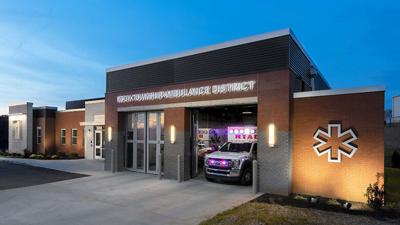

The Rock Township Ambulance District will ask voters on Nov. 8 to approve a 1/4-cent sales tax increase to provide more staff and funding needed to keep up with the growth in the area, according to district officials.
The measure requires a simple majority for passage.
If Proposition Reduced Property Taxes is approved, the increase would raise the district’s sales tax to 1/2 cent but would result in a reduction in the real estate and personal property tax amount residents pay, Rock Ambulance Chief Jerry Appleton said.
“We can fulfill the needs of the district and give something back to residents – how often does that happen?” Appleton said.
The district’s current 1/4-cent sales tax brings in about $1.75 million annually, he said.
“It’s a statutory requirement that we reduce your property tax by 50 percent of that amount,” Appleton said. “That’s why the consumer tax (sales tax) is more fair, in my opinion. Everybody pays – those who visit here, those who spend money here. The whole burden doesn’t have to be on the backs of the property owners.”
The district’s current tax levy is 10.42 cents per $100 of assessed valuation for real estate, costing the owner of a home valued at $250,000 by the Jefferson County Assessor’s Office $49.50 a year in real estate taxes.
Ambulance district officials estimate that the levy would be reduced to less than 2 cents and the homeowner would pay $7.41 a year if the measure passes, Appleton said.
“The idea is that as the district grows, as the economy improves, as consumer confidence goes up, the amount we get from sales tax will grow,” Appleton said. “Eventually, it could reasonably be predicted, the levy could drop to zero.”
The district also collects personal property tax on cars, trucks, boats, trailers, motorcycles, recreation vehicles and other items.
“What people pay there, of course, depends on the values of what they own,” Appleton said. “Our current best estimates, though, are that everyone will see an 85 percent reduction in the real and personal property taxes that are paid to the district for general revenue.”
He acknowledged that the increase in sales tax on residents’ purchases inside the district will slightly offset that savings.
“That cost will vary depending on the size of the family and their annual purchases,” Appleton said. “But we like the way this takes the sole tax burden off residents and spreads it around to visitors and shoppers who don’t live here.”
Keeping up with growth
Rock Ambulance has seen dramatic growth over the past several years, Appleton said.
“Just since 2017, our call volume has drastically increased by nearly 20 percent,” he said. “We’re on a pace to end up with more than 11,000 calls this year.”
Appleton said increasing the district’s sales tax should generate enough money to help alleviate some of the staffing problems that come with that growth.
“Our current staffing is just not enough with five crews,” he said. “Based on the calls we’re running and the trends we’re seeing, five (crews) is just not going to be enough. We’re going to need six every day.”
Appleton said adding another crew is “crucial” in keeping response times as low as possible.
“What we don’t want to see is people waiting for an ambulance because it has to come a long way from somewhere else,” he said. “We’re never going to be able to cover every situation every time, but we need to minimize the risk to our community.”
Appleton also pointed to rising costs in other areas.
“Medications cost more, insurance goes up, changes in technology necessitate extra training expense,” he said. “We have to try and grow and adapt to the changing industry, but we don’t want to do that on the backs of the property owners.”
The district’s board of directors voted 5-1 in late August to place the issue on the ballot, with Jeremy Day casting the lone no vote.
“He isn’t against the idea; he just didn’t agree with timing of it,” Appleton said. “Jeremy said he didn’t think we’d have enough time to adequately educate people about his, market it to the voters.”
The Rock Ambulance district covers approximately 108 square miles of northern Jefferson County and serves about 130,000 residents in Arnold, Kimmswick, Imperial, Antonia, Barnhart and a part of the Jefferson County portion of Fenton. It has 46 full-time and 15 part-time employees operating from its four stations.