
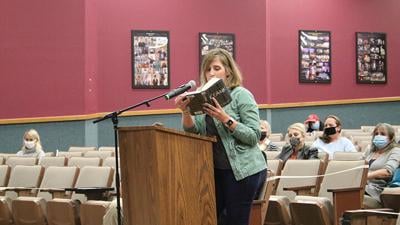
The Rockwood School District’s Oct. 21 Board of Education meeting turned graphic.
Three parents challenged the board to consider whether several books were appropriate to be in the district’s libraries, and they read excerpts from the books and graphic novels to try to convince the board that the material was too explicit for school-age children.
The parents also handed out a flyer with passages from books they found offensive.
“How many of us parents have placed parental controls on our children’s electronic devices or checked out a movie before we let our kid watch it? Most of us, I bet,” Janet Deidrick said. “Then we send them to school where we think they are safe, only to find that they are freely offered books that most of us would consider pornography.”
The flyer had five examples of what the parents alleged were inappropriate and supplied passages and illustrations found in “This One Summer” by Mariko Tamaki, “Crank” by Ellen Hopkins, “Looking for Alaska” by John Green, “Gender Queer: A Memoir” by Maia Kobabe and “The Haters” by Jesse Andrews.
The flyer said the material they found offensive was available in libraries at Eureka, Rockwood Summit, Marquette and Lafayette high schools as well as Rockwood South and Rockwood Valley middle schools.
“I’m fairly certain they’re all in our libraries,” said Shelley Willott, assistant superintendent for learning and support services.
Deidrick told the board that she considers the book “This One Summer” to be child erotica, saying it is filled with foul language and a teenager learning about oral sex, teen pregnancy and an R-rated movie.
“A Rockwood mom found this book in her sixth-grader’s backpack,” said
Deidrick about “This One Summer.”
She also read from “Looking for Alaska,” which she said portrays alcohol abuse and a young girl learning about oral sex.
Amy Krebs said the graphic novel “Gender Queer: A Memoir” contains illustrations that show how to perform sex acts.
Kristin Eldridge, a Eureka resident, read from “Crank,” which has a rape scene.
“I would never want my two boys exposed to anything like this at school,” she said. “I hope that everyone would agree that a detailed rape scene is completely inappropriate for children of any age and does not help the cause against domestic violence against women.”
In an interview, Eldridge said she found out about the books because other parents in school districts across the county have highlighted the titles.
“We investigated and received confirmation that they are in our libraries,” she said.
She said she felt “shock” and “disgust” after she discovered the books were in Rockwood.
“We believe that the entire system of how books enter our libraries needs to be examined and revamped,” she said. “It is no longer acceptable for books to be chosen simply because they are ‘award-winning,’ have great reviews or fit into teacher-student interest areas. We see, by the few books we have discussed, that these criteria alone are not enough for choosing appropriate books for our children’s libraries.”
Willott said parents expressing concerns about reading material available to students is a common occurrence.
“I have been in education for 28 years now and I don’t think there’s been a year where I haven’t had a question about a book that students are reading,” she said.
Willott said Rockwood has policies to allow parents to choose what materials their child has access to in school libraries, such as placing restrictions on the student’s account that does not allow them to check out books labeled “Young Adult.”
“We always offer an opportunity for a parent to say that they do not want their children to have access to certain books,” Willott said. “It’s important to remember that for every person that doesn’t want their child to read a certain book, there’s somebody who does want their child to read those books.”
Willott said librarians select books for libraries based on professional reviews of the material, and she said the district has books that address issues like drugs and sex.
“I think it’s important to note that a lot of young adult literature today has some of those themes in it, but those often aren’t the central themes of those books,” she said. “There are other things that are in the books as well.”
Challenge process
Anyone is allowed to challenge whether a book should be available in schools, and a formal process is set up to review such material, Willott said.
“Regulation 6241 permits any community member or employee of the district to take an instructional material through a challenge materials process and that starts with taking the first step of contacting the classroom teacher to talk through the resource and how it’s being used,” she said.
Willott said if the book is not used in the classroom but is shelved in a library, the challenge process starts with the librarian.
Willott said if the issue is not resolved, the person raising the concern would next go to the building principal.
“If it still isn’t resolved, at that point, the building principal will offer the challenge materials form for that parent, community member or employee to place a formal challenge,” she said.
Once a formal challenge is filed, a committee of parents, teachers, librarians and principals reads the book, Willott said.
She said the committee looks at the curricular value of the book, how the book is being used and what age groups the book might be appropriate for.
The committee then would recommend whether the Board of Education should allow the book to continue to be available, place restrictions on who has access to the material or remove the book.
Willott said she has never seen a book banned from a school.
“I have been in book challenges where things have maybe been put on a reserve section in the library where students have to get permission to check it out,” she said.
Challenges
Board members were asked Oct. 21 to rule on whether the book “The Hate You Give” by Angie Thomas should be available to students or used as instructional material. The board voted unanimously to continue to keep the book in the district’s middle schools.
Willott said the book was formally challenged by a parent at the end of August because it was being used in an eighth-grade lesson plan called “critical literacy unit.” The challenge contended that the book contained inappropriate language, sexual references and police brutality, district officials said.
A committee reviewed the material and recommended the book should continue to be available as the lesson plan had changed and was now called “analyzing contemporary literature” and “The Hate You Give” was no longer being used as an example.
The committee’s review also noted that middle school librarians have marked the book “Young Adult,” which allows parents to restrict their child from checking the book out of the library.
Willott said portions of “The Hate You Give” were used in the previous lesson plan, but students were not assigned to read the entire book.
The challenge review summary said portions of the book were presented to students to explore themes, and students would then choose books that explored similar themes or concepts.
“It wasn’t assigned to every student instructionally,” Willott said. “It was a choice novel, and it was in our libraries.”
A book was challenged last year, Willott said.
She said a Batman comic book called “Batman: The Brave and the Bold – Clobbered by Clayface” was challenged when the parent of a kindergarten student objected to the work’s depiction of a gun. The book was in the Chesterfield Elementary School library.
The publisher recommends the graphic novel be read by second- and third-grade students, between the ages of 7 and 11.
The board voted 7-0 in February to retain the book without restrictions.
Willott said none of the books talked about Oct. 21 have been formally challenged.