


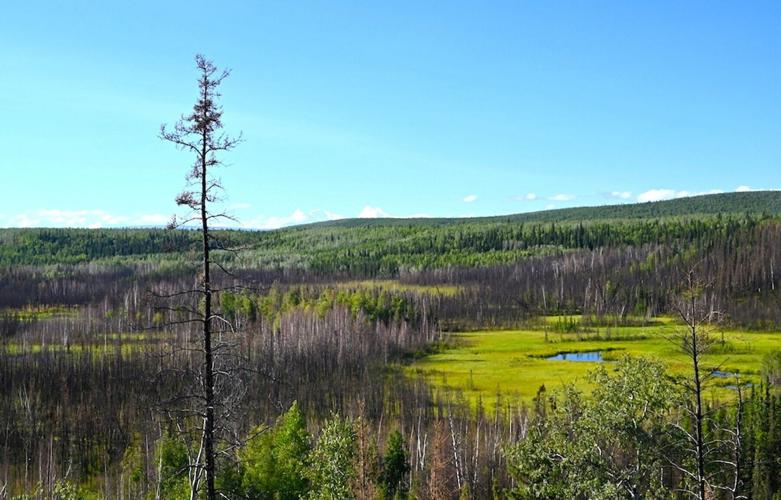

The view from the Shég Xdaltth in site shows the Alaska Range in the distance. (Kelly Graf via SWNS)
By Stephen Beech
People living on a land bridge linking North America to Asia 13,000 years ago hunted mammoths, bison and horses, reveals new research.
They used hammers to break the bones so they could extract marrow and probably render grease, say scientists.
The sea between present-day Russia and North America and the Pacific and Arctic oceans is now known as the Bering Strait.
But it was once what is called the Bering Land Bridge, an exposed land and maritime region that connected Asia to North America.
Scientists say the Bering Land Bridge formed 35,000 years ago, eventually disappearing under rising sea levels around 12,000 years ago.
But the humans and wildlife which inhabited the territory have left behind plenty of archaeological evidence of their presence.
Professor Kelly Graf, from the University of Kansas in the U.S., said: “It’s fascinating to me how people have evolved and how our meager beginnings as hunter-gatherers have led to where we are now.”
She is part of a team of researchers who have spent years studying the region.
Their findings from the Shég’ Xdaltth’i’ site in Alaska have been published in the journal Science Advances.

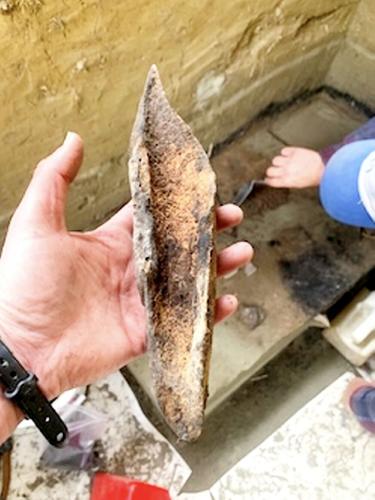
Kelly Graf holds a steppe bison bone recovered at Shég Xdaltthi with a hearth oven feature being excavated in the background. (Kelly Graf via SWNS)
Study co-author Graf explained that the site in Alaska contains three early archaeological components dating to 13,800, 13,000 and 12,700 thousand years ago.
She says Shég’ Xdaltth’i’ — pronounced shehg xuh-tuhl-th’ee and meaning “they were there” in Alaska Native Athabascan — has revealed new information about the people who lived in the far northern setting toward the end of the last Ice Age.
Graf said: “The site is on a small ridge that overlooks the Tanana River, which is a major river system of the region.
“Today there are spruce trees all around.
“During the last part of the Pleistocene — the Ice Age — it was covered by shrub-tundra vegetation.”
Graf says the region of Beringia, which included the Bering Land Bridge, is full of evidence showcasing the hunting of “megafauna” such as mammoths.
She said: “Like at Shég’ Xdaltth’i’, they hunted mammoth, bison and horse.
“Those three particular sorts of animals are extinct now.
“But then they also hunted caribou, which is extant today.
“Indigenous people in Alaska today hunt caribou.
“It’s a really important resource for them, and it always has been.”
Graf explained that Beringian archaeological sites are concentrated in an area slightly larger than the U.S. state of Maryland.
She began making the lengthy trek to the Shég’ Xdaltth’i’ site in 2013, visiting every year until the COVID pandemic.
Director of the excavation project, Graf has since returned in 2021, 2023 and 2025.
More than 80,000 archaeological specimens were found during her excavations, yielding a range of cultural remains.
The finds include a unique hafted-biface form, osseous tools, diverse fauna and well-preserved activity areas.
Among Graf’s favorite finds was a large stone anvil.
She said: “It was sitting within a dwelling feature, and all around it were really bashed-up bison bones.
“And there were a lot of quartz and quartzite-rock hammerstones — which were the hammers they used to break the bones.
“So we think they were using these stones to fully process the bones to extract marrow and likely to render grease.
“This was all happening near a large earth oven.”
Other key discoveries include bird bones used to fashion needles and several diamond-shaped bifacial points, which Graf believes were perhaps the sharpened tips of weapons.
She said: “It’s the only site in Alaska that features this clear diamond shape.
“And the only other places at this time that have such points in a northern context are on the Russian side of the land bridge.
“It suggests people traveled across the Bering Land Bridge to and possibly from this location.
“I remember taking North American archaeology during undergrad.
“I fell in love with the Bering Land Bridge concept: people hunting megafauna and traveling from one massive continent to another across exposed continental shelf.
“Studying extinct animals and the tools hunters used to take these animals.
“I just got caught up in the ‘wow’ of that.”
Graf noted the importance of studying the evolution of humans and their environment.
She says what started as a “mere handful” of individuals in a small region expanded to more than 8 billion in just a fraction of geological time.
Graf added: “The past informs us on how humans have adapted and responded to life’s exigencies.
“The more we learn about the evolution of the Homo sapiens species, the more we can understand ourselves today.”