




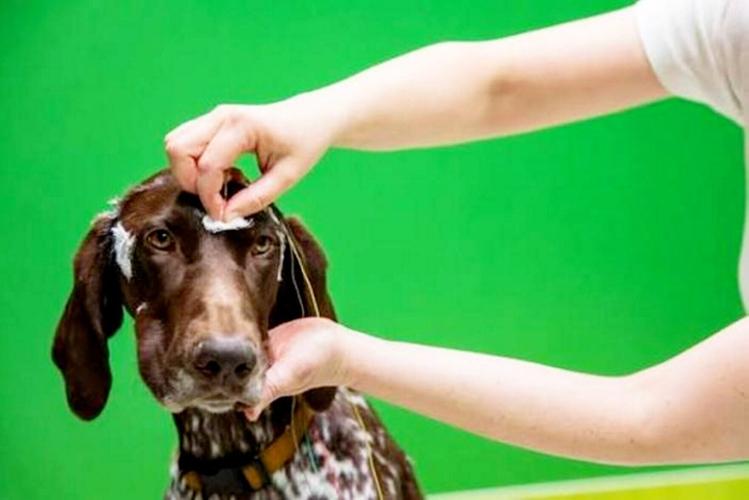

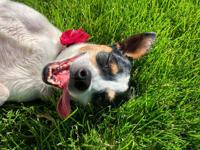

(Photo by Samson Katt via Pexels)
By Stephen Beech
Dogs show "human-like" brain activity when they restrain themselves, reveals new research.
The study suggests that when a dog is told "no" and resists temptation, it may do more than respond automatically.
Researchers discovered that when canines restrain their behavior, their brains show a pattern of activity resembling the human neural signature of self-control.
Scientists say their findings could further the understanding of disorders such as attention deficit hyperactivity disorder (ADHD).
The Hungarian research team explained that survival and adaptation are not only about what we do, but our ability to stop ourselves at any given moment can also be almost as important.
For example, a mouse that stops moving when a predator is nearby or a person who successfully stubs out smoking after years of damaging their own health.
Ivaylo Iotchev, from the HUN-REN Research Centre of Natural Sciences, Budapest, said: "These examples illustrate that the capacity to stop a behavior or resist a temptation can be achieved by different mechanisms.

When we tell a dog no, and it resists temptation, what happens in its brain? (Gáti Oszkár Dániel via SWNS)
"The freezing response of the mouse is ancient and automatic, whereas when a human gives up smoking, they must invoke conscious effort and willpower.
"In humans, this kind of self-control relies on the youngest part of the brain's self-control system – the frontal lobes."
The research team wanted to discover what happens in dogs' brains when their owner commands them to stop and restrain themselves.
Iotchev said: "Dogs can learn not to grab things within reach even when they are interesting or to their taste.
"But do their brains solve this problem automatically or deliberately?"
The Hungarian research team tackled the question using awake, noninvasive electroencephalography (EEG) technology which measures neural activity.

(Photo by Astrid Sosa via Pexels)
Iotchev said: "We measured 226 short EEG recordings, each around half a minute long, from 14 dogs who for the duration of a recording were either obeying a command or idle.
"This data was then analyzed to see if within and across dogs, theta waves are more pronounced for recordings in which the animals were obeying the restraint command.
"The absence of such an effect would have left open the possibility that dogs obey commands automatically, but what we observed does not align with this interpretation - during self-control situations, we instead observed EEG activity that resembles human theta in both frequency and localization."
The study, published in the journal Animal Cognition, was conducted under the supervision of Anna Kis and Márta Gácsi, who have investigated how dogs could help the understanding of human conditions such as ADHD and obesity for several years.
Gácsi said: "Dogs live and age faster than humans but move in the same environments and adapt to the same social and physical challenges.
"This means that developmental and age-related factors associated with pathological conditions can be examined more time-efficiently than in human populations."

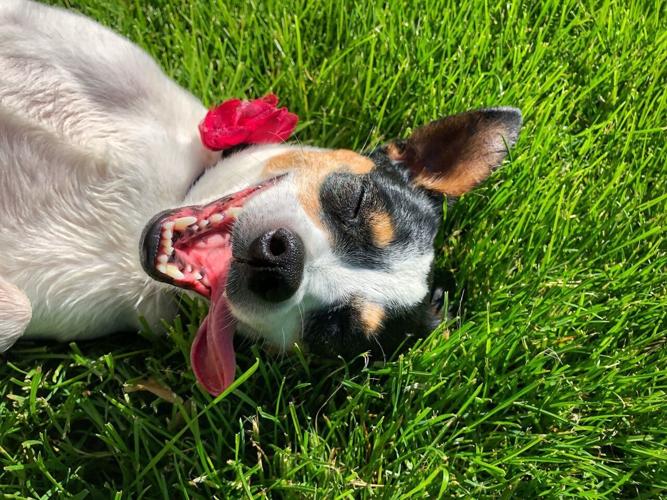
(Photo by Laura (Habegger) Ratke via Pexels)
Kis said: "In humans, failures in the function of the frontal lobes play a role in both ADHD and abnormal weight gain.
"The ability to measure the EEG correlates of frontal lobe involvement in dogs will allow us to investigate just how close these conditions in dogs resemble their human counterparts and allow us to extrapolate better predictions for humans, too."
Iotchev placed the findings within a bigger picture.
He said: "The frontal lobes of a dog have received surprisingly little attention so far, given how many people believe that their pawed companions have a rich inner life.
"We know a lot more about this part of the brain as it operates in the rat."
Iotchev added: "As we have demonstrated that non-invasive EEG, which is cheaper and easier to implement than the fMRI measurement, can also be of use, this opens the door to many more future studies on mental processes and their neural substrate in the dog."